
Trinity College Dublin’s School of Medicine has published its Health Policy and Civic Engagement Report 2026: Engaging for Greater Impact. Launched by the Provost on October 1st, the 2026 document builds upon its 2024 inaugural report, and represents a major expansion in civic engagement and evidence-based policy work across the School. The report highlights how health researchers, clinicians, educators, and students partner with over 40 public, civic, and community organisations to advance health equity and inform policy.
Aligned with Trinity College Dublin’s Strategic Plan 2020–2025 (Thrive) and the university's Civic Engagement for Societal Impact (CESI) Action Plan 2024–2026, the report details key university-community initiatives structured around five strategic pillars: Advancing Health Equity and Inclusion, Promoting Community Health Through Creative Engagement, Planetary Health and Sustainable Healthcare, Shaping Evidence-Based Health Policy, and Socially Responsible Education.
Spotlight on Civic Partners and Key Speakers
At the core of the 2026 report launch event are first-hand case stories from civic partners and advocates, illustrating the real-world impact of Trinity's collaborative and policy-related research:
- Ms. Lora Ruth Wogu, co-founder and managing coordinator of Migrant Health Alliance Ireland spoke to the audience and presented critical insights into the healthcare experiences of vulnerable migrant women in Ireland, addressing language barriers, systemic hurdles, and strategies for culturally competent, inclusive healthcare delivery.
- Dr. Conor O’Neill, Consultant Forensic Psychiatrist & Lead for the Prison In-Reach and Court Liaison Service (PICLS) spoke passionately about the transformation of mental healthcare in Irish prisons through the Prison In-reach and Court Liaison Service (PICLS). He lauded the efficacy of how diversion programmes such as this divert individuals with severe mental illness from the criminal justice system into appropriate psychiatric care.
- Jenny McDonald, Director, SoloSIRENs Theatre Company, highlighted the role of creative arts in cancer care and survivorship, referencing 'The Tightrope Walker'—a collaborative theatrical performance developed with patient survivors and clinicians at Trinity St James’s Cancer Institute to foster emotional healing and dialogue.
- Joan Carthy, Head of Advocacy, Irish Wheelchair Association, emphasised essential priorities for advancing health equity and inclusion for people with physical disabilities, focusing on universal access, inclusive transport, and removing barriers to healthcare facilities.
Speaking at the event, Professor Linda Doyle, Provost & President of Trinity College Dublin said:
"In our Trinity College strategic plan, we talk about serving and challenging society. This report really shows how the School of Medicine is serving those in the greatest need and also challenging Ireland to be a better place. — Professor Linda Doyle, Provost & President of Trinity College Dublin
To view full report go to Trinity School of Medicine Health Policy and Civic Engagement Report 2026
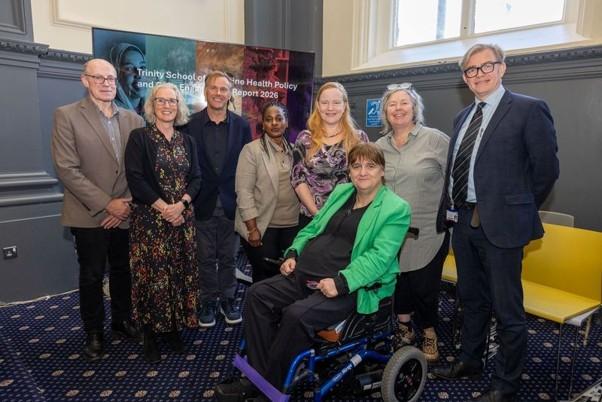
From left to right Professor Padraic Fallon ,Dean of the Faculty of Health Sciences, Professor Susan Smith, Professor of General Practice, Trinity College Dublin, Dr. Conor O’Neill, Consultant Forensic Psychiatrist & Lead for the Prison In-Reach and Court Liaison Service (PICLS), Ms. Lora Ruth Wogu, co-founder and managing coordinator of Migrant Health Alliance Ireland, Ms. Jenny McDonald, Director, SoloSIRENs Theatre Company, Professor Linda Doyle, Provost & President of Trinity College Dublin, Professor Colin Doherty, Head of School of Medicine, Ms. Joan Carthy, Head of Advocacy, Irish Wheelchair Association