“Frantic and a little stressful” is how Joe McCauley describes observing the 2026 solar eclipse from the air. After more than a year of preparation, the success of the mission ultimately came down to just two minutes and a single opportunity to collect data over the North Atlantic.
You really want to capture all of the valuable data in those 2 minutes explains McCauley.” Eclipse observations leave little room for error and historical expeditions are full of cautionary tales about seemingly small mistakes. There’s just a lot to go wrong and you’re under quite a bit of stress in those moments.”
Why take an observatory into the air?
Flying was essential not because of altitude, but location. Ireland lay outside the path of totality, so the team needed to travel into the eclipse’s path over the North Atlantic.
Totality was essential because the team wanted to observe the solar corona, the Sun’s outer atmosphere, which is normally hidden by the brightness of the solar disc. Using polarimetry, the team was also to gather information about magnetic fields in the corona.
“What you’re trying to do is put yourself in a position where it’s 100% eclipsed,” McCauley said. The team also wanted totality to last for as long as possible and the Sun to be as high above the horizon as possible. Flying offered the added benefit of reducing (though not eliminating) the risk of clouds blocking the view.
Those measurements could contribute to a much larger question in solar physics. The corona reaches temperatures in the order of two million Kelvin (approximately 2 million °C), McCauley explained, while the photosphere what we loosely think of as the Sun’s visible surface is around 5,500 °C. Why the outer atmosphere is so much hotter remains an important area of research, with magnetic fields thought to play a significant role. The team hopes that these measurements can contribute to understanding this question.
Planning for what cannot be controlled
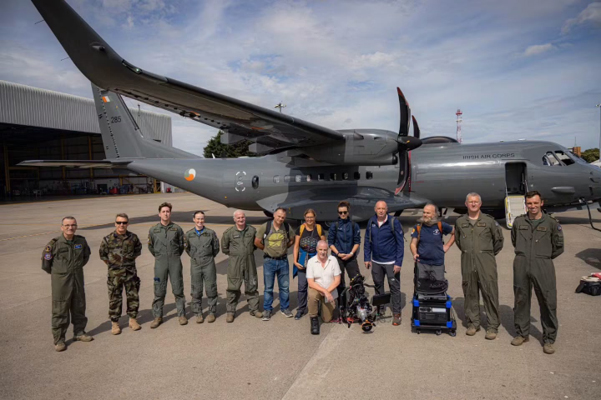
Preparations began in July 2025. Before finalising the observations, the team first had to determine whether the mission was feasible, including securing an aircraft, permissions and a suitable instrument.
Prof. Peter Gallagher (Dublin Institute for Advanced Studies (DIAS), Trinity College Dublin) played a key role in getting the mission off the ground, helping to bring together the people and resources needed to make the airborne observations possible.
Even after a year of planning, two factors remained outside the team’s control. The aircraft could be reassigned to a higher-priority military task, while weather could make the observations impossible. “You could prepare quite a lot and find that it was all for nothing,” McCauley said.
The team monitored forecasts until departure. Cloud cover forced them to move their observing position several hundred kilometres south of their preferred location. Unlike Trinity’s 2015 eclipse mission, when a pilot had to divert to a small patch of clear sky, conditions cooperated for the 2026 mission. The team was able to collect 62 usable frames which are now being analysed by Italian collaborators, who developed the instrumentation used on the flight. McCauley said there is no fixed timeline for when the analysis will be completed, but the team hopes the measurements will ultimately contribute to a scientific paper.
Two minutes of totality
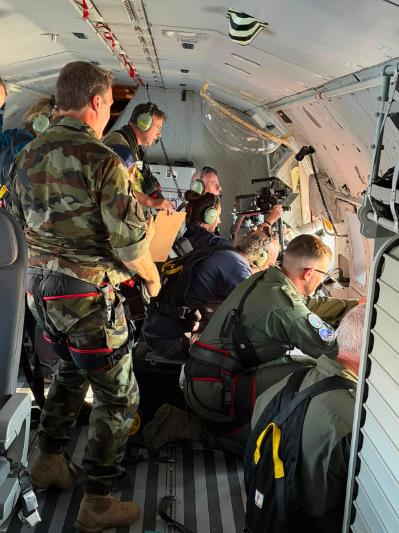
Once in position, the challenge became keeping the instrument fixed on the Sun from a moving aircraft. Observations were carried out through an open window at an altitude of about 3,000 metres. The Sun had to remain within a field of view of roughly two degrees.
Along with Trinity’s Joe McCauley, the Irish-Italian eclipse team included Prof. Peter Gallagher (Director of DIAS Dunsink Observatory and Adjunct Professor at Trinity), Dr Laura Hayes (DIAS, and Trinity graduate), Lucia Abbo, Gerardo Capobianco, Hervé Haudemand (INAF) and Ciarán O’Callaghan (TU Dublin).
McCauley kept the target centred while Hayes operated the camera. Gallagher monitored the eclipse with Air Corps EOIR operators, O’Callaghan coordinated with the flight deck, and Capobianco and Abbo operated the instrument.
“It sounds really simple to do,” McCauley said. “But trust me, when you’re in a moving platform, there’s a lot of vibrations and everything else is moving.” His background in electronic engineering and years of working alongside Trinity’s astronomy and solar physics researchers helped prepare him for that kind of problem-solving. McCauley has been involved in radio astronomy work in Birr since 2008, including the Irish LOFAR station. McCauley believes that these experiences were also part of why he was asked to join Trinity’s 2015 and 2026 eclipse missions.
During the 2026 flight, problems were still being solved right up until the team acquired the data. “You can’t apply for an extension on this sort of a job,” McCauley said. Problems have to be solved there and then.
Keeping the Sun in frame proved challenging, and the target drifted out twice. Despite these hurdles, the team managed to successfully capture that data that they had set out to gather.
McCauley also made a last-minute decision to attach a GoPro near his workstation. Looking back at the footage afterwards, he realised just how focused he had been. In fact, he was so focused during the mission, that neither he nor Hayes actually saw the eclipse themselves. For McCauley, who had already watched totality through a telescopic sight during the 2015 flight, that was simply part of doing the job.
“It was fantastic to do one mission and a privilege to do two,” he said.
Reflecting back on what an experience like this might show students about where physics can lead. McCauley added: “A career in physics can take you pretty much anywhere. There’s no kind of limits on you, except whatever you put on yourself, really.”