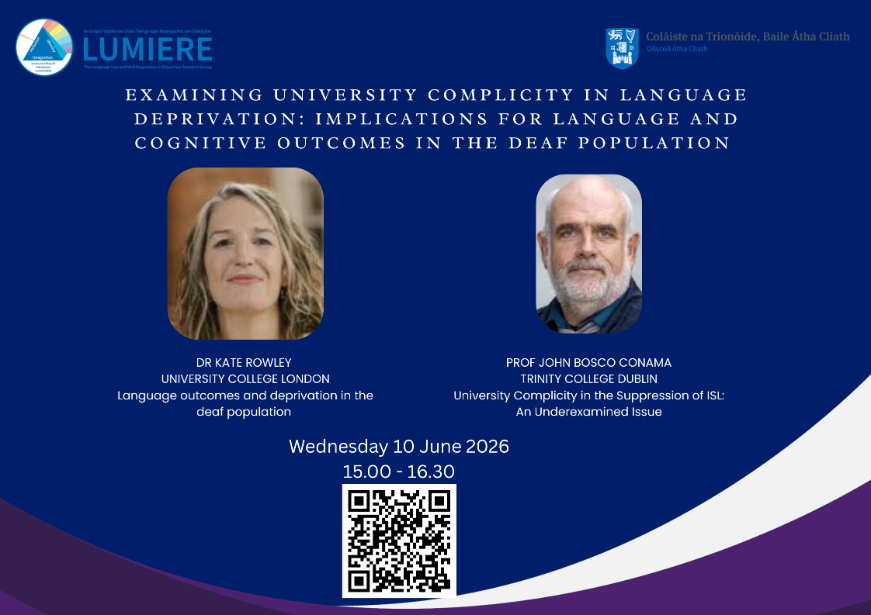
Examining University Complicity in Language Deprivation: Implications for Language and Cognitive Outcomes in the Deaf Population
Dr Kate Rowley & Prof John Bosco Conama Wednesday 10 June 15.00 – 16.30 (webinar)
LUMIERE a School of Education research group is delighted to host a webinar by Dr Kate Rowley (University College London) and Prof. John Bosco Conama (Trinity College Dublin) entitled Examining University Complicity in Language Deprivation: Implications for Language and Cognitive Outcomes in the Deaf Population.
Register here: https://tcd-ie.zoom.us/meeting/register/Uuz__LL2S2qhcJO000QeZQ
Dr Kate Rowley (University College London)
Dr Kate Rowley is a deaf psycholinguist specialising in deafness, language, and cognition. She is a Lecturer in Deafness, Cognition and Language and Deputy Director of the UCL Deafness, Cognition and Language Research Centre (DCAL). Her research focuses on sign language acquisition, language and literacy development in deaf children, multilingualism, sociolinguistics, and psycholinguistic processing across signed, written, and tactile modalities. She leads a £1.4 million ERC Starting Grant (2026–2031) on tactile British Sign Language, the first major UK study of tactile signing used by deafblind people. She has also led an ESRC-funded project on language comprehension in deaf children and is a Co-Investigator on projects exploring reading development, multilingualism, and Deaf Studies pedagogy. Her work is grounded in deaf-led, community-centred research and aims to improve language access and outcomes for deaf communities.
Language outcomes and deprivation in the deaf population
This talk will begin by introducing language outcomes in the deaf population, highlighting the variability in early language development and the factors that shape it. I will then introduce the concept of language deprivation, outlining what is meant by language deprivation and why it matters. The Critical Period for language development will be discussed as a key framework for understanding risk. I will then explore the impact of language deprivation across cognitive, social and emotional domains. Finally, the talk will consider how language deprivation can be prevented, followed by an overview of current interventions and strategies aimed at supporting early and accessible language development in deaf children.
Prof John Bosco Conama (Trinity College Dublin)
Dr John Bosco Conama, Ph.D., M. Litt, BA in Social Policy is the Director of the Centre for Deaf Studies and an Associate Professor at Trinity College Dublin. As Vice-Chair of the Irish Deaf Society and co-chair of the group implementing the Irish Sign Language Act, he actively shapes policies to enhance the rights and inclusion of Deaf individuals. His academic journey, culminating in a Ph.D. in Equality Studies from University College Dublin, focuses on language rights and social justice for Deaf communities.
University Complicity in the Suppression of ISL: An Underexamined Issue
Higher education in Ireland has played a role in the suppression of Irish Sign Language (ISL) by prioritising spoken language (English) in professional courses that lead to qualifications serving deaf people, both directly and indirectly, while excluding ISL from teaching and research and failing to include deaf perspectives. As a result, deaf people may be less likely to be inspired to become professionals who can contribute valuable lived experience. Viewed through a Bourdieuan lens, universities can be understood as powerful centres of cultural and ideological production, where dominant norms are reproduced and legitimised. In this context, higher education has reinforced the status of spoken language while marginalising ISL. Universities have influenced teacher training and policy in ways that support oral approaches, thereby reducing the status and use of ISL. Although there has been progress in recent years, this issue remains underexamined and requires more open discussion and research. The limited attention to ISL contrasts with how universities engaged earlier with other marginalised languages in Ireland, such as those of the Traveller community, highlighting uneven approaches to linguistic diversity.