Students from Trinity College Dublin’s School of Engineering have secured first and third place in the Engineering & Innovation: Product Design category at the Smarter Travel Student Awards 2026, held on 7 May at the Lighthouse Cinema in Dublin.
Organised by the National Transport Authority (NTA), the awards recognise student-led ideas that support safer, more sustainable and accessible transport systems. This year marked a record level of participation, with more than 290 entries from over 580 students across 17 campuses.
Both award-winning projects were developed by third year Mechanical Engineering students as part of the undergraduate module: 3B9 Universal Design Innovation, coordinated by Prof. Gar Bennett and supported by Dr. Paddy Lynch, within the Department of Mechanical, Manufacturing and Biomedical Engineering. 3B9 is a user-centered design module where the students themselves identify their own stakeholders and collaborate with them to identify a real user-need that is addressed with a working electro-mechanical prototype.
First place - LumoSignal
-900X600.jpg)
Eoin Finnegan, Lily Bean, Evan McCarron, Cathal Foley, Conor O’Reilly and Sam Gillick Friel
The first prize-winning project, LumoSignal, addresses a persistent safety challenge for cyclists - visibility and clear signalling in busy and low-light environments.
The team conducted needfinding including surveys and interviews to identify key limitations in current approaches. Clothing-based indicators are often obscured by backpacks, while traditional hand signals can be difficult to see, particularly at night or in poor weather.
Their solution is a retrofittable LED turn signalling system integrated into a waterproof backpack cover. Ultrasonic sensors mounted on the handlebars connect via Wi-Fi to an Arduino within the cover. A simple hand wave activates left or right turn signals, providing a clear and intuitive indication of direction.
By focusing on ease of use, affordability and real-world conditions, LumoSignal offers a practical way to improve cyclist safety on everyday journeys.
Third place - SideSense
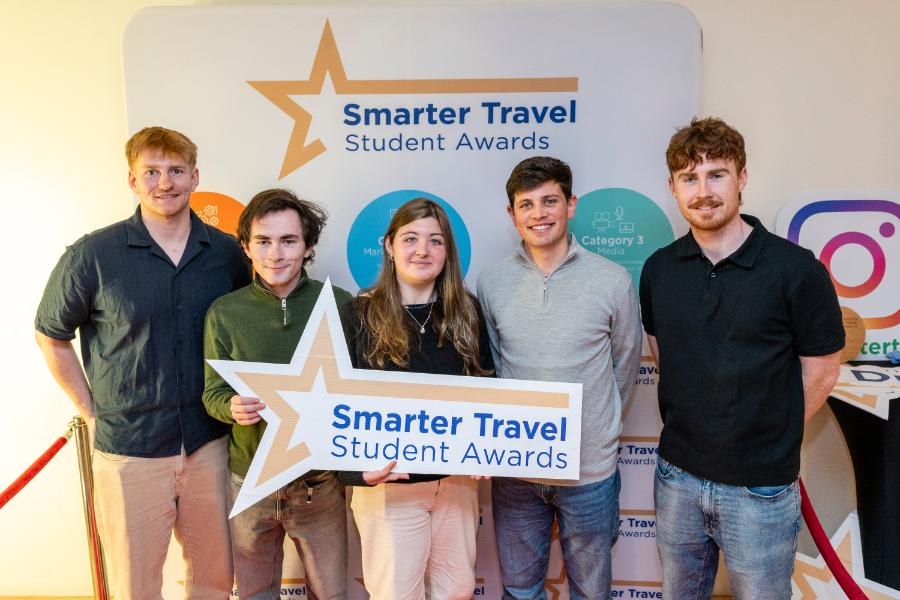
Cristina Franco, Samuel Mochnacz, Maria Simoes Franklin, Eamon MacNicholas, Cathal O’Sullivan and Liam Norton
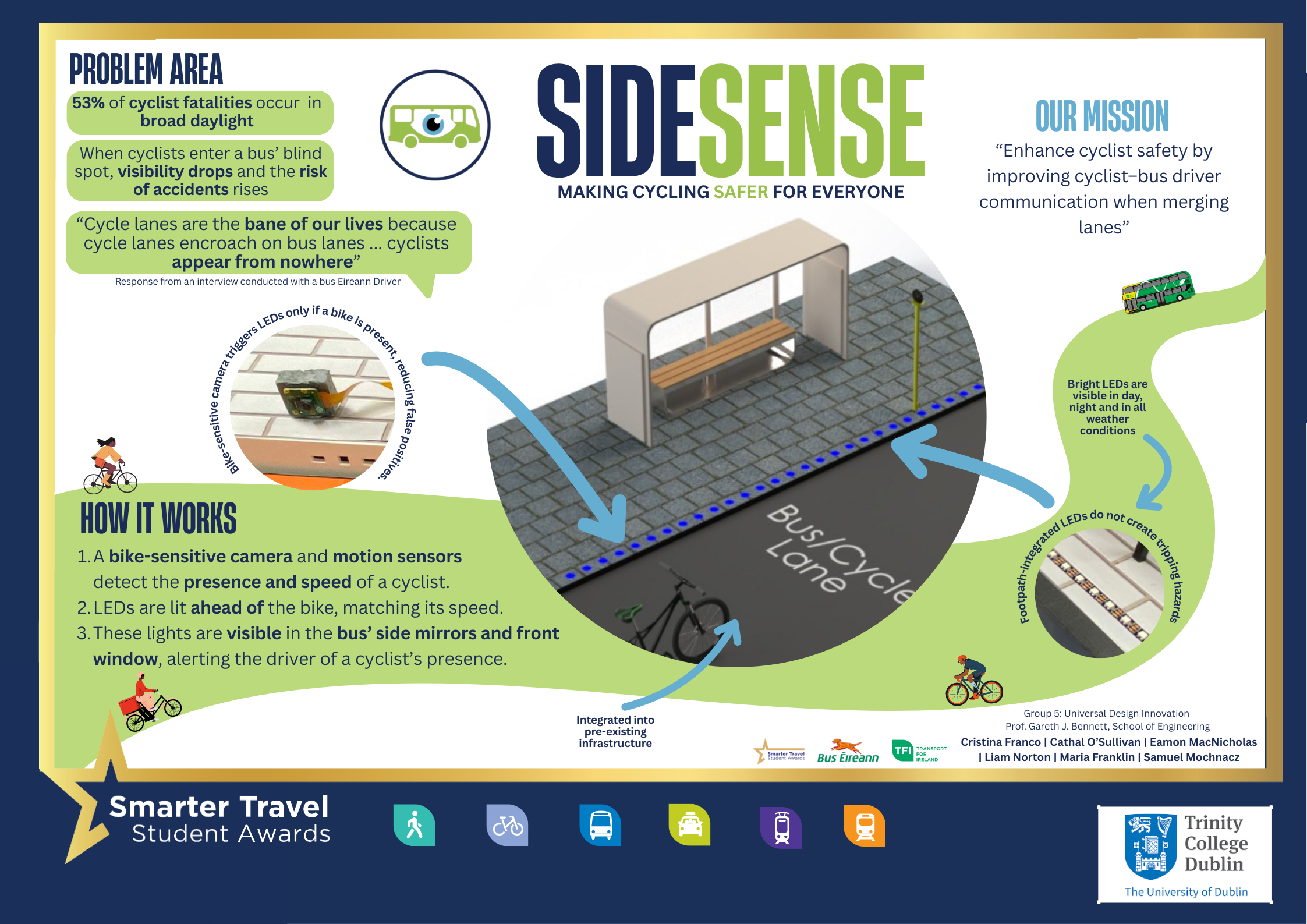
SideSense focuses on one of the most challenging areas of urban cycling - shared spaces where buses and cyclists interact, particularly at bus stops.
The team drew on Road Safety Authority insights and engagement with transport stakeholders, including Dublin Bus drivers, to understand the risks. A key issue identified was cyclists entering bus drivers’ blind spots as buses move into stops, creating a risk for both.
In response, the team developed a sensor-driven system combining AI camera recognition and LED alerts at bus stops. Sensors detect movement, activating a camera that identifies approaching cyclists. When a cyclist is detected, LED light strips track their movement, providing a clear visual warning to the bus driver before they manoeuvre into the stop.
The project presents a strong prototype and a focused solution to a specific and high-risk interaction in urban transport.
Supporting sustainable transport innovation
The Smarter Travel Student Awards highlight the role of students in shaping the future of mobility through engineering and design.
Anne Shaw, Chief Executive Officer of the National Transport Authority, said:
“The Smarter Travel Student Awards highlight the ingenuity and ambition of students across Ireland who are reimagining how we move. These projects demonstrate not only creative thinking, but also practical solutions that can help build a smarter and more connected public transport system for the future. Harnessing this type of innovation is essential as we work to meet growing demand, reduce emissions and improve accessibility for all and inspire our future transport leaders.”
Academic leadership and collaboration
The students were supervised by Professor Gareth Bennett, lecturer and module coordinator for Universal Design Innovation.
The teams also received technical support from Dr Paddy Lynch, particularly in Arduino automation and control, alongside sustainability-focused input from Claire Byrne, Sustainable Travel Officer, Trinity Sustainability.
Delivering on Trinity’s strategy
These projects reflect the ambitions set out in Trinity’s strategic plan Thrive 2025–2030, where Climate Action and Biodiversity are key priorities.
They also demonstrate how engineering education at Trinity connects technical expertise with real-world challenges, supporting safer and more sustainable transport systems.
The School of Engineering congratulates both teams and thanks the National Transport Authority for recognising the importance of student innovation in this area.
/filters:format(webp)/filters:quality(100)/prod01/channel_3/media/tcd/engineering/images/20260507_145636.jpg)
.png)