/filters:format(webp)/filters:quality(100)/prod01/channel_3/media/tcd/engineering/images/RedBull-Soapbox_News_Banner_2026.png)
Supported by funding from Trinity, the project brought together design thinking, hands-on build experience and teamwork beyond the classroom. In this interview, the team reflects on how they developed their concept, tackled engineering challenges and what it meant to represent the School on such a public stage.
Can you take us back to the moment you realised you had won the Red Bull Soapbox Race in Belfast?
The wait leading up to the result was very tense. On one side, the overwhelming rush of emotion as a team, the pure relief of having actually finished the race, of crossing that line together. On the other, the nerves: had we actually done it?
It brought us straight back to the day before, walking down alongside the track, every jump we passed looking more complex than the last. In that moment, we adjusted our expectations, our goal shifted to just getting down the hill. On the way back up, we all distinctly remember counting seven jumps in total.
Then as we got called over to the Red Bull start line with zero context, nerves built by the second. We were jumping around, joking, messing, laughing, thinking maybe we could have made the podium. Third place was called. It wasn't us. Second place. We all looked at each other. First place, the PretEngineers. All we could see was a smile simultaneously spreading across every face, before we all sprinted forward as it finally sank in that we’d won.
What did it mean to you and the team to represent the School of Engineering on that stage?
Representing the School of Engineering was something we all felt the weight of, even if we rarely said it outright. It came through in the skills on display throughout the build. Sitting in the evenings, if you'd taken a step back and looked at us from the outside, it must have been a strange sight. We were casually sketching free body diagrams, calculating forces at different points on the frame, debating how to account for air drag in the design. To us, we were just doing what we'd been learning throughout the school for three years. It all felt completely normal, because to us, it was.
Looking back now though, it's genuinely astonishing to think how those skills led us to that moment, producing complex CAD models and structural analysis on our own designs. But what representing the School of Engineering truly meant to us goes far beyond the technical education. It's the friendships and communication built through group projects and shared experiences, the ability to challenge each other's ideas, adapt under pressure, and deliver to a high standard as a team while enjoying every moment of it. That's what it meant to us.
The team scored highly across all categories - which aspect of your performance are you most proud of?
As a team, our stage performance is honestly what we're most proud of, and we say that with a laugh, because it was entirely down to an oversight on our end. Coming into the race, we hadn't given enough preparation time to the live performance, only to find out on the day that it was scored the same as both our design creativity and our speed down the track.
Undeterred, we all got together and ran ten minutes of practice. We found our confidence in each other, knew our individual roles, and then we just winged it. Five tens. Fifty points. Full marks.
The moment the cameras were on, everyone played their part to perfection. But here, I think we all quietly felt that less was more. We knew that if we over-engineered the act, we'd lose the raw, natural energy that made it work. And we were right.
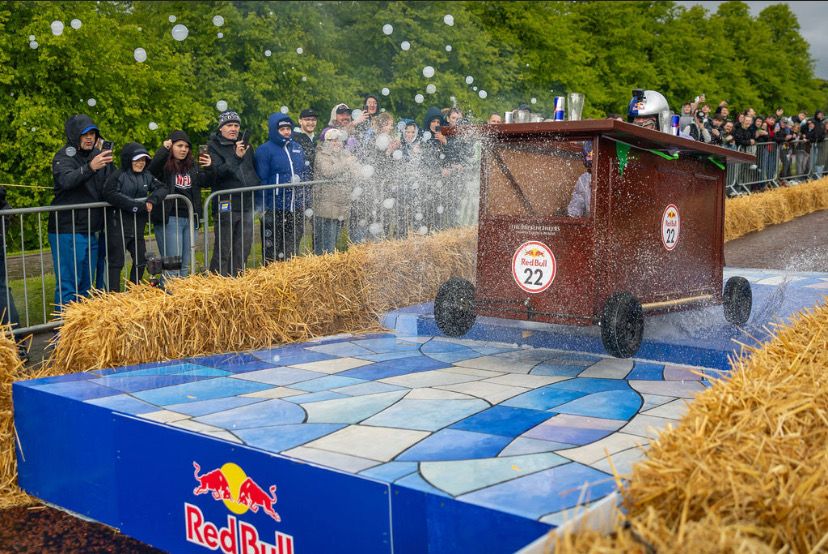 The team's soap box jumps
The Concept and Creativity
Your entry scored 44/50 for creativity - where did the idea for your soapbox come from?
The idea for our soapbox came straight from our college experience. Whether it was the Pav or somewhere local, the bar was where most people found each other at the start of college, and it's where a lot of our earliest memories together were made. It came up in one of our early meetings and the reaction said everything. The image of flying down a hill in a bar on wheels had everyone in stitches. That was enough to sell it to everyone. If we got that much enjoyment out of the idea, we were sure everyone else would too.
The broader framework for generating ideas was something distinctly Irish, presented well, with real entertainment value for the crowd. We came up with plenty of other concepts too, filtering them down until we were all satisfied, we'd landed on the right one.
How did you translate that idea into a working design?
By the time we submitted our application, we already had all the technical work done on paper alongside our CAD files, so the translation from idea to working design was relatively straightforward.
As a team we had both the technical knowledge and the hands-on experience to back it up. We started by breaking the design down into the non-negotiables, weight limits, size limits, structural strength for impact, and worked outward from there. We talked through each aspect together and pulled the best ideas from everyone.
We started with an old buggy we found on DoneDeal and brought it down to the shed during exams, stripped it right back to the rear axle, steering, and front wheels, then welded everything onto our frame within all the required limits. Once the structural side was sorted, it was on to the aesthetic design, which came down to one question: how do we make this look like a pub but weigh as much as a chair?
We had about 10kg left to play with on design after the structure was finished, which meant keeping materials light, leading us to 3mm ply and insulation foam. From there it was a process of thinking it through on paper, getting everyone on board, buying it, testing it, and if it wasn't right, go back and try a different approach until we were happy.
Were there any particularly creative or unusual design features that helped set your entry apart?
The creative element we were all most thrilled with, and one that we think did set us apart, were our bar taps. Crafted from PVC pipe, spray foam, and 3D prints, they ended up indistinguishable from the real thing. We measured and cut straight sections of PVC alongside 90-degree bends, then sprayed the whole thing in a bronze-gold finish. The spouts and handles were designed and 3D printed by us, then sanded and painted by hand, before filling the inside of the pipes with spray foam and letting everything set solid. They were the standout piece, the thing that tied the whole build together and took it from a wooden box on wheels to an Irish pub on wheels.
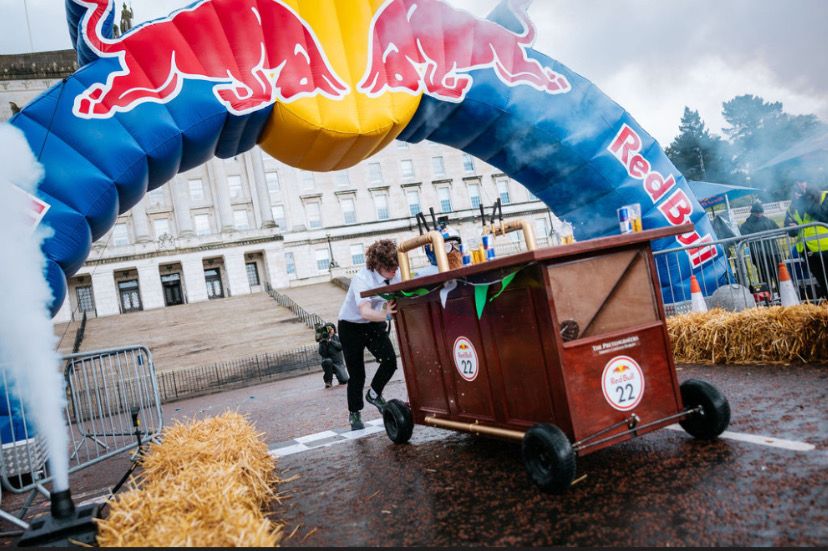 The PretEngineers team start their run
Engineering and Build Process
Can you talk us through the engineering behind the soapbox - what were the key design considerations?
We wanted to strike a balance between performance, reliability and weight from the start. The starting point for the build was an old racing buggy, which gave us a proven rear axle and steering system to work from. That meant we had a solid foundation and could focus our time on improving the overall performance of the soapbox rather than building everything from scratch. For the chassis we used steel for strength and durability, while the body was constructed from 3mm plywood and insulation board to keep the weight down. One of the biggest constraints was staying under the 80kg weight limit, so every decision was a trade-off between the two. We also fitted brand new lawnmower wheels because reducing rolling resistance was a major priority.
For braking, we designed a pedal operated system linked to two bicycle disc brakes. We wanted something simple and reliable that gave the driver enough stopping power. As the design developed, we also looked at aerodynamics. Originally we planned to use a solid Perspex front section, but we realised it would trap air and create unnecessary drag. Instead, we switched to mesh panels at the front and rear, which allowed air to pass through much more easily.
Throughout the build we were testing and refining the cart, checking the strength of the structure, monitoring the weight and carrying out trial runs to make sure everything was performing as expected. One compromise we made was leaving out suspension. While it would have improved comfort, it would also have added weight and complexity, so we decided that keeping the soapbox lighter and faster was the better trade-off for the race.
What challenges did you encounter during the build, and how did you overcome them?
We definitely ran into our fair share of challenges during the build. One of the biggest was sourcing parts. Our soapbox was built around a three stud wheel setup, and we quickly discovered that replacement rims were almost impossible to find at short notice. In the end, we had to refurbish the existing rims, source new tyres ourselves and fit them. One of the wheels was also slightly buckled, which wasn't ideal when you're trying to build the fastest soapbox in the race.
Weight was another constant challenge. We had an 80kg limit to work within, and it's amazing how quickly everything adds up. Every piece of steel, every sheet of plywood and even the paint had an impact. We were continually weighing components and looking for opportunities to save weight without compromising the cart's strength.
We also had several 3D printed components fail during development, so we had to improvise and redesign certain features, including using drainage pipe fittings as mounts for parts of the bar themed exterior.
Time was probably the biggest challenge of all. Because we were in the middle of third year exams, we couldn't fully commit to the build until they were finished. Straight after one of our exams we set off on a seven hour round trip to collect the base cart, and from that point we had around two weeks to design, build, test and finish the entire soapbox before race day.
How did your academic experience in Trinity Engineering feed into the design and construction?
Our academic experience in Trinity played a major role throughout the project. As Engineering with Management students, we'd developed both the technical knowledge and the problem solving mindset needed to take something like this from an idea to a finished product.
Several modules directly influenced the design. Our design projects gave us experience working through the full engineering process, from developing concepts to refining a final design. Materials engineering was particularly useful when making decisions about weight and strength, we were constantly trying to balance durability with the strict weight limit, so understanding material properties helped us make informed choices throughout the build. Even fluid dynamics fed into our thinking, leading us to replace solid panels with mesh to reduce drag and improve performance.
Beyond the technical side, the teamwork aspects of the Engineering with Management programme were equally important. We'd worked on many group projects throughout the course, so we were already used to collaborating under pressure, dividing responsibilities and working through disagreements. That experience was probably just as valuable as anything we learned in a lecture.
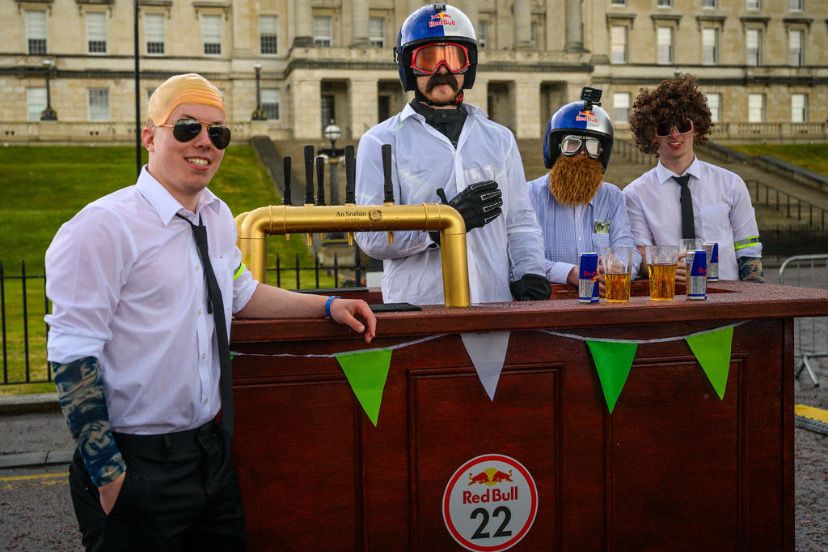 Marcus, Luke, Thomas and Sean from the PretEngineers team
Performance on the Day
You achieved the fastest run of the day at 47 km/h - were you expecting that level of performance?
We always had the attitude that we were going to Belfast to win rather than just take part, but that was probably more ambition than expectation at the start. We wanted to be competitive, and we put a huge amount of effort into making the soapbox as fast as possible, but with 42 teams competing it was impossible to know what standard everyone else would bring.
We were confident that the soapbox would be quick. During testing we had reached speeds of around 45 km/h, so we knew the fundamentals were good. At the same time, we never actually tested the cart with all of the final decorations and bodywork installed because we didn't have the time and we didn't want to risk damaging it before race day.
When we crossed the finish line and heard that we had hit 47 km/h and recorded a time of 49.83 seconds, we genuinely couldn't believe it. Luke and Sean were in the cart for the run and it felt incredibly fast, but neither of them expected it to be the fastest run of the entire day.
One of the funniest parts was that Thomas and Marcus were pushing at the start and once they launched the cart, they couldn't get anywhere near it. The soapbox just took off down the hill. To find out afterwards that we had set the fastest time of the day and broken the track speed record was an unbelievable feeling.
How did you prepare for race day, both technically and as a team?
Preparation for race day started well before we got to Belfast. From a technical point of view, we carried out a good number of test runs on a steep hill near home. In true engineering fashion, we used a quad bike and rope to tow the soapbox back up after each run rather than pushing it every time. Those tests were really valuable because they allowed us to check the handling, steering and braking systems and make adjustments before the race day.
One of our biggest concerns was actually getting the soapbox to Belfast in one piece. After putting so much work into it, the last thing we wanted was damage during transport, so we took it easy with the trailer and made sure everything was secured properly. Once we arrived, we spent time adding the finishing touches and carrying out final checks to make sure it was safe and looking its best.
As a team, preparation was just as important. We had spent around two weeks building the soapbox together, including a few late nights, but honestly it never felt like work. It was a great experience and felt more like spending time with friends than completing a project. We even managed to fit in a few rounds of golf and trips to the beach during the build.
The night before the race we went out for a few drinks, got a good night's sleep and made sure to have a proper breakfast before heading to the event. Once we arrived, we spent time in the paddock chatting with other competitors and taking in the atmosphere.
We had also clearly defined roles within the team. Luke was our driver because he was confident behind the wheel and trusted his ability to handle the cart at speed. Sean was the passenger and was responsible for playing the role of the barman during the run. Thomas and Marcus provided the power at the start line and gave us an incredible push off the ramp.
Walking the course beforehand was probably the moment reality set in. Some of the jumps looked huge and with no suspension on the soapbox, Luke and Sean were definitely a little nervous. At that stage though, our mindset was simple. We had put everything we had into the project, so all we could do was trust the engineering, work as a team and enjoy the experience.
What was going through your mind during the 49-second run?
There was a lot going through our minds during those 49 seconds. Before we even got to the start line, our focus was on putting on a good pre-race performance for the crowd and judges. Once that was done, all of our attention shifted to getting the best possible launch. We knew a strong push from Thomas and Marcus could make a huge difference to the run.
As soon as we rolled off the ramp, both Luke and Sean were definitely nervous about the first jump. We had walked the course earlier and knew how big some of them were, especially considering we had no suspension. We actually had a small wobble after the first jump, but once we landed safely and realised the cart was handling it well, our confidence grew immediately.
From that point on, the soapbox just came alive. Luke was driving brilliantly and seemed to hit every corner perfectly. It felt like he was following a racing line the whole way down the course. We never touched the brakes once. The cart felt incredibly stable and solid, which gave us a huge amount of confidence.
Meanwhile, Sean was having the time of his life on the back. The soapbox felt so sturdy that he barely needed to hold on, so he could focus on enjoying the moment, interacting with the crowd and playing his part as the barman.
We had absolutely no idea how fast we were going. We weren't thinking about records or winning. We were just focused on getting through each jump, each corner and making it safely to the bottom.
When we finally crossed the finish line and skidded to a stop, we were absolutely delighted. Once Thomas and Marcus eventually made it down the hill to join us, after what they would probably tell you was a long session of signing autographs and posing for photos, we all just hugged each other and celebrated.
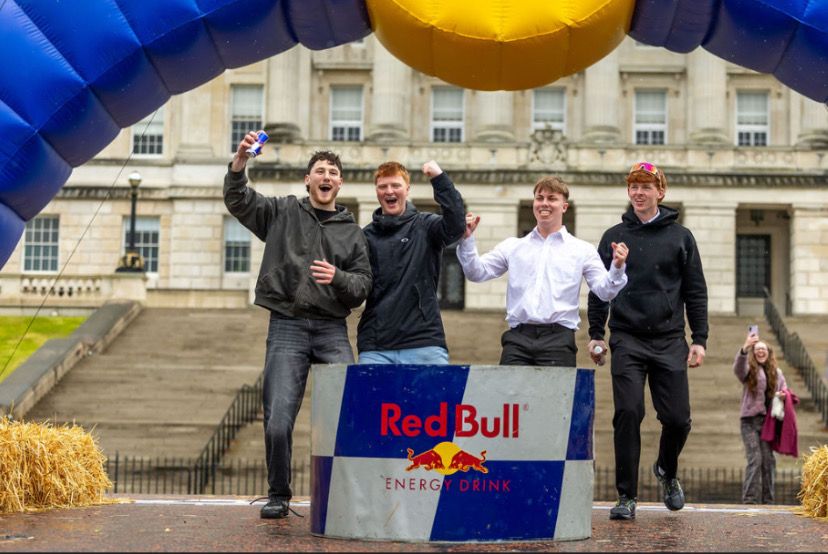 The team celebrate their success
The 20-Second Performance
You achieved full marks for your 20-second performance - what was the concept behind it?
We knew the performance had to be memorable, so we leaned fully into the pub theme. Our four characters were a bartender with a big handlebar moustache, a wild Irishman with a long beard, flat cap and a fake belly, and two bouncers in shirts and ties with sunglasses, tattooed arms, one bald cap and one afro wig. The soundtrack was Eileen Óg by the Mary Wallopers. It is up-tempo, unmistakably Irish, and it fit the scene perfectly. The wild Irishman refuses to pay for his pint, tensions rise, he throws the pint over the bartender, right on cue the music kicks up a gear, the bouncers storm in and grab him by both arms, but he breaks free and dives into the soapbox, the drenched bartender climbs into the driver's seat, the bouncers shove the box down the hill, and the chase is on.
How important is storytelling or showmanship in an event like this?
With 35,000 people in the crowd, entertainment was the whole point. We wanted to be as enthusiastic, dramatic and exciting as possible. We had 20 seconds to perform and every second counted. We figured if the crowd was loving it, the judges would feel the same. We all grew up watching Red Bull Soapbox races, so we knew exactly what we'd want to see from the other side of the barriers, and we tried to deliver that. By the time we got to the start line, looked down the hill and saw the scale of it, we all got a massive hit of adrenaline that brought everything up a level.
Did you rehearse the performance extensively beforehand?
We knew the performance was worth a third of the total points, so we made sure we had a clear plan and knew our individual roles going in. The most important moment was timing the pint throw perfectly with the music switching to a faster beat, so we made sure that was locked in. Being 22nd out of 42 teams gave us time to run through it once more on the day, which settled any nerves before we got to the start line.
Teamwork and Experience
How many people were involved in the project, and what roles did they take on?
There were four of us on the team: Marcus, Luke, Thomas and Sean, all third year Engineering with Management students. Every task was split evenly between us, and we played to each other's strengths where we could. None of us had ever built a soapbox before but we were all hands -on and had experience with the kind of processes the build involved. Each day we'd agree on who was taking responsibility for what, which kept things moving. The biggest pressure we faced was lead times on orders, and anything we realised we needed mid-build was cutting it very fine on delivery.
What did you learn about teamwork from this experience?
The biggest thing we took from this was how much good communication matters. When someone had an idea that clashed with another person's we always made sure to listen to each other properly and reach an agreement as a group rather than pushing our own view. Having done group projects together throughout our degree meant we already had a sense of how each other worked before we even started. Planning tasks and splitting the workload before we stepped into the workshop each day kept everything structured and efficient. Having four sets of eyes on everything also made it much easier to spot problems before they turned into mistakes. Taking our time rather than rushing eliminated errors and saved us time in the long run. How well we functioned as a team was the most important factor in pulling it off.
What was the most memorable or enjoyable part of the entire process?
The most enjoyable part was probably the two weeks we spent living together down in Wicklow where the workshop was. Some days we were in there from 9am until 8pm but even though they were long and tiring, we made the most of it, cooking together most evenings and on the odd day even heading to the beach or out for a round of golf. There was also something really satisfying about watching the soapbox take shape day by day. The moment it really clicked was when we put the countertop on for the pub design, we all just stood back and felt this real sense of satisfaction because it had finally stopped looking like a wooden box. We were into the finer details at that point and you could really see the vision coming together. The most memorable part was standing at the top of the hill in front of 35,000 people, the nerves just disappeared. Or so we thought, until we found ourselves standing on the podium and still couldn't quite believe we had actually won the Red Bull Soapbox Race.
Support from Trinity
How important was the support from Trinity in enabling the project?
The support from Trinity was critical. We finished our third year exams and went straight down to Wicklow the very next day, with no window to earn money or prepare financially. As Engineering with Management students, keeping on top of your grades and holding down a part-time job at the same time is genuinely difficult, so none of us were in a position to fund this out of our own pockets comfortably. Every penny Trinity gave us went straight into the build. The steel for the chassis and the wood for the bodywork was all covered by the funding. Without it, the cart simply wouldn't exist.
What does it mean to you to represent Trinity Engineering at an event like this?
It doesn't happen often. Teams can only enter if the event lands in their home country, so when Belfast 2026 was announced we knew this was a genuine once-in-a-degree opportunity. Standing at that start line, we were up against teams from UL, TUS, Queen's and UCD all of whom had put serious work into their builds. We were aware of that. We wanted to show what Trinity engineering students are capable of when you take the work outside of a lecture hall and put it in front of 35,000 people. To then come away with the win made it mean even more. It wasn't just a result for the four of us.
Would you encourage other students to take part in similar extracurricular projects?
Without hesitation. This was never a chore, not for a single day of it. We are a close-knit group and we saw this as a chance to do something together that we'd actually be proud of. Every summer before this, once exams finished everyone scattered home and you'd be lucky to meet up a couple of times before September. This summer was completely different. We put everything we had learned throughout our degree into something real, and the result spoke for itself. If you get the chance to do something like this, take it.
The Bigger Picture
Events like this bring engineering to a wider audience - why do you think that matters?
Engineering is the backbone of the modern world no cars, no planes, no buildings without it. But that interest has to be sparked somewhere. A 10 year old standing in a crowd of 35,000 people watching a pub on wheels flying down a hill is not thinking about thermodynamics. They are thinking "how did they do that?" and "I want to do that." We know, because that was us. We grew up watching the Red Bull Soapbox Race on TV and asking those exact same questions. Events like this make engineering feel exciting and human and creative rather than something that only happens in a lab. If it gets even a handful of people curious enough to pursue it, that matters enormously.
Did the experience change how you think about engineering or your future career?
Completely, in two ways. The first was finally understanding what engineering actually looks like in practice. There is a big difference between working through a problem on paper and standing over a chassis you have built yourself, knowing that every decision you made has a real physical consequence. That gap between theory and reality closed very quickly once we were in the workshop.
And secondly the rewards of all the hard work paying off. That feeling of something tangible coming together in such a visible way is something that will stick with all of us going into our careers. Whether it's delivering a major project for a company or building something of your own from scratch, now we know what that finish line feels like.
What advice would you give to next year’s teams thinking of entering?
Go for it, and go for it properly. The moment we heard the event was coming to Ireland we were straight into it individual design concepts, CAD drawings, a three page application explaining who we are and why our cart belonged on that hill. That attitude has to be there from day one.
Once you get started, time moves faster than you expect. We had only had around two weeks from the end of exams to race day, and anything we needed mid-build was cutting it very fine on delivery. Start early, be decisive, and don't overcomplicate things. The other thing is communication. Every problem we ran into was solved by talking it through as a group. Four sets of eyes on a problem will always beat one. If the team is communicating well, everything else tends to follow.
The Trophy and Legacy
You’ve offered to donate the trophy to the School - why was that important to you?
The reason we want to donate the trophy to the school is because Trinity played a huge role in our success. None of us knew each other before this degree. We all come from different parts of the country with very different backgrounds, and it was Trinity that brought us together. The skills and knowledge we picked up throughout our degree fed directly into the build and design of the soapbox. We heard about the event through the Trinity Engineering Society, and when we got selected, Trinity helped by sponsoring us. From the friendships to the education to the funding, it all traces back to the University. Donating the trophy felt like the right way to acknowledge that, and we'd love to think it might inspire the next group of students who walk past it to go and put their skills and knowledge to the test.
Where would you personally like to see it displayed?
Personally, we would love it to be somewhere visible to everyone, like the main entrance or a common area, a place where students pass through every day. We hope it can catch people's eyes, and ideally make someone stop for a second and think about what they could go and do.
What do you hope future students will take from seeing your team’s success?
We hope our success inspires future students and shows them what they are capable of. Going into it, we had no idea how far we could take it. As the build progressed our confidence grew, and we surprised ourselves with what four engineering students could pull together in under two weeks. Not just the Red Bull Soapbox Race specifically, but hopefully it encourages students to sign up to any kind of competition or team project that challenges them and gives them a chance to put their practical skills to real use.
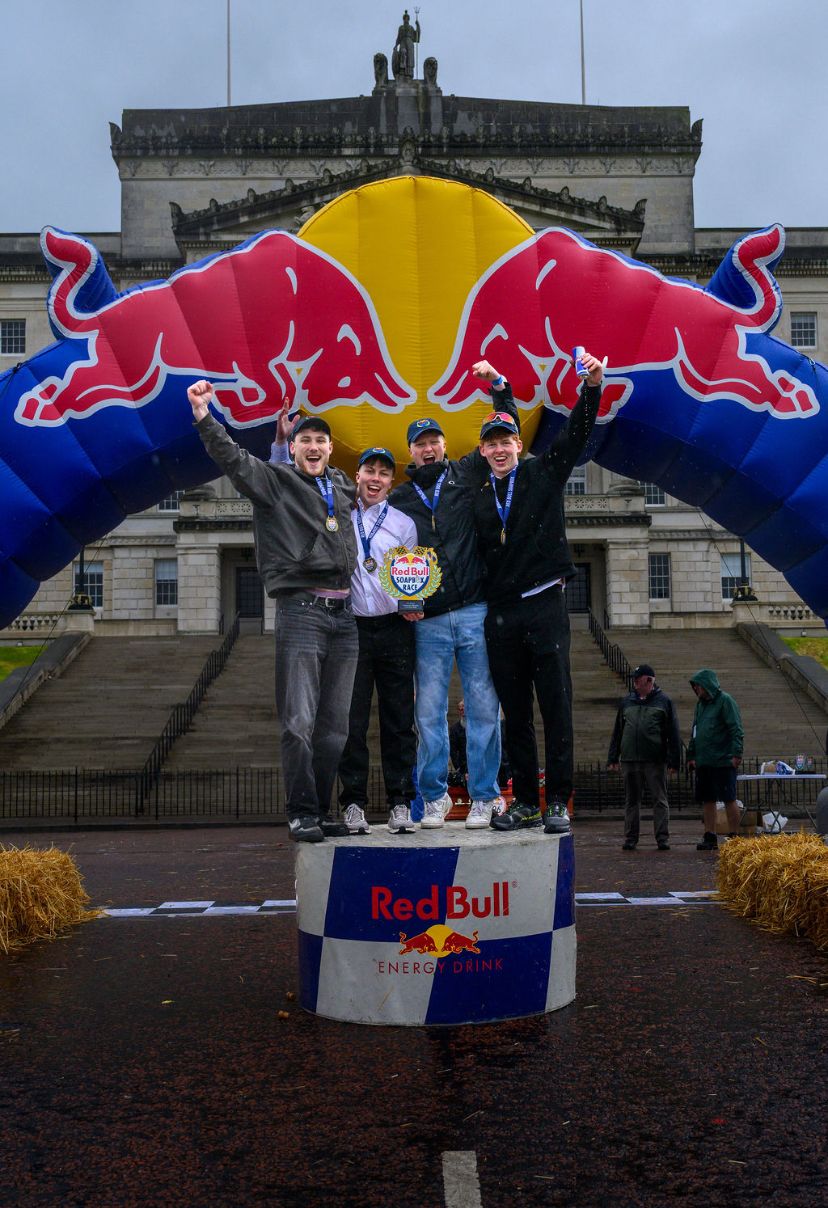 Left to right: Luke Symes, Thomas O'Neill, Sean O'Dowd, Marcus Davis-Kunze.
And finally...
If you had to sum up the experience in one sentence, what would it be?
An experience full of great memories with friends that showed us anything is possible with enough hard work.
What’s next for the team?
It's actually quite funny, about a week before the race we were already talking about the next Red Bull event we'd want to enter. There's a Red Bull Flugtag where you design and build a glider, launch it from a height and see how far it flies. We're not sure when it will next come to Ireland though. After this experience the team feels ready to take on another competition that requires similar skills to the Red Bull Soapbox Race. In the meantime, we have the first-place prize to look forward to which is a holiday to Austria and a Red Bull Ring driving experience. We can't wait!
From early sketches and late nights in the workshop to a record-breaking run in front of thousands, the team’s success captures what Trinity Engineering looks like beyond the classroom. It is a story of skill, creativity and trust in each other, backed by the confidence to take on something ambitious and see it through. The School of Engineering is proud of the team’s achievement and the way they represented Trinity on such a public stage. As they return with a trophy soon to be displayed on campus, their success stands as a reminder of what students can do when they turn theory into something real and enjoy the process along the way.