
Research by three Master in Engineering (MAI) students from Trinity College Dublin's School of Engineering was featured at the 4th International Conference on Quiet Drones, held at TU Delft in the Netherlands from 29th June – 1st July.
The students are members of Trinity's Fluids, Acoustics and Vibrations Research Group, which is based in the Discipline of Mechanical, Manufacturing & Biomedical Engineering at the School of Engineering and conducts research in aeroacoustics, vibration, noise control and fluid dynamics.
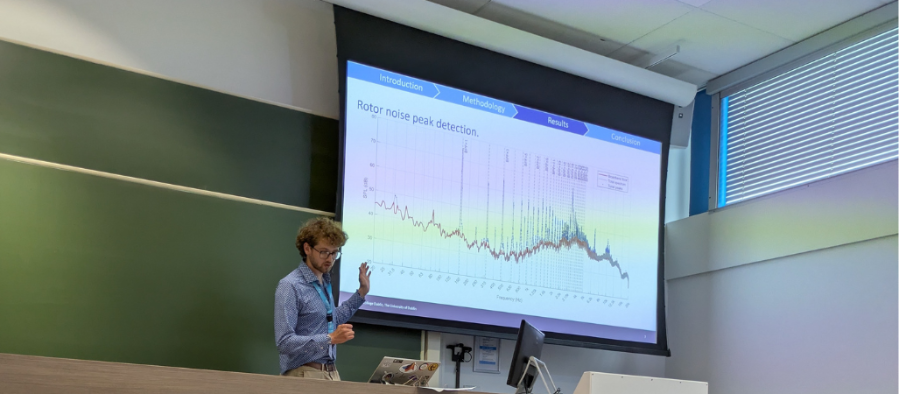
Craig Gillespie presenting his research "Mitigation of UAV Airframe Interaction Noise Using Porous Coatings"
MAI student Craig Gillespie attended the conference and presented his research, "Mitigation of UAV Airframe Interaction Noise Using Porous Coatings", in person to an international audience of researchers, industry representatives and regulators working on the future of drone technology.
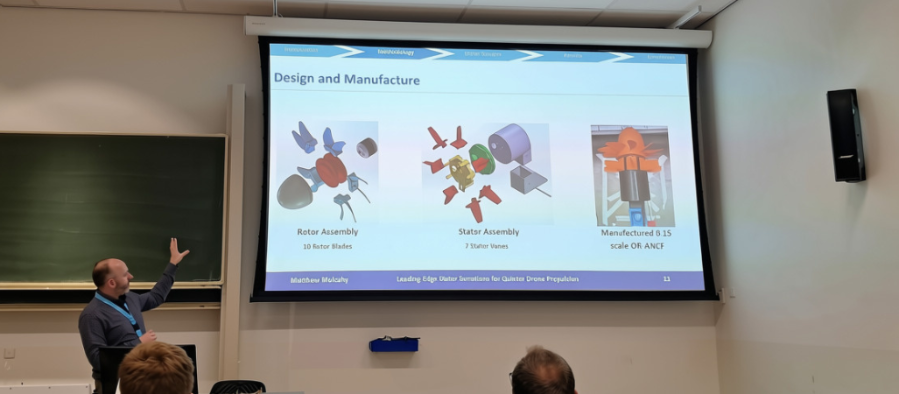
Dr John Kennedy presents at the Quiet Conference 2026
Two further MAI research projects were presented by Dr John Kennedy, Associate Professor in Vibrations, Acoustics and Dynamics at Trinity College Dublin and Principal Investigator of the Fluids, Acoustics and Vibrations Group, on behalf of their student authors.
The projects were:
- Craig Gillespie - Mitigation of UAV Airframe Interaction Noise Using Porous Coatings (Supervisor Dr. John Kennedy)
- Alexandra Duffy - Context Matters: Public Response to Delivery Drone Noise in Quiet vs Noisy Areas (Supervisor Prof. Henry Rice)
- Matthew Mulcahy - Stator Noise Reduction Technologies for Quieter and More Efficient Drone Propulsion (Supervisor Prof. Gareth Bennett)
Alexandra's research examined how public response to delivery drone noise can vary depending on the surrounding acoustic environment, while Matthew's project investigated technologies that could reduce stator-generated noise and improve the efficiency of drone propulsion systems.
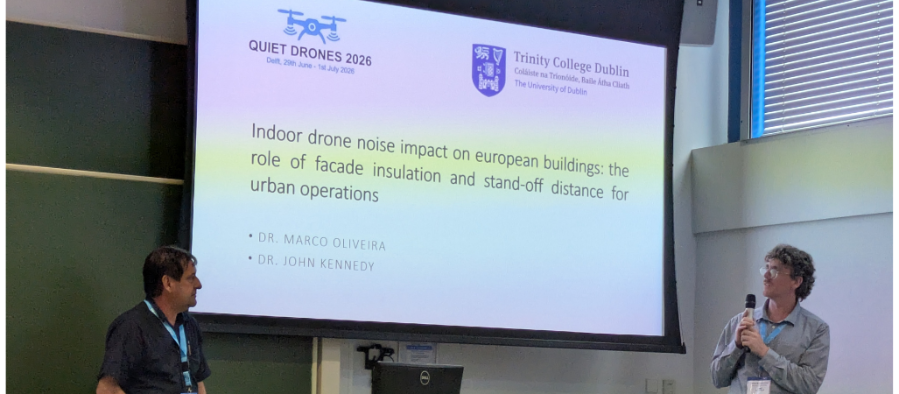
Dr Marco Oliveira presents his research "Indoor Drone Noise Impact on European Buildings: The Role of Façade Insulation and Stand-Off Distance for Urban Operations"
The group's contribution to the conference also included a presentation from postdoctoral researcher Dr Marco Oliveira, whose paper, Indoor Drone Noise Impact on European Buildings: The Role of Façade Insulation and Stand-Off Distance for Urban Operations, examined how drone operations may affect indoor noise levels in urban environments.
Having Master's-level research presented at a specialist international conference is a significant achievement and reflects the quality of work being carried out within the Fluids, Acoustics and Vibrations Group. The event provided an opportunity to share Trinity research with experts from academia, industry and government who are helping to shape future standards and technologies for drone operations.
The students are part of Trinity's Master in Engineering (MAI) programme, a professionally accredited five-year integrated engineering degree. Students begin on a general engineering pathway, complete a four-year Bachelor in Engineering (BAI), and may then progress to the fifth-year MAI programme subject to academic requirements.
The School of Engineering congratulates Craig, Alexandra and Matthew on their excellent work, and thanks Dr John Kennedy and Marco Oliveira for representing the group at Quiet Drones 2026.