
/filters:format(webp)/filters:quality(100)/prod01/channel_3/media/tcd/engineering/images/Noise-Summit-Logo-News-Story-Bannerv5.png)
The summit marked a significant milestone for environmental noise research in Ireland, providing a high- level platform to confront a growing public health challenge - one increasingly linked to cardiovascular disease, sleep disturbance and cognitive impacts. The event’s keynote address from Professor Kerstin Persson Waye outlined the latest evidence for the wide-ranging impacts of noise exposure on health.
The event was organised by the Noise 2050 research project team, a collaboration between Trinity College Dublin (TCD), University College Dublin (UCD) and the University of Galway, funded through the EPA Research Programme 2030.
International expertise highlights health impacts of noise
-900X675.jpeg) Prof. Kerstin Persson Waye (Gothenburg University, Sweden) delivering the keynote address. Photo credit: Priscila Wunderlich, University of Galway
Prof. Kerstin Persson Waye (Gothenburg University, Sweden) delivering the keynote address. Photo credit: Priscila Wunderlich, University of Galway
The keynote address by Professor Kerstin Persson Waye (University of Gothenburg, Sweden) offered an international, life-course perspective on healthy sound environments. Bringing World Health Organization-level expertise into an Irish context, she highlighted the need for coordinated action at both European and national levels.
National discussion highlights need for policy framework
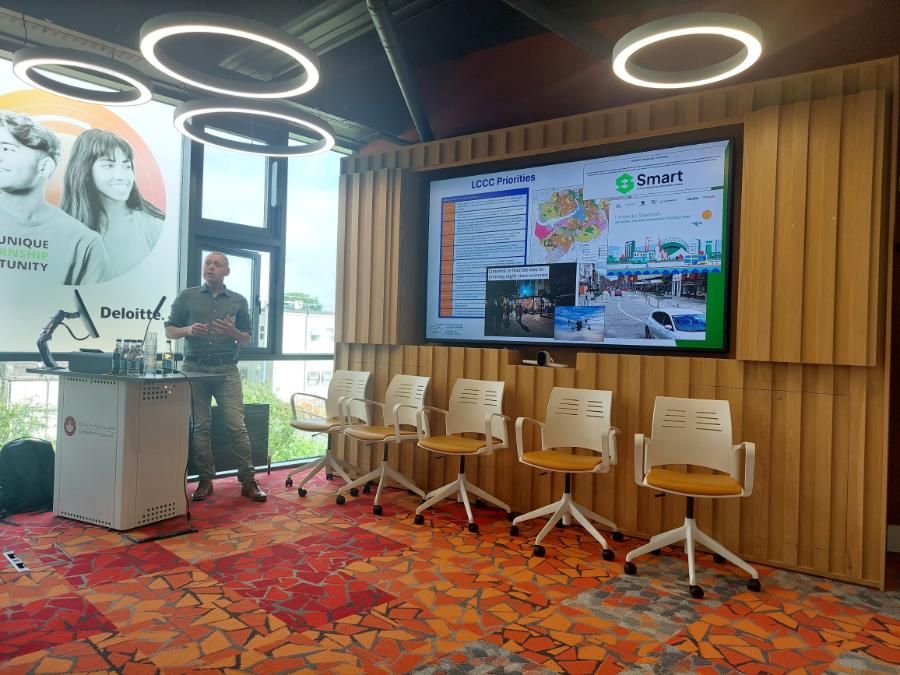 Simon Jennings, Limerick City and County Council, contributing to Panel A discussion. Photo credit: Priscila Wunderlich, University of Galway
Panel A, Environmental Noise in Ireland, brought together perspectives from across practice and policy, including Transport Infrastructure Ireland (TII), Limerick City and County Council, and Amplitude Acoustics. Discussions covered road noise management, local authority challenges and current industry practice.
A clear message from the panel was the need for a national noise policy framework in Ireland.
Professional bodies - including Engineers Ireland, the Institute of Acoustics, and the Association of Acoustic Consultants of Ireland - also contributed, outlining how their sectors can play a stronger role in addressing environmental noise.
Breakout sessions generate practical priorities
-900X675.jpeg) Breakout session on Citizen Science and Future Noise Monitoring, Photo credit: Priscila Wunderlich, University of Galway
Breakout session on Citizen Science and Future Noise Monitoring, Photo credit: Priscila Wunderlich, University of Galway
Interactive breakout sessions focused on three themes:
- The Future Noise Environment
- Citizen Science and Future Noise Monitoring
- Interventions for a Healthy Environment
These discussions generated practitioner-led insights that will directly inform the Noise 2050 research programme. Strong engagement from participants was evident throughout, particularly during panel discussions and breakout round-ups.
Facilitators from the Noise 2050 team synthesised key priorities emerging from the sessions, including:
- The need for a national policy on noise
- Increased training resources for professionals
- Greater engagement with the public
Initial insights from these groups will be reported in a conference paper at Forum Acusticum 2026 in Graz, Austria.
-900X675.jpeg) Breakout session on Interventions for a Healthy Environment. Photo credit: Priscila Wunderlich, University of Galway
Breakout session on Interventions for a Healthy Environment. Photo credit: Priscila Wunderlich, University of Galway
Environmental noise identified as an under-recognised public health issue
A strong consensus emerged that environmental noise is increasingly recognised as a serious public health issue in Ireland, yet remains under-resourced relative to other environmental challenges.
Key challenges identified include:
- Fragmented regulatory frameworks
- Limited national noise monitoring infrastructure
- Gaps in data on emerging sources such as electric vehicles, drones, heat pumps and offshore wind
While road traffic noise remains Ireland’s dominant source, future drivers - including EV adoption, rail expansion, aviation growth and offshore wind - are expected to significantly reshape the noise landscape by 2050.
Participants highlighted the need for a holistic, forward-looking national noise strategy integrating transport planning, urban development and climate action.
Trinity-led Noise 2050 project driving national engagement
The Noise Summit was organised by the Noise 2050 project, led by Dr John Kennedy (TCD), Professor Enda Murphy (UCD) and Dr Eoin King (University of Galway). The event represents the first of three planned stakeholder engagement milestones within the project.
Dr Kennedy presented the project’s aims and work packages, positioning the summit as the beginning of a sustained national dialogue.
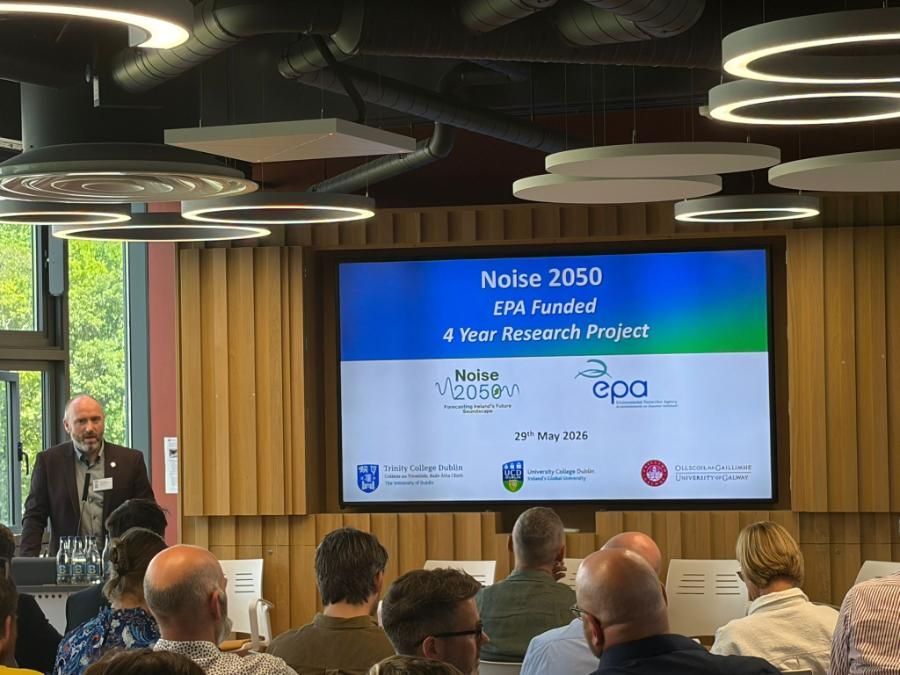 Dr John Kennedy (Trinity College Dublin) presenting the Noise 2050 research project. Photo credit: Priscila Wunderlich, University of Galway
Survey data collected from registrants was analysed and presented on the day, demonstrating the project’s commitment to evidence-informed and participatory research. The summit fulfilled a core objective of Noise 2050’s Work Package 4, focused on communication, dissemination and knowledge transfer.
“Noise pollution is increasingly recognised as a critical environmental issue with significant impacts on human health and biodiversity. Addressing this concern is essential for creating a sustainable future. Noise 2050 will advance knowledge and inform policy solutions within Ireland. Today’s event was an important first step towards a national policy on environmental noise.”
- Dr John Kennedy, Trinity College Dublin
Dr Eoin King, University of Galway, co-principal investigator and host of the event, added:
“Environmental noise affects millions of people every day, yet it has rarely been given the same level of attention as other environmental challenges. In Ireland the EPA estimates that over one million people are exposed to environmental noise levels that are damaging to health. This summit created a national platform for collaboration and helped start a conversation that Ireland needs to have about the quality of our sound environment.”
Priscila da Silva Wunderlich, Noise 2050 researcher at the University of Galway, noted:
“The National Noise Summit marked an important first step towards a more coordinated approach to environmental noise management in Ireland. A key message from the event was that noise can affect health and wellbeing even when people do not consciously perceive it as a problem.”
Next steps and future summits
The Noise Summit is planned as a recurring event, with the next edition scheduled for 2028, focusing on future noise scenarios in an Irish context. A third summit is planned for 2030 to coincide with the conclusion of the Noise 2050 project and reflect on progress towards a national noise policy.
Outputs from the breakout sessions and participant survey will be compiled into a workshop report and made publicly available on the Noise 2050 website and the EPA Research Data Archive.
These findings will directly shape the research direction of the Noise 2050 project through to 2030, including the development of national guidance documents for acoustic consultants and policymakers, culminating in a final symposium and report at project close.
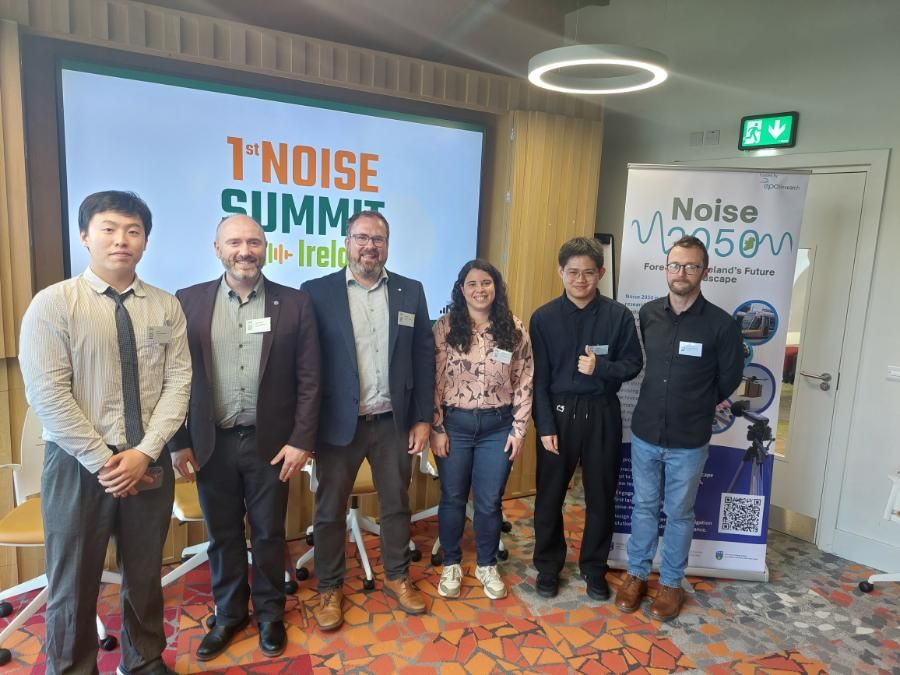 Noise 2050 project team at the University of Galway. Photo credit: Priscila Wunderlich, University of Galway