/filters:format(webp)/filters:quality(100)/prod01/channel_3/media/tcd/engineering/images/TF-Wind-Group_wide.png)
Top Image: The TF Wind team for 2025/26 comprising of 23 engineering, maths and theoretical physics students across all year groups and engineering disciplines
TF Wind is a student‑led engineering team focused on designing and building a floating offshore wind platform for international competition. With most of Europe’s strongest wind resources located in waters deeper than 60 metres, floating platforms offer one of the most promising ways to expand renewable energy generation across the continent. The team is entering its second year in the Floating Wind Challenge, an international competition featuring undergraduate and postgraduate teams from around the world, including Japan, Australia, Canada, the Netherlands and France.
Last year, TF Wind secured three awards at the competition: first place for power generation efficiency, second place overall and the sustainable transport award. Building on that momentum, the team is preparing for the 2026 edition of the competition, which takes place in the South of France this July. Their task is to design a platform and mooring system capable of supporting a 500W turbine positioned 1.2 metres above the water.
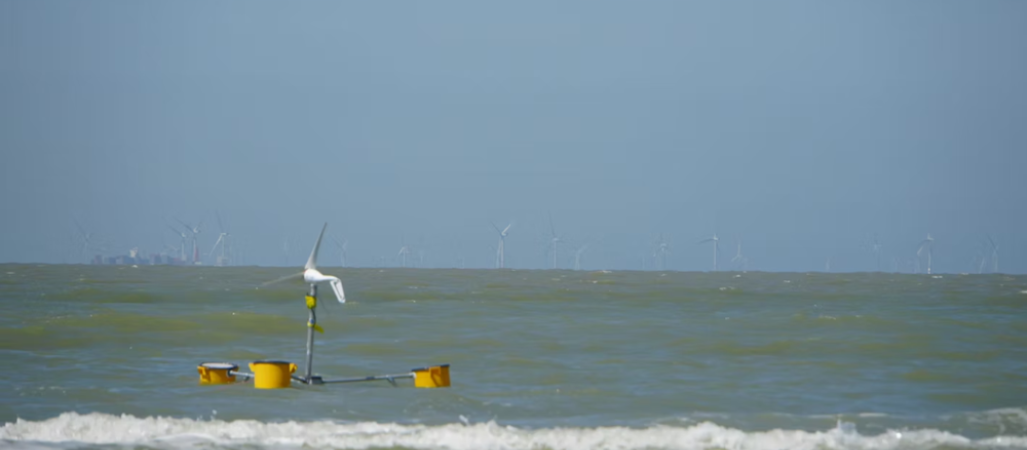
Image of the model designed and constructed by TF Wind, competing at 'The Floating Wind Challenge' in July 2025 in Zeebrugge, Belgium.
Exceptional support from industry
This year’s project development has been strongly supported by leading organisations in the energy and offshore engineering sector. The team has received sponsorship from ESB, EirGrid, Ørsted, BrightWind and Accenture, in addition to guidance and two internship opportunities for team members provided by Dublin Offshore.
Each sub‑team is paired with an industry mentor aligned with its specialist area:
- Design – Dublin Offshore
- Manufacturing and Testing – ESB
- Conditions and Modelling – BrightWind
- Economics and Research – Accenture
SEAI has also supported the team by covering tank testing time at the Lir National Ocean Testing Facility. The results gathered during these sessions will help inform the team’s 40‑page technical report, which must be submitted to the competition organisers in early May.
TF Wind is made up of 23 students drawn from all engineering disciplines at Trinity, along with students from mathematics and theoretical physics. The team stresses that the sponsorship, mentorship and internship opportunities they have received this year have played a critical role in shaping their work and ambitions.
New design work and additional student‑led projects
Alongside the core design for this year’s competition, TF Wind members are pursuing several additional projects aimed at strengthening future entries. The Manufacturing and Testing team is building a miniature wave tank for next year’s prototype trials, and one member is exploring the feasibility of producing in‑house wind turbine blades. Meanwhile, the Economics and Research team is preparing an abstract for Wind Energy Ireland’s “Thesis in Three” competition, titled How Concrete Spar‑Buoy‑Barge Hybrids fit Ireland’s Floating Wind Capabilities.
Academic and Technical Staff Support
The team has also been supported throughout the year by academic staff from the School of Engineering, whose guidance has been vital during the design, modelling and testing stages. Prof. David Igoe is the team’s academic supervisor, and Dave McAuley in the Civil Engineering Lab has been instrumental in assisting the team with the manufacturing of their design. Prof. Rui Teixeira and Prof. John Gallagher have also been a great support to the team.
Visitors can learn more about TFwind, their design and their upcoming projects at https://tfwind.team/.