
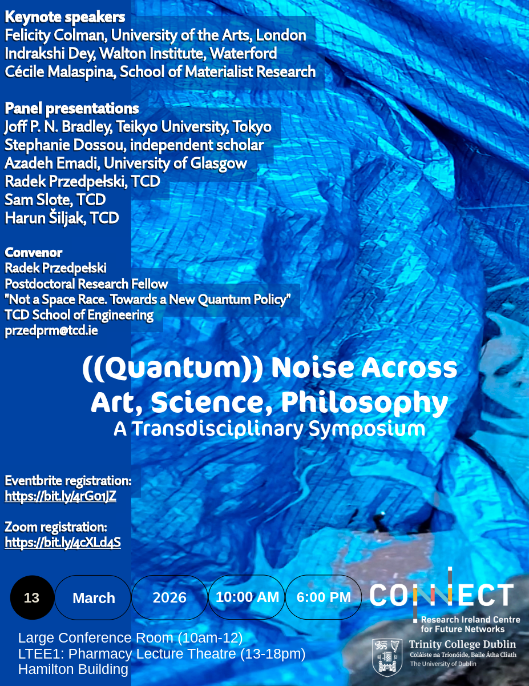
Date and time: Friday, 10:00-18:00 13 March 2026
Schedule: 10.00-12.00 Welcome address and panel presentations
12.00-13.00 Lunch break
13.00-15:00 Panel presentations
15:00-16:00 Keynote speech and Q&A: Felicity Colman
16:00-17:00 Keynote speech and Q&A: Indrakshi Dey
17:00-18:00 Keynote speech and Q&A: Cécile Malaspina, "Annual Lecture in French Thought and Philosophy 2026"
Venues:
10.00-12.00 Large Conference Room, O’Reilly Institute, Hamilton Building, TCD
13.00-18.00 LTEE1 Pharmacy Lecture Theatre, Hamilton Building, TCD
Format: Hybrid
In-person Registration: https://bit.ly/4rG01JZ
Zoom (Online) Registration: https://bit.ly/4cXLd4S
Thought in its three great forms—art, science, and philosophy—is always confronting chaos, laying out a plane, throwing a plane over chaos. (…) Philosophy wants to save the infinite by giving it consistency. (….) Science (…) relinquishes the infinite in order to gain refence. (…) Art wants to create the finite that restores the infinite.
Deleuze and Guattari, What Is Philosophy? [1991] 1994: 197
Already in 1982 Richard Feynman presciently speculated about the possibility of a quantum computer capable of “imitate[ing] any quantum system, including the physical world;” this would not be “a Turing machine, but a machine of a different kind.” Feynman anticipated what we know today as Quantum Computing—not grounded in the classical binary logic of either 1 or 0, but based on quantum bits (qubits), which are in superposition, affirming the logic of both-and-neither by enfolding the potential to become 0, as well as the potential to become 1. “The Second Quantum Revolution” designates the current era of Quantum Technology marked by operationalisation of the principles of quantum mechanics to perform complex computational tasks and solve problems intractable for classical computers. Frequently framed as an “uncharted new territory” sparking the “race to win technological advantage,” the technology is however still at the NISQ (Noisy Intermediate-Scale Quantum) stage. Indeed, a chief problem Quantum Technologies are presently facing is, precisely, noise, which pushes a quantum system into decoherence, for example through an interference of the outside milieu. What current Quantum Technologies then bring into focus is the very question of information and noise, and the latter’s ontological and epistemological dimensions.
What then are the scientific, technological, technical and energetic aspects of noise? Is noise opposed to information and individuation as something that needs to be kept at bay at all times? Something that slows down, or prevents, progress? Can we move beyond the idea of noise as only an aesthetic judgement? What is the role of noise in artistic cosmos-building? What can Arts and Humanities learn from cybernetics and communication theory insofar as (quantum) noise is concerned, and how can artistic interventions inspire philosophical and scientific-technological inquiries? What are political and ethical dimensions of quantum systems and noise? How can we articulate a critical, emancipatory and decolonial framework for using these technologies countering their dogmatic, reactionary, or elitist capture? How does noise relate to the allied concepts of chaos, contingency, indeterminacy, outside?
Let’s make some noise!
Click here to see the speakers, panel presentations and organising committee