Trinity chair warns politicians that universities are "on a very real cliff-edge"
Posted on: 15 October 2026
"The harsh reality is that State funding per student is now over 30% lower in real terms than in 2008. This country ranks 36th out of 37 OECD countries for investment in higher education as a share of GDP."
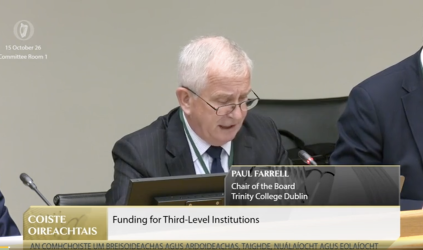
Paul Farrell, Chair of the Board of Trinity College Dublin, addressed the Joint Committee on Further and Higher Education, Research, Innovation and Science on Thursday 15 October 2026 about funding for universities.
In response to the most recent Budget he said: "I would describe this as treading water: the help for students and families is welcome and is appreciated, but the Budget Day speeches offer no clear commitment to closing the remaining core funding gap."
His full opening statement was as follows:
Cathaoirleach, members of the Committee, thank you for the invitation today. Your role in scrutinising higher education policy and expenditure is vital: ensuring that public investment delivers for students, society and the economy. But the timing of our appearance today is somewhat ironic, coming so soon after an admittedly disappointing Budget 27. While we welcome the investment made to date, it is incumbent upon us to point to the very real cliff-edge we are teetering upon.
The harsh reality is that State funding per student is now over 30% lower in real terms than in 2008. This country ranks 36th out of 37 OECD countries for investment in higher education as a share of GDP.
Despite chronic underfunding, Ireland’s universities remain key to Ireland’s economic, political and cultural life. Trinity College Dublin’s alumni, count among them three Nobel laureates, two Irish Presidents and innumerable writers from Bram Stoker to Sally Rooney. I will share some examples in a moment of some of the incredible innovations that have been made at Trinity – and each of our universities could share a long list of similar achievements. When I do, I ask you to imagine what more could be achieved with ambitious funding for higher education and research.
Over four decades, Trinity has produced more than 75 spin-out companies across medical technology, engineering, life sciences and technology. Last year alone, our spin-outs raised €108 million..
Our record includes Iona Technologies, Havok, Inflazome, SilverCloud Health and many others.
Trinity helped establish Atlantic Bridge’s University Bridge Fund, has participated as a limited partner, and has committed to its third fund.
Our researchers are advancing earlier cancer diagnosis, secure communications and accountable artificial intelligence. This research addresses the greatest challenges our world is facing. These achievements depend on people, laboratories and the everyday capacity to teach and conduct excellent research. All this is happening as research-led teaching is delivering graduates who think critically and question the world around them.
Sustained investment will allow us to deliver more. We have the capacity, enthusiasm and skills set to do so.
Our core mission is, of course, to teach our young people. It is our responsibility to give them all the opportunities they deserve. At our universities, we believe that everyone who wants it should have access to higher education and should be supported in doing so. 20% of our undergraduate students come to Trinity through alternative pathways. In 2015/16, 5.6% of students came through the DARE scheme. Over the past nine years, that has increased to 9.2%.
Student numbers, inflation and pay awards have outpaced funding, putting pressure on teaching, student support and research.
With Budget 2027 now announced, the additional supports for students and their families are undoubtedly welcome: the permanent €150 reduction in the student contribution fee, the enhanced and new grants for families with more than one child attending higher education, and the 4.5% increase in SUSI maintenance grants from January.
The funding for over 1,420 additional higher education places in key health and social care professions is also a welcome development. As too is the National Training Fund money for AI-related skills.
In summary however, I would describe this as treading water: the help for students and families is welcome and is appreciated, but the Budget Day speeches offer no clear commitment to closing the remaining core funding gap.
Ireland should be ambitious.
Adequately funded universities create businesses, attract investment and equip our people to think critically. Back our universities, and we will help secure Ireland’s future. Fail to do so and we will have failed to invest in our future. We ask the Committee to be ambitious, to back our students and back our research.
In 2022, your predecessors produced a report entitled The Future Funding of Higher Education which called for substantially increased investment in and a sustainable funding model for the sector. Today I would call on you strongly to revisit, revise and renew that document, seeking an updated response from the Department of Further and Higher Education, Research, Innovation and Science and the Department of Public Expenditure, Infrastructure, Public Service Reform and Digitalisation. In this way, we are asking you to back our students, back our researchers and back our future.
ENDS