Trinity economist urges rethink on proposed personal investment scheme
Posted on: 06 May 2026
Prof. Roantree noted that the proposed model for an Irish savings scheme “would bestow the biggest tax break on investments with the highest returns, and would actually increase taxes on investments that yield a low or negative return.”
Using the Swedish investment scheme as a model for a new Irish personal investment account will favour the wealthy, Trinity College Dublin Professor Barra Roantree has warned.
Addressing the Oireachtas Joint Committee on Finance, Public Expenditure, Public Service Reform and Digitalisation and Taoiseach, Roantree, an Assistant Professor and Programme Director of the MSc Economic Policy at Trinity, was critical of the current and planned tax treatments of investments.
“Like many parts of the tax system, the way that we currently tax savings and investment is in need of reform,” he said. “These distortions create a strong set of incentives for individuals to hold assets in particular tax-favoured forms and until certain tax-favoured points in life. This has the effect of distorting the choices individuals make about when and how to invest, with potentially significant consequences for economic efficiency and productivity.”
Minister for Finance Simon Harris said in late March that the planned personal investment account regime would feature an annual flat-rate tax that could potentially serve as the sole form of taxation on investments made through the new account.
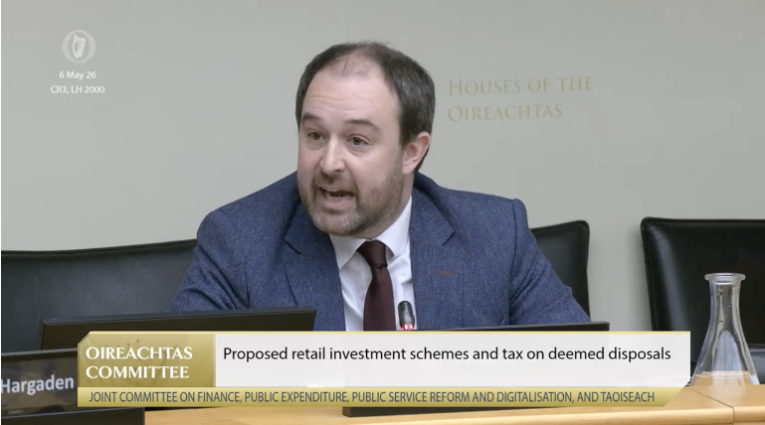
Prof. Roantree (pictured above at the meeting) noted that the proposed model for an Irish savings scheme “would bestow the biggest tax break on investments with the highest returns, and would actually increase taxes on investments that yield a low or negative return.”
“This is very difficult to justify in economic terms given that high-return investments will generally be less responsive to taxation, and that there is good evidence showing that wealthy and high-ability investors are more likely to earn high returns.”
“Instead of following the Swedish approach, I would encourage the Committee to explore the Norwegian model. This subjects only returns in excess of an investor's risk-free return allowance to taxation, ensuring that high-return investments are taxed while low-return investments are not.”
Barra Roantree’s comments were reporting in the Irish Times and Irish Independent.
Media Contact:
Catherine O’Mahony | Media Relations | catherine.omahony@tcd.ie