Mario Draghi, Tony Connelly receive honorary degrees to mark Irish EU presidency
Posted on: 27 November 2026
Also honoured were Tony Connelly, RTE’s Europe Editor, Professor Brigid Laffan, Chancellor of the University of Limerick and political scientist and renowned champion of the EU, as was Dr Síofra O’Leary, the first woman - and the first Irish person - to serve as President of the European Court of Human Rights.
To mark the year of Ireland’s presidency of the European Union, four outstanding individuals, including former European Central Bank President Mario Draghi, were conferred today with honorary degrees at Trinity College Dublin for their exceptional contributions to the EU.
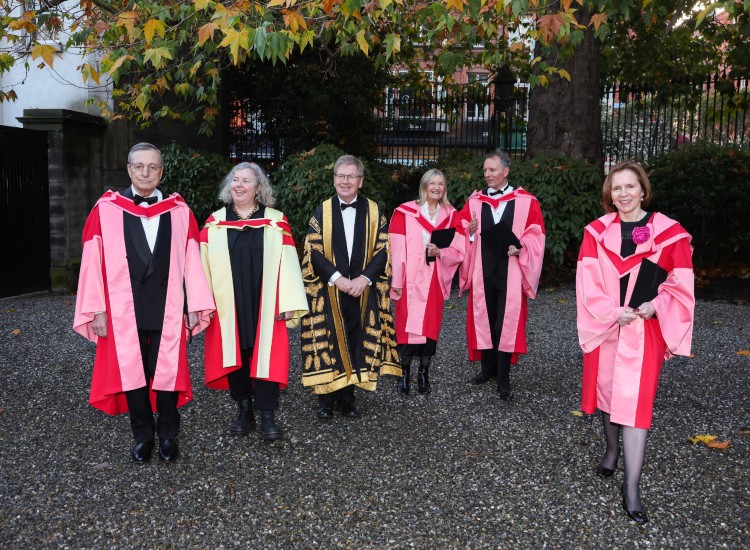
(pictured above l to r are Mario Draghi, Provost Dr Linda Doyle, Pro-Chancellor Jürgen Barkhoff, Brigid Laffan and Tony Connolly with Dr Síofra O'Leary).
Further details on the awardees as follows:
Tony Connelly (Doctor in Laws)

Tony Connelly (above with sons Felix and Jack and wife Rikke Albrechtsen) is RTÉ’s Europe Editor and is widely acclaimed for his insightful and empathetic reporting on the EU, European affairs, Brexit, and global affairs. He has covered wars in the Balkans, the Middle East, and Ukraine, written two highly praised books, and earned a reputation for being able to communicate what is happening in Europe to Irish audiences in an accessible and insightful way. Tony Connelly is one of Ireland’s most trusted and insightful journalists, combining deep expertise with empathy, clarity, and an incredible degree of personal courage. As RTÉ’s Europe Editor, he has spent decades reporting from the frontlines of European and global events. His work has helped how we in Ireland understand how European decisions shape our daily lives and how Ireland’s voice fits within a wider community of nations. During the war in Ukraine, he has reported from cities under fire, bringing heartbreaking and humane accounts of civilians caught in the conflict. At one point he and his RTÉ crew were forced to take shelter in a basement as shelling struck nearby, but he continued to file reports that captured both the fear and resilience of ordinary Ukrainians.
Connelly’s first book, Do not Mention the Wars: A Journey Through European Stereotypes (2009), revealed his curiosity and his ability to blend rich storytelling with cultural analysis. The Irish Times described how: “RTÉ’s Europe correspondent Tony Connelly has plunged straight in: are all French waiters rude, Germans innately bellicose, Swedes depressed, Spaniards obsessed with death? He visits each country, placing himself in the front line. In Paris he has served in a swanky restaurant; in Spain he attends a bullfight; in Sweden he looks at a skyscraper where none of the windows opens (to prevent suicide).” The book was praised for being humorous as well as filled with sharp observations connecting people across borders. His second book, Brexit & Ireland: The Dangers, the Opportunities, and the Inside Story of the Irish Response (2017), is regarded by scholars as a brilliant account of how Ireland navigated the most complex political challenge in decades. Across his career he has won awards for accuracy and integrity and has earned the respect of diplomats, politicians, and journalists alike.
If this was not enough, he has also played in a band with (Trinity immunologist) Luke O’Neill thereby contributing to the cultural life of the EU.
Speaking in Latin, the Public Orator Anna Chahoud praised Connolly’s “eye-witnessed accuracy, empathy and enthusiasm.”
“There is no topic that he does not cover thoroughly and responsibly, as is expected from a trusted reporter; but he is much more than a reporter. He is an insightful commentator of the increasing complexities of the European Parliament, of the Irish response to Brexit, of the unprecedented challenges to democracy, to the environment, to human intelligence in our times. He is an interpreter, who translates European policy for an Irish audience.”
Mario Draghi (Doctor in Laws)

Mario Draghi has been one of the most influential architects of modern Europe, embodying the ideals of unity, resilience, community, and the shared purpose that define the European project. As President of the European Central Bank during the sovereign debt crisis, he restored faith in the euro and in the EU itself. His now-historic pledge to do “whatever it takes” to preserve the common currency became a symbol of determination and solidarity, calming markets and reaffirming the belief that Europe’s future would be decided together, not apart. Draghi’s leadership helped steer the continent away from fragmentation and towards recovery, securing stability for millions of citizens and proving that cooperation could triumph over crisis. Beyond crisis management, Draghi’s vision for Europe has always been innovative and looking for the future. As Prime Minister of Italy and later as author of the European Commission’s report on the future of European competitiveness, he called for deeper integration, renewed investment in innovation, and greater solidarity between nations. He has urged Europeans to rediscover confidence in their collective strength and to embrace a more ambitious Europe capable of global leadership. Draghi represents the best of the European ideal: pragmatic as well as visionary, grounded in economic realism, but at the same time driven by a belief in shared destiny. His legacy is courage in adversity and faith in cooperation. Repeatedly, Mario Draghi has shown that Europe is strongest when it stands together. His work has been guided by trust, purpose, and the unwavering belief that its unity is its greatest achievement.
The Public Orator Anna Chahoud said of Mario Draghi: “Preserving the common currency is perhaps the most memorable of his many achievements, because it became a symbol of the power of solidarity and common purpose against the grave danger of fragmentation.
“He devoted his virtue and incredible energy to the service of “government and affairs,” guiding Europe to a future of stability and sustainable growth.”
Brigid Laffan (Doctor in Laws)

Professor Laffan’s groundbreaking academic work has been instrumental in exploring the dynamics of the European Union as a polity: governance, enlargement, Europeanisation, and institutional change. She has led and participated in major international collaborative research projects under EU Framework Programmes, including “Organising for EU Enlargement” and “New Governance in Europe.” On the European stage, her influence is equally distinguished. From 2013 to 2021, she served as Director of the Robert Schuman Centre for Advanced Studies at the European University Institute in Florence. In 2018 Political designated her as one of the top twenty women who influenced Europe. She also played a key role in civil-society campaigning for Irish EU-treaty referenda, founding the Irish Alliance for Europe in 2002 in support of the Treaty of Nice and Ireland for Europe in 2009 in support of the Lisbon Treaty. At a time when European values and the European Union were being undermined by misinformation and disinformation, Professor Laffan provided an articulate and passionate voice that was truthful and compelling. The fact that Ireland never fell sway to the types of liars and demagogues who pressed for Brexit, is because of people like Brigid Laffan, who were courageous when it counted, and who stood up against untruths and distortions. Professor Laffan’s distinguished contributions have been recognised through multiple honours: the French National Order of Merit (2010), the THESEUS Award (2012) for outstanding research on European integration, the UACES Lifetime Achievement Award (2014), the 2023 US European Studies Lifetime Achievement Award in European Studies. In 2024, she was awarded the Gold Medal of the Royal Irish Academy. Professor Laffan has made many significant academic contributions to our understanding of Europe, and this combined with high-level institutional leadership and public-engagement roles has made her one of Ireland’s most influential voices in European studies. It is also worth saying that she is an incredibly distinguished Chancellor of the University of Limerick and honouring her shows a wonderful sense of cross-institutional collegiality and respect. To quote then President Mary McAleese in 2002: ‘Professor Brigid Laffan, as Jean Monnet Professor and Director of the European Institute at University College Dublin, is a formidable champion of the [European] Union. Her enthusiasm is underpinned by rigorous scholarship and among her many talents is an ability to communicate easily and effectively to all audiences. Hers is a voice which refuses to speak only to the academic world but insists on doing well that very thing the institutions are accused of neglecting, informing the public, debating the issues, insisting that fact and not myth underpin perception.’
Public Orator Anna Chahoud said Brigid Laffan was celebrated around the world as “one of the women who shaped Europe.”
"Our honorand is a leader and protagonist in such breakthroughs, with her scholarship, teaching, representation and public communication, always speaking up clearly and courageously against misinformation.”
Síofra O’Leary (Doctor in Laws)

Dr Síofra O’Leary is the first woman - and the first Irish person - to serve as President of the European Court of Human Rights. The Court is central to the protection of human rights, democracy, and the rule of law in Europe. As our Minister for Foreign Affairs noted at the time of her appointment, ‘Never have these ideals and principles been more important.’ Under Dr O’Leary’s leadership, the European Court of Human Rights emphasised the protection of individual rights and the institutional integrity necessary to preserve access to independent justice across Europe. She has been widely acclaimed for combining intellectual rigour with a commitment to human dignity. The author of seminal works on EU citizenship and the free movement of people and services; she has always bridged academic insight with judicial practice. Throughout her career in Europe, she has given a clear expression to the idea that law can be an instrument for protection and integration in a difficult and divided world. She is one of the most accomplished legal minds in Europe and has advanced both the cause of rights and the dignity of judicial service. The Taoiseach, Micheál Martin, has spoken often about Dr O’Leary and has praised her as ‘a source of great pride to us in Ireland.’ And he has suggested that thanks to her work our standing in Strasbourg has never been higher. Finally, recognising Dr O’Leary is also a way of recognising and honouring the European Court of Human Rights. ECHR is also a crucial part of the framework of the Good Friday Agreement. In thousands of different ways, many known, some less obvious, the Court has helped make Ireland a better, a fairer, a more equal, and a more peaceful country. It has done the same for countries across Europe. We should be proud of the role that we have helped to play in building this better, fairer, and more tolerant world, and no one has helped do more to ensure our laws serve society and the common good than Dr O’Leary.
Public Orator Anna Chahoud said: We are deeply grateful for her relentless commitment to the health of our societies and for her generosity in communicating these vital principles, as Visiting Professor of Law at the College of Europe in Bruges (a role she has held since 2003) and as a regular keynote speaker around the world.
Dr O’Leary is, she noted, “an exceptional lawyer and judge” who, in her own words, “an Irish woman who has devoted her entire professional career to European law and to Europe.”
ENDS
Media Contact:
Catherine O’Mahony | Media Relations | catherine.omahony@tcd.ie