Modern language scholars receive honorary degrees at Trinity
Posted on: 17 April 2026
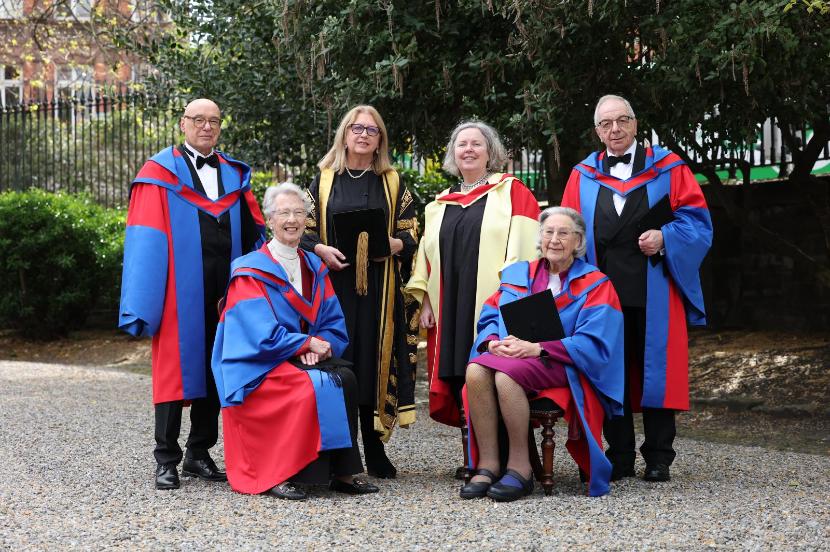
As part of the year-long celebrations to mark 250 years of modern languages at Trinity College Dublin, four outstanding individuals were conferred today with honorary degrees of the university for their exceptional contributions to this field.
Linguistics and language scholar David Little, Italian scholar Corinna Salvadori Lonergan, literary translator Hans-Christian Oeser and Eda Sagarra, Trinity's first female Chair of German, all received Trinity’s highest honour from Chancellor Dr Mary McAleese at a ceremony conducted in Latin in the historic Public Theatre.
Trinity awards honorary degrees each year to mark exceptional achievements by individuals. All the above recipients have made an enormous impact on modern languages both in Ireland and overseas.
Trinity was the first university in Ireland to introduce the study of modern continental languages. Its first professors in French, German, Spanish and Italian, appointed in 1776, were the first university Chairs in modern languages and, in the case of the Chairs in French and German, the oldest continuous Chairs in these languages in the world.
More on the honorary degree candidates:
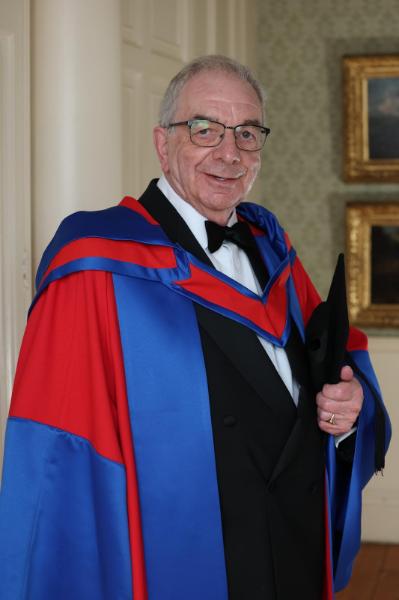
David Little (Doctor in Letters)
David Little is a distinguished and internationally renowned scholar in applied linguistics and language education whose work has had a profound and lasting impact on language teaching, educational policy, and the inclusion of linguistically diverse learners in Ireland, across Europe and beyond.
In 1979 he founded the Centre for Language and Communication Studies (CLCS) at Trinity, and later served as Director of CLCS and as Head of the School of Linguistic, Speech and Communication Sciences, guiding the school’s academic development until his retirement in 2008.
He was a founder member and chairman of Institiúid Teangeolaíochta Éireann's Modern Languages Project 1978-83, Chairman of the Royal Irish Academy's National Commission for the Teaching of Modern Continental Languages between 1981-83; he represented Trinity on the Department of Education’s Syllabus Committee for Leaving Certificate German between 1983-85; and he has been Director of Integrate Ireland Language and Training. Beyond Ireland he is Academic Coordinator of the Council of Europe’s Romani–Plurilingual Policy Experimentation.
As one of the leading interpreters of the Common European Framework of Reference for Languages (CEFR), he has played a leading role in the development and implementation of the European Language Portfolio (ELP) at both national and European levels. He continues to act as consultant to the Council of Europe's European Language Portfolio Validation Committee and to contribute to the Council of Europe's Modern Languages Projects.
From 2000 to 2008, he served as non-stipendiary Director of Integrate Ireland Language and Training and subsequently directed the Trinity Immigration Initiative’s English Language Support Programme, which developed subject-specific language materials for post-primary education. He has also made a significant contribution to Deaf education and teaching Irish Sign Language (ISL), and helped to embed Deaf studies within higher education in Ireland: in this context, he was instrumental in the establishment of the Centre for Deaf Studies at Trinity in 2002
He is the author of some 176 peer-reviewed publications and is internationally recognised for his pioneering work on the theory and practice of learner autonomy in second and foreign language education and the management of linguistic diversity in schools, curriculum design, and language assessment.
Trinity’s Public Orator Anna Chahoud praised Little’s “radical innovations” in language teaching, describing his vision for linguistic education in the following terms: “Collaborative learning, with each student’s individual interests and needs at its heart, is the key to autonomy and freedom.”
“Through his linguistic research and pedagogy, this man has proved that a good education is an exercise in social justice.”
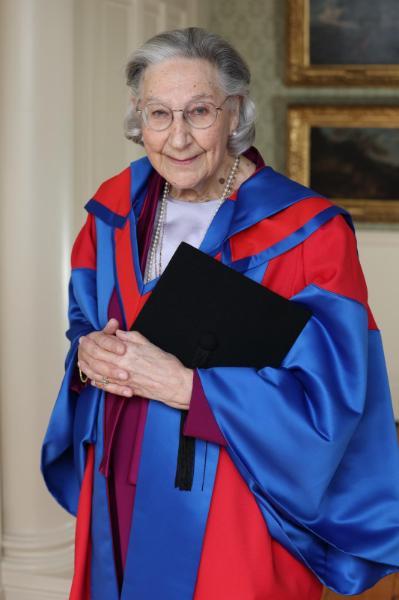
Corinna Salvadori Lonergan (Doctor in Letters)
Corinna Salvadori Lonergan has, for 65 years, epitomised the teaching of modern languages in Trinity. She is the child of classical musicians who, after harsh wartime experiences, came from Florence to Dublin to play in the Radio Éireann Symphony Orchestra. Her Master’s thesis on Yeats and Castiglione was published as a monograph by Allen Figgis in 1965, while she was still in her twenties, and it gave a taste of the passion, erudition and intellectual brilliance that came to characterise her scholarship.
She was appointed to a lectureship in Trinity in 1961 as a young assistant lecturer and remained there until her “retirement” in 2001. Her teaching commitments continued long after “retirement;” for many years she has offered specialist options for Italianists as well as supervising postgraduate students on recently developed MPhil degrees. Students continue to praise her academic rigour, vast knowledge, and warmth.
When the Provost’s teaching awards were first introduced, she was given a lifetime award for her contribution to teaching. The Society for Italian Studies awarded her life membership, in recognition of her outstanding presence within the discipline, and the International Association of Italian Professors (AIPI), over which she had presided for several years, appointed her Honorary President of the Association. Again fittingly, the Italian
Government conferred her with the title of Commendatore in the “Ordine al Meritodella Repubblica Italiana,” Italy’s most prestigious honour.
Her research has been prolific, focusing on Castiglione, Dante Alighieri and Lorenzo de’Medici. She is co-editor of Italian Culture: Interactions, Transpositions, Translations (2006), and co-ordinating editor of the AIPI collection Insularità e cultura mediterranea nella lingua e nella letteratura italiana (645 pages, 2012).
Trinity’s Public Orator Anna Chahoud paid tribute to Corinna Lonergan’s “incomparable vitality and generosity”, adding: “She has brought to life the dialogue between Italian and Irish literature, through her perceptive translations, insightful studies, and public readings of Dante, Lorenzo, Poliziano, Ariosto, of Yeats, Beckett, Heaney, and many others. She has transmitted her passion to entire generations of students of Italian and of Literary Translation, whom she generously teaches to this day, in her firm belief in the transformational power of education.”
Hans-Christian Oeser (Doctor in Letters)
Hans-Christian Oeser is the most well-known, prolific, and important literary translator in Ireland. To date he has translated, authored, and edited 250 works overall, and all of those to the absolute highest standard of his trade.
He was a founder member of the Irish Translators’ and Interpreters’ Association (ITIA, now ATII) and also served on the Commission for Literary Translation of FIT, the worldwide Fédération Internationale des Traducteurs. In 1995–99 he was a Board member of ILE, the Ireland Literature Exchange, and he is currently a board member of the Trinity Centre for Literary and Cultural Translation.
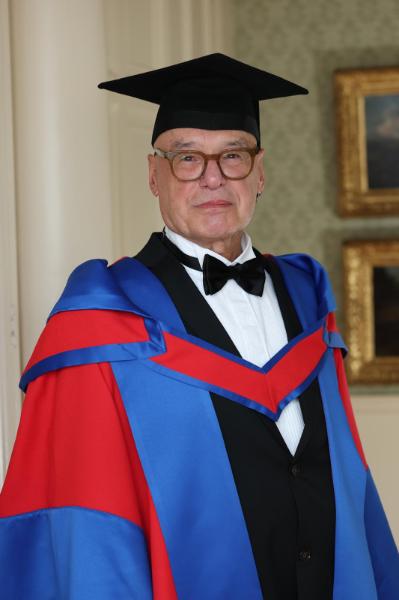
He has translated literary works by a pantheon of Trinity alumni - Oscar Wilde, William Trevor, Jennifer Johnston, Derek Mahon, Sebastian Barry, Anne Enright, Eoin McNamee– and twenty-seven other Irish writers ranging from long established literary figures to important new voices. Publications which have carried his commentary include the Irish University Review, Éire-Ireland, The Stinging Fly, The Irish Times, Poetry Ireland Review, Translation Ireland. Apart from appraisals of new work, topics addressed include political change, misinformation, censorship, and the ontology of translation. He has also worked for freedom of expression through PEN International.
His 1997 Aristeion Prize, a Europe-wide award (one of the most financially valuable in the world at that time) is one among countless recognitions, bursaries, fellowships and prizes conferred by his peers and other cultural authorities, including the Rowohlt Prize for lifetime achievement (2010), and the Straelener Übersetzerpreis der Kunststiftung NRW (2020).
He is joint author of books on James Joyce and Oscar Wilde, and author of travel books, literary guides, and political works on Ireland. Among his editorial projects, his 450-page anthology, Irische Short Stories des 20. Jahrhundert (1999), together with his English-language anthology, Contemporary Irish Short Stories (1989), present many more Irish writers including Elizabeth Bowen, Maeve Kelly, Ita Daly, Pádraic Ó Conaire, Liam O'Flaherty, Sean O’Faolain, Anne Devlin, Mary Lavin, Claire Boylan, Máirtín Ó Cadhain.
Trinity’s Public Orator Anna Chahoud said of Oeser: “His achievement is all the more remarkable because of the distance between the German language and English, both in its highest poetic expressions and in the most colloquial demotic varieties of Hiberno-English.” He is, she said, “a man who has taught us that at the heart of translation are human understanding and creativity, with a sense of register and style, with a respect of personal voices that no machine can achieve: our voice is who we are.”
Eda Sagarra (Doctor in Letters)
From 1975 until 1998 Eda Sagarra was the first female holder of the Chair of German (1776) at Trinity.
In 1979 she became Dean for International Students and on becoming Registrar in 1981she was the first woman in the history of the College to hold a statutory officership.
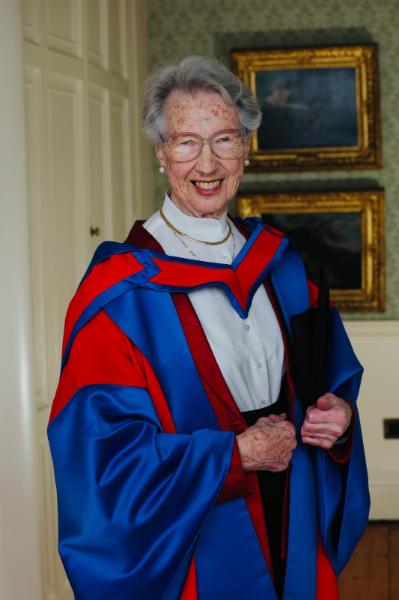 From 2000 to 2008 she served as Pro-Chancellor of the University of Dublin. Beyond Trinity, she was Secretary of the Royal Irish Academy and after her retirement she was for five years the Founding Chair of the Irish Research Council of the Humanities and Social Sciences (IRCHSS) – a body whose existence owes a great deal to her vision and energy. In acknowledgment of her work, Research Ireland annually award the Eda Sagarra Medal of Excellence to the top-ranked PG researcher in the Humanities and Social Sciences
Her academic work has been extremely influential in German Studies. Eight edited volumes and over 80 articles in English and German on German literature, culture and history are testament to her enormous erudition and boundless intellectual curiosity.
On the European front, she was a powerful advocate for the Humanities and an influential ambassador of Irish academia. She served on many influential commissions of the European Science Foundation and the Deutsche Forschungs Gemeinschaft and other institutions.
She was the driving force between the design and implementation of multiple new degree courses such as European Studies, Business and a Language, Law and a Language and Computer Science, Linguistics and a Language, all with a mandatory year abroad, making maximum use of the opportunities the new Erasmus-programs offered.
Her exceptional achievements have been recognised on many fronts: she is holder of the German Order of Merit, the Bundesverdienstkreuz, the Austrian Ehrenkreuz for Science and Art and she was awarded the Goethe Medal of the Goethe-Institut in 1990.
In 1995 she was the very first recipient of the DAAD Jakob- und Wilhelm Grimm Preis for German Studies Abroad and in 2022 she was awarded the Fontane-Wissenschaftspreis for her academic work on the 19th century novelist Theodor Fontane.
Trinity’s Public Orator Anna Chahoud described Eda Sagarra as “a free-spirited Irish woman of unbounded generosity, curiosity and creativity, courage and compassion.”
“With her natural disposition to identify problems and determination to solve them, she has given her unwavering support to women in academia, aided in her mission by other exceptional Trinity women who are with us today, in body or in spirit.”
Media Contact:
Catherine O’Mahony | Media Relations | catherine.omahony@tcd.ie