
Overview
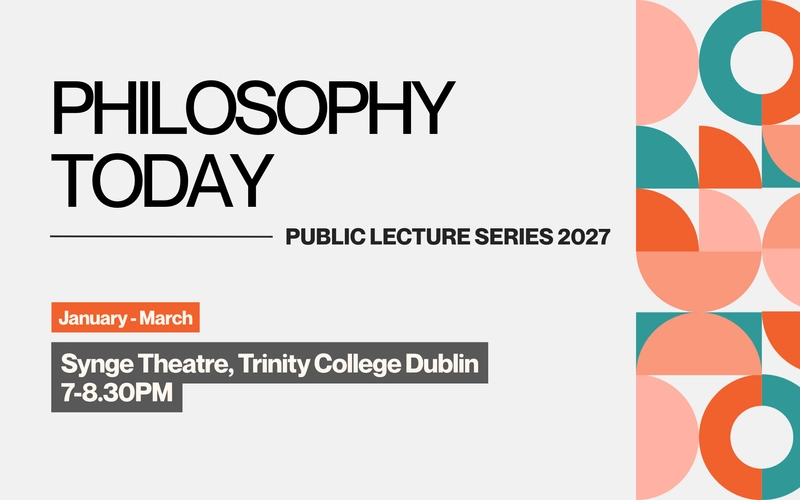
The popular Philosophy Today series is back for 2027 with a new line-up of public lectures that connect philosophical ideas to everyday experience. Across five evenings, Trinity philosophers ask how we live with difference, why we stand with others, whose voices shape the way we think, and much more.
📅 Thursdays, starting 28 January 2027 and continuing every second Thursday for five sessions
🕖 7pm - 8.30pm
📍 JM Synge Theatre, Arts Building, Trinity College Dublin
🎟️ €85 for the full series. A concession rate of €40 applies to students, senior citizens, unemployed people, groups of 20+, TCD staff and graduates.
Because each session is interactive and includes live Q&A, Philosophy Today is in-person only and won’t be offered online.
Thursday, 28 January 2027 | Professor Lilian Alweiss
 Pluralism AND Universalism
Pluralism and universalism are commonly understood as opposed to one another. Pluralism affirms the many, while universalism privileges the one. But must we really choose between them? In this lecture, Professor Lilian Alweiss challenges this opposition, showing that pluralism and universalism are not mutually exclusive. Drawing on the writings of Heraclitus and Husserl, she explores how the relation between the two might be understood in a “new” way, and what this rethinking could mean for our understanding of political pluralism.
Thursday, 11 February 2027 | Dr Rowan Mellor
 Solidarity and Self-Deprivation
When people lack a good, others will sometimes act in solidarity with them by depriving themselves of that good too. Alexander the Great, for example, is fabled to have refused water while leading his army through the desert, choosing instead to share in his soldiers’ suffering. But if going without doesn’t improve things for others, and only leaves you worse off, why do it? In this talk, Dr Rowan Mellor defends the rationality of self-depriving solidarity, suggesting that such acts are a form of “self-signalling”: our reason for engaging in them is not to benefit others, but to gain important information about ourselves.
Thursday, 25 February 2027 | Dr Jamie Turner
 ‘The Lamps are Many but the Light is One’: An Islamic Philosophy of Religious Diversity
Religious believers in our multicultural society face serious obstacles to their faith, among the most prominent being a heightened awareness of religious and non-religious others. Members of the world’s religions are just as intellectually and morally upright as each other, and yet each claims that their home religion is superior to all others in some significant respect. So how should we make sense of religious diversity? In this talk, Dr Jamie Turner draws on insights from the Islamic philosophical tradition to explore the prospects of a pluralistic approach to religions, one that affirms parity among them all, whilst leaving open which, if any, might in some sense be “superior”.
Thursday, 11 March 2027 | Professor James Levine
 Is there a special form of insight that philosophers can provide?
Some philosophers have denied, while others have held, that there is a special sort of insight or understanding that philosophers are capable of providing. In this talk, Professor James Levine looks at one way that some philosophers have claimed to provide this sort of insight, and at how others have criticised this view. Taking Berkeley and Wittgenstein as examples of philosophers who present themselves as offering distinctly philosophical insights, he considers some aspects both of their views and of how they may be challenged.
Thursday, 25 March 2027 | Dr Jade Hadley
 Reloading the Canon: Women Philosophers in Early Modern Philosophy
The history of early modern philosophy is usually taught through a familiar cast of thinkers, whose works make up what is known as the philosophical canon. But what happens when we look beyond the usual suspects? In this talk, Dr Jade Hadley introduces some of the largely overlooked women who contributed to early modern philosophy, whilst exploring how philosophical canons are formed, who gets left out, and how we might begin to think outside of them.