“Everybody is slightly terrified”: What is a university in the age of AI?
Posted on: 23 April 2026
“Everybody is slightly terrified of the hugeness of AI – there is just so much unknown, so much potential for good and for bad - especially for the soul of a university like Trinity,” said Cliona O’Farrelly, Chair of the Fellows of Trinity and the organiser of this event.
A landmark public discussion took place at Trinity College Dublin yesterday to explore how artificial intelligence is reshaping the concept of a university.
Convened by the Fellows of Trinity College Dublin, the event addressed how AI might be held accountable for future public good (Abeba Birhane, Trinity AI Accountability Lab), what perils and possibilities AI poses for the human mind (Ian Robertson, Trinity School of Psychology), and whether universities can maintain their position in a world of infinite content (Fintan O’Toole, Irish Times).
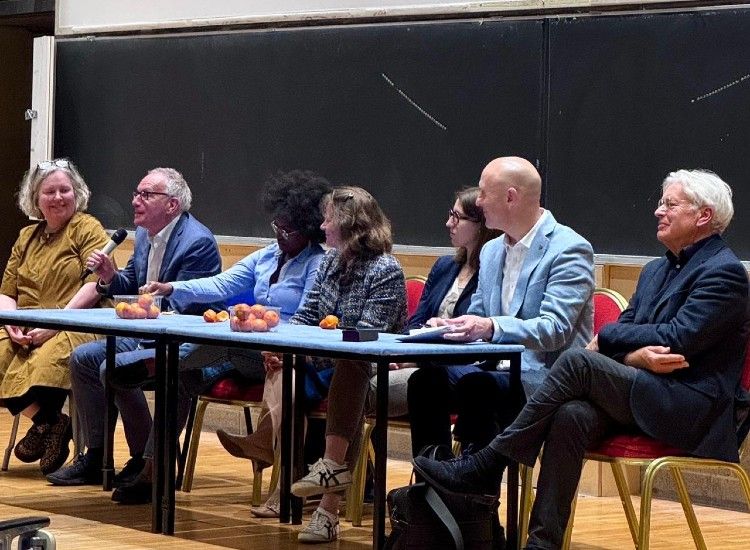
Attendees included local community representatives both from the Greenore Community Centre and the St Andrew’s Resource Centre.
“Everybody is slightly terrified of the hugeness of AI – there is just so much unknown, so much potential for good and for bad - especially for the soul of a university like Trinity,” said Cliona O’Farrelly, Chair of the Fellows of Trinity and the organiser of this event (pictured below on right).
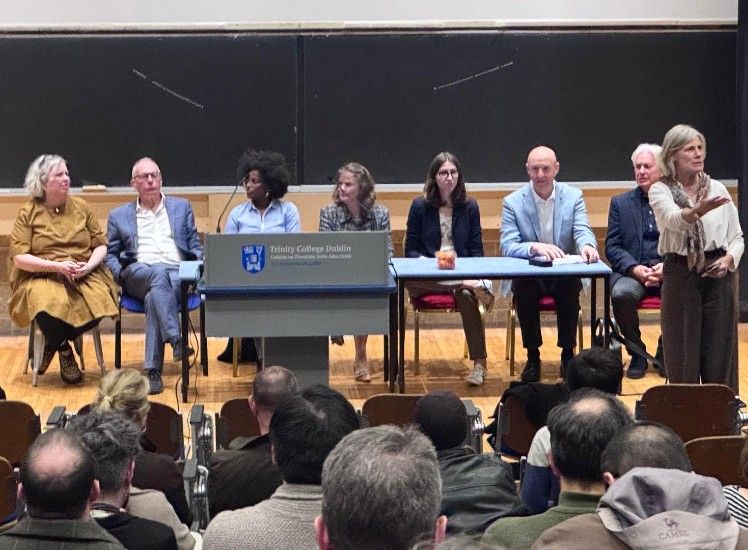
“This event was designed to explore a spectrum of views on AI, from pragmatic to the ethical to the philosophical. The framework for it all was Edmund Bourke’s aphorism: ‘What is liberty without wisdom, and without virtue’?”
Trinity’s Provost Dr Linda Doyle said the evolution of AI was a useful reminder that universities like Trinity need to ask themselves questions like: “Are we good enough? Can we raise our human game to be able to cope with this world?” and “What does it mean to do research? What does it mean to collaborate and innovate with a machine?”.
She declared that, where AI is concerned: “I have an optimistic view. For me, we should not be afraid to look AI in the face. Unless you deeply engage, you can’t really figure out how to navigate the world of AI.
“What I think we need to do as a university, as we critically engage with AI, is to understand that what is unthinkable now may one day be acceptable, or maybe what’s unthinkable now is something we don’t want to ever become acceptable. The bottom line is – we need to engage.
She added: “Perhaps the greatest role we can play as universities is in provenance – the kind of research papers we produce, we can stand over in terms of provenance and that is important.”
Topics covered in the event included:
What Is a University in the Age of AI?
Cliona O'Farrelly, Chair of the Fellows
AI, Knowledge, and the Future of the University
Linda Doyle, Provost of Trinity College Dublin
Can Universities Keep Authority in a World of Infinite Content?
Fintan O'Toole, Columnist and public intellectual
Attention, Memory, and Learning: The Perils and Possibilities for the Human Mind
Ian Robertson, Professor Emeritus in the School of Psychology, TCD
Excellence, Ethics, and the Public Good in the AI University
Jennifer Edmond, Professor in Digital Humanities
What AI Changes — and What It Should Not Change — in Higher Education
John Kelleher, Professor of Computer Science, TCD
Holding AI accountable for the Public Good of tomorrow
Abeba Birhane, Cognitive Scientist, AI Accountability Lab, TCD
Perspectives from a student
Camilla Persello, Secretary to the Scholars
A recording of the discussion will be available on YouTube.
ENDS