
New Trinity Centre launched for Reproductive Sciences and Women’s Health
Posted on: 12 October 2026
The new Centre will create a coordinated research ecosystem spanning discovery science, clinical research and policy, addressing important evidence gaps in women’s and reproductive health.
A new transdisciplinary Trinity Centre for Reproductive Sciences and Women’s Health (TCRW) was launched today, with an ambition to transform research, clinical care, education and policy in women’s and reproductive health.
Launched by Minister for Health Jennifer Carroll MacNeill, TD, (pictured below) the Centre brings together more than 70 clinicians, scientists, social scientists and policy-relevant researchers across 20 disciplines at Trinity College Dublin and its clinical partners, including St James’s Hospital, Tallaght University Hospital, the Coombe Women and Infants University Hospital, and Children’s Health Ireland at Crumlin.
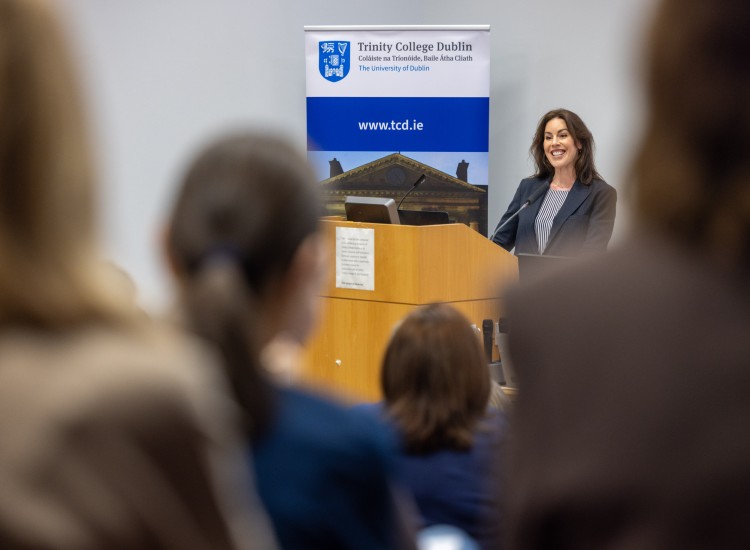
TCRW, Trinity College Dublin’s first dedicated transdisciplinary centre for women’s and reproductive health, will be hosted by the Trinity Translational Medicine Institute (TTMI).
Its Co-Directors are Professor Cliona O’Farrelly, Professor of Comparative Immunology at Trinity Biomedical Sciences Institute (pictured third from right below); Dr Lisa Owens, Consultant Endocrinologist at St James’s Hospital and Clinical Senior Lecturer at Trinity (third from left); and Dr Michelle Lavin, Consultant Haematologist at the National Coagulation Centre, St James’s Hospital (second from right, also pictured below l to r are TTMI Director Mark Little, St James's Hospital CEO Mary Day, Minister for Health Jennifer Carroll-MacNeill, Colin Doherty, Head of School of Medicine at Trinity and Padraic Fallon, Trinity's Dean of Health Sciences).
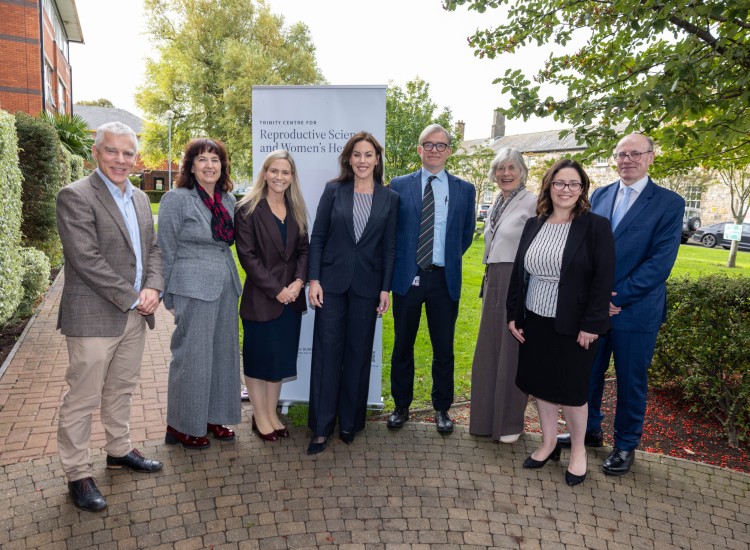
The Centre’s objectives are organised around five integrated areas: research; shaping clinical practice and policymaking; dedicated policy brokerage and structured engagement; education and training; and public engagement and visibility. Its three principal research pillars are Translational Reproductive Science; Lifespan Reproductive Research; and Menstrual Disorders and Fertility, with inclusion, equity and access embedded across all three.
The Centre will collaborate closely with patient representatives and advocacy groups, ensuring that lived experience and patient priorities inform research priorities and engagement activities.
Women’s health and reproductive health have historically been under-represented in research, contributing to important evidence gaps, delayed diagnosis and inconsistent care pathways. Conditions including polyendocrine metabolic ovarian syndrome (PMOS), endometriosis, infertility, menopause-related health needs and abnormal uterine bleeding carry substantial personal, societal and economic burdens. Male reproductive health and subfertility are also comparatively underexplored, despite their importance to infertility and family health.
The Centre was officially launched at the Trinity Translational Medicine Institute at St James’s Hospital.
Minister Carroll MacNeill said:
“We know that, for sustained improvements in reproductive and women’s health, we need to build research infrastructure to generate the evidence on which those services are based. I congratulate Trinity College Dublin and St James’s Hospital on their leadership in opening this centre which addresses a critical societal and medical issue. This centre will have a real impact on evidence gaps and delayed diagnosis and I look forward to continuing to engage with the centre as we - together - work to improve our health services."
Mary Day, CEO of St James’s Hospital, said:
“We are very proud to support the launch of the Trinity Centre for Reproductive Sciences and Women’s Health. It brings together an exceptional breadth of clinical, scientific and academic expertise around an area of major importance to patients. The Centre exemplifies the ambition of an Academic Health Sciences Campus: connecting research and clinical care, working collaboratively across traditional boundaries, and creating a cohesive academic focus that can translate discovery into meaningful improvements in care and outcomes.”
Dr Lisa Owens, Co-Director of TCRW, said :
“TCRW will bring together expertise across reproductive sciences and women’s health to create a more connected and collaborative research community. The measure of our success will not simply be publications or research grants; ultimately, it will be improved evidence, earlier diagnosis, better treatments, more equitable healthcare and better outcomes for people affected by reproductive health conditions.”
Professor Padraic Fallon, Dean of the Faculty of Health Sciences at Trinity College Dublin, said:
“This is the first dedicated transdisciplinary centre of its kind at Trinity and represents a significant milestone. It will connect and coordinate the considerable activity already underway across the University and its clinical partners, strengthen national and international collaborations, increase our competitiveness for major research funding, and enhance the visibility and impact of Trinity’s research in this field.”
ENDS
Media Contact:
Catherine O’Mahony | Media Relations | catherine.omahony@tcd.ie