Professor Tomás Ryan among four researchers to secure €10.5 million European Research Council Synergy Grant
Posted on: 12 November 2026
Prof. Ryan, from Trinity’s School of Biochemistry and Immunology and Trinity College Institute of Neuroscience, is among a four-strong, international team of researchers to have secured the €10.5 million Synergy Grant that seeks to discover how memory may control the immune system.
Crucially, this frontier neuroimmunology project is developmental and studies how early life experiences shape these processes in both mice and humans.
“Brains are not built, they are grown”, as Prof. Ryan notes. “In order to understand memory, we need to focus on early life experiences”.
Additionally, the team aims to determine the effect of chronic inflammation during pregnancy on immune memory function and its impact(s) on altered neural development.
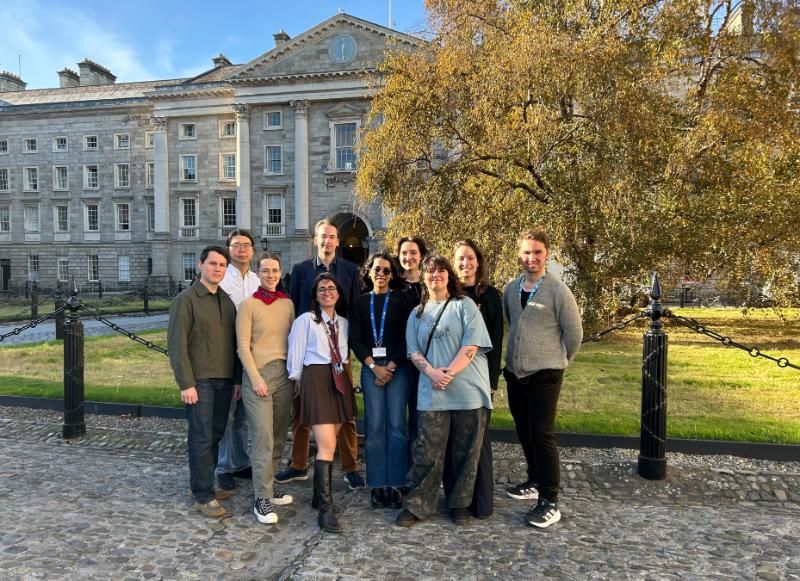 Prof. Tomás Ryan and his Trinity lab team in Trinity's Front Square.
Prof. Ryan said: “We often think of the brain and the immune system as two separate systems, but in reality they are in constant communication. What we are interested in understanding is how the brain remembers past immune experiences, stores these experiences as ‘engrams’, and how those memories might influence the body’s ability to respond to future situations.”
“We already know that the immune system can influence the brain, but we understand much less about the reverse relationship: how the brain remembers immune experiences and uses that information to influence immune function. By exploring this relationship and the many connections driving it, we hope to uncover a new dimension of communication between the brain and the body.”
“Ultimately, by identifying the mechanisms involved, we hope to contribute to a better understanding of lifelong health, disease susceptibility and the importance of early development.”
This particular Synergy grant will be led from Trinity with Prof. Ryan as coordinating PI. He will work with colleagues Prof. Staci Bilbo (Duke University, USA), Prof. Claudia Buss (Charité – Universitätsmedizin Berlin, Germany), and Prof. Markus-Werkle Bergner (Max Planck Institute for Human Development and University of Bremen, Germany) on their project.
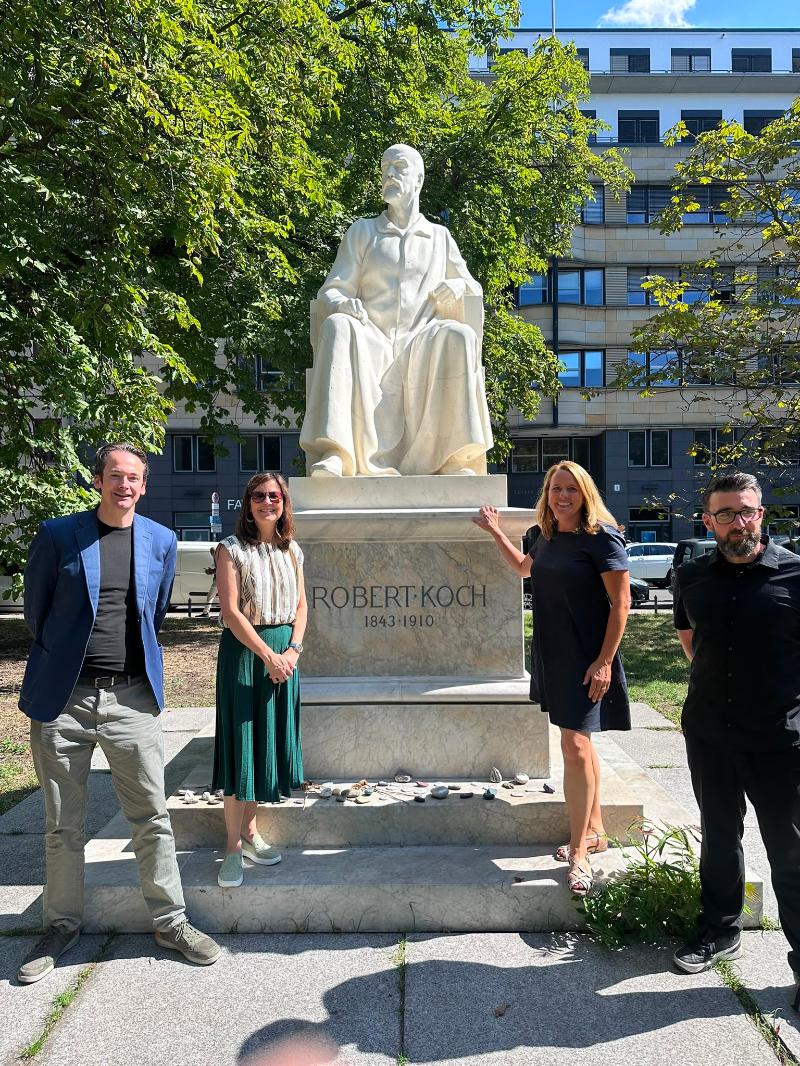 From left to right are Tomás Ryan (Trinity), Staci Bilbo (Duke University, USA), Claudia Buss (Charité – Universitätsmedizin Berlin, Germany), and Markus-Werkle Bergner (Max Planck Institute for Human Development and University of Bremen, Germany).
ERC Synergy Grants support projects like these that are too ambitious to be carried out by one researcher alone. Instead, a team of up to four Principal investigators combine their skills and resources to tackle major research challenges.
These projects are often interdisciplinary in nature, bringing together those from different countries, institutions, fields, and career stages. This enables the Synergy teams to examine a problem from many different angles and come up with innovative approaches.
Ryan and Werkle-Bergner are primarily experts in the neuroscience of memory, while Bilbo and Buss are leaders in the neuroimmunology of inflammation, particular across pregnancy. The Ryan and Bilbo labs work with mouse models, whilst the Buss and Werkle-Bergner groups focus on human experiments.
The complementarity of expertise, in combination with a novel shared vision that goes beyond the portfolio all four research groups, is what made this Synergy possible.
This year only 48 Synergy projects were funded out of 957 proposals across Europe, highlighting the competitive nature of the process.
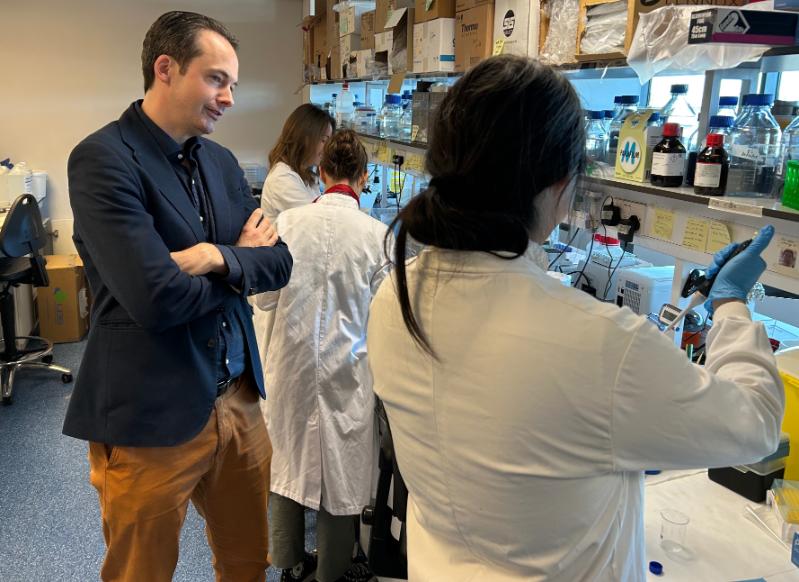 Prof. Tomás Ryan with some of his lab team in the Trinity Biomedical Sciences Institute, where he is based.
For more information on Trinity's past and present ERC projects, see the ERC Awards at Trinity webpage.
Prof. Sinéad Ryan, Dean of Research at Trinity, added: “I warmly congratulate Tomás Ryan on his success in securing such a prestigious and competitive ERC grant, his second ERC award, this time through the Synergy competition. It is evidence of the exceptional research talent that we have fostered here at Trinity, and a testament to all the work behind the scenes that went into conceiving and developing the project, as well as the teamwork between these four world-leading researchers.”
Dr Linda Doyle, Provost of Trinity, said: “The Immune Memory research project has fantastic potential to deepen our understanding of the link between the brain, memory and immunity. It is a great example of the fascinating and impactful research being undertaken in Trinity. I am delighted to offer my congratulations to Tomás and his fellow investigators on securing this ERC Synergy Grant."
“The award demonstrates the excellence of the research led by Tomás and his team, and also the strength of their international research partnerships. Scientific breakthroughs increasingly depend on the connections we foster across disciplines, institutions and national boundaries. This ERC Synergy Grant is a recognition not only of the quality of the research itself, but also of the power of collaborative networks to advance knowledge and drive discovery.”
Placing this award in the context of the Irish ecosystem, Prof. Tomás Ryan added: “Europe’s biggest scientific breakthroughs are built on foundations laid at home. Every Synergy grant won by an Irish team is a sign of what our researchers can achieve, but also a reminder of how much more we could achieve with sustained national investment in basic research."
“If Ireland wants to be scientifically competitive, we must invest in the ideas that will shape the next generation of discovery. Ireland’s place in European science is earned in its laboratories long before the grant is awarded. If we want to lead, we must fund the basic research that makes leadership possible.”
What is the potential impact of this research?
This research could transform our understanding of how the brain and immune system communicate, revealing how early-life immune experiences shape brain development, immune function and lifelong health. By identifying the brain circuits responsible for storing and acting on immune memories, the work could uncover new mechanisms underlying susceptibility to disease and cognitive differences, ultimately opening new avenues for understanding and potentially improving health across the lifespan.
Media Contact:
Thomas Deane | Media Relations | deaneth@tcd.ie | +353 1 896 4685