Trinity celebrates Welsh-Irish culture with loan of 11th century manuscript for landmark exhibition on the Normans
Posted on: 19 November 2026
An 11th century Welsh illuminated manuscript, the Ricemarch Psalter, has gone on loan to the National Library of Wales for a landmark international exhibition ‘Normans: The Welsh Perspective’. Trinity College Dublin has been custodian of the precious manuscript since the 17th century.
The exhibition, which opens on November 21st, forms part of an international partnership between cultural institutions in Wales, Ireland, England and France, contributing to a wider programme of European activities marking the Norman Conquest and the millennium of the birth of William the Conqueror in 2027.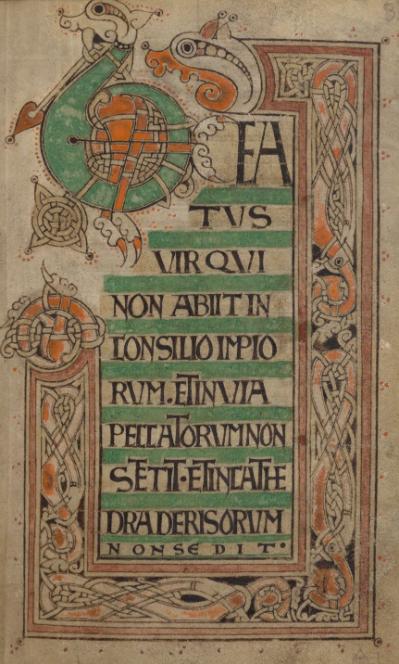 From Llanbadarn to Dublin, Cambridge, London and Normandy, the project highlights the cultural and intellectual connections that shaped medieval Europe.
For the first time in almost a thousand years, three exceptional manuscripts created in the famous Welsh Llanbadarn Fawr scriptorium will be reunited, and displayed alongside other medieval manuscripts and treasures which contextualise their history. Together, they tell the story of a centre of learning of international importance that connected Wales to the intellectual networks of medieval Europe.
The exhibition will feature the historic reunion of:
- The Ricemarch Psalter, Trinity College Dublin.
- St Augustine's De Trinitate, Corpus Christi College, Cambridge.
- Macrobius' Commentarii in Somnium Scipionis, British Library, London
The Ricemarch Psalter is a manuscript of a Book of Psalms that was created in the scriptorium of Llanbadarn Fawr near Aberystwyth, dated around 1079. Llanbadarn was an important centre of learning and book-making in the Middle Ages. The book which is handwritten in Latin was used as a record of saints and a calendar of Christian holidays. It is one of two 11thcentury manuscripts from Wales still in existence both of which originated in the Llanbadarn Fawr. The other is St Augustine's De Trinitate.
The Ricemarch Psalter was written by Ithael, a scribe who trained at Llanbadarn, and it was illustrated by Ieuan ap Sulien. Ithael presented the Psalter to his brother Ricemarch who was a resident of the school at St David’s. Their father, Sulien who would eventually become the Bishop of St. David's in 1072, had previously lived in Ireland for 13 years for the purpose of study.
The beautifully decorated manuscript shows the influence of two Celtic countries. The script is a finely realised Welsh version of Insular Miniscule − a medieval script system originating in Ireland that spread to England and continental Europe under the influence of Irish Christianity. All of the manuscript’s 150 psalms begins with a colourful Celtic interlace with animals.
The Ricemarch Psalter sits with other important early medieval manuscripts of a similar date such as the Book of Kells and the Book of Durrow. It formed part of the scholar and church leader, James Ussher’s Library collection, one of the foundational collections of the Library of Trinity College Dublin.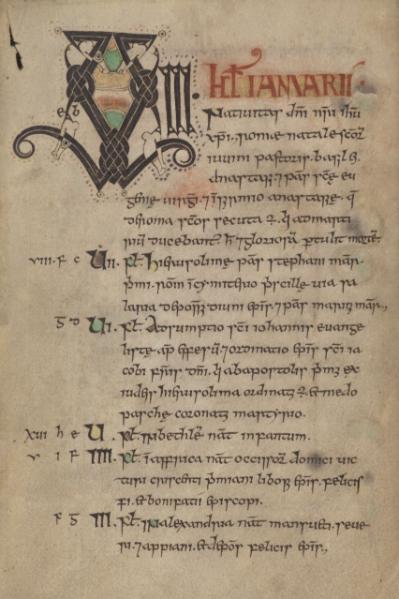 The manuscript has been fully digitised making it accessible to researchers and the general public around the world. Its digitisation forms part of the Virtual Trinity Library programme which is opening up the unique and distinct collections of the Library of Trinity College Dublin, catalysing research and safeguarding the treasures of the Library of Trinity College Dublin for generations to come. This ambitious, multi-year initiative is to catalogue, conserve, digitise and research these unique collections of national importance making them accessible to a global audience, from schoolchildren to scholars.
Manuscripts Curator at the Library of Trinity College Dublin, Estelle Gittins said: “The Ricemarch Psalter is a jewel of a book, packed full of intricately drawn interlaced animal forms exhibiting Irish influence, like the goat on display with elegantly curving horns and perfectly symmetrical beard, we can just imagine the artist taking inspiration from the animals of the local landscape and immortalising them in decoration which has survived for nearly 1000 years.”
The Librarian and College Archivist at the Library of Trinity College Dublin, Helen Shenton said: “The exquisitely illuminated Ricemarch Psalter is at the heart of western Europe’s Celtic heritage. Through this partnership with the National Library of Wales, people will be able to see it reunited for the first time alongside major medieval manuscripts, marking the impact of the Normans in Wales and across Europe. This exhibition exemplifies Ireland’s partnership with Wales, and the Irish and UK Government’s cultural cooperation.”
The Library's Chief Executive, National Library of Wales, Rhodri Llwyd Morgan, said: "This is one of the most significant medieval exhibitions ever presented by the National Library of Wales. It brings international treasures back to Wales and allows us to tell the story of the Norman Conquest from a perspective that has too often been overlooked. It's a chance to see that this isn't just a story of conquest, but a story of resilience, creativity, and learning. Significantly, these manuscripts, created in a time of conflict and major political change, are being reunited today through collaboration between libraries and cultural institutions, showing the power of partnership in protecting and sharing our common heritage."
'Normans: The Welsh Perspective' will run at the National Library of Wales from 21 November 2026 to 20 March 2027. See here for more information.
Media Contact:
Fiona Tyrrell | Media Relations | tyrrellf@tcd.ie | +353 1 896 3551