
Trinity experts call for public health interventions for head injuries in sport
Posted on: 29 April 2026
Professor Colin Doherty, Head of the School of Medicine at Trinity College Dublin, Prof Matthew Campbell of Trinity’s Smurfit Institute of Genetics, and Andrew Dunne, a former professional rugby union player, all addressed the Joint Committee today.
Experts from Trinity College Dublin today called for a move from self-regulation by sporting bodies to government-led public health interventions for head injuries in sport, including strategies for prevention, mitigation, monitoring and long-term risk management.
A meeting of the Oireachtas Joint Committee on Arts, Media, Communications and Sport on Wednesday April 29th 2026 heard their call for the establishment of a national clinical and policy group to develop evidence-based guidance across all sports, as well as a publicly funded National Concussion Centre, and other measures.
“Our purpose here is not to diminish sport, but to ensure that it can continue to thrive safely for future generations,” Professor Colin Doherty, Head of the School of Medicine at Trinity College Dublin (below centre), told the committee.
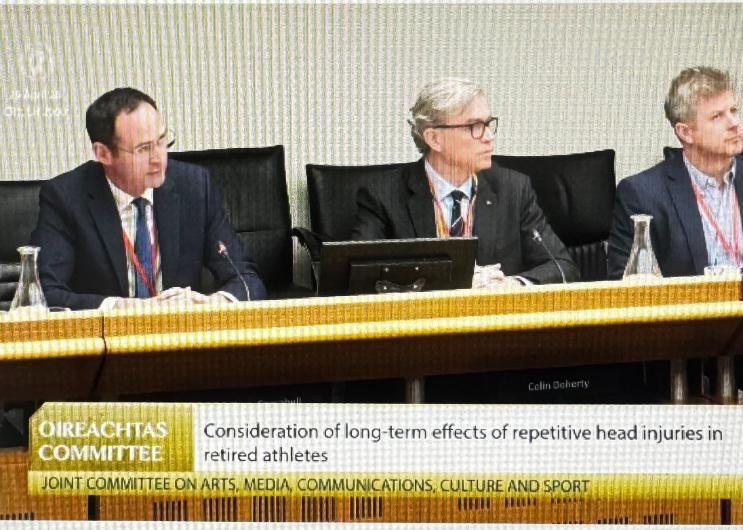
Also speaking at today’s meeting were Professor Matthew Campbell of Trinity’s Smurfit Institute of Genetics (above on left), and Andrew Dunne, a former professional rugby union player.
They urged the Committee to consider
- Establishing a national, multi-stakeholder clinical and policy group to develop consistent, evidence-based guidance across all sports;
- A publicly funded National Concussion Centre for expert advice and guidance to be continually delivered and updated;
- surveillance system (register) to monitor concussion and head impact exposure over time;
- A focus on prevention, particularly in youth sport and training environments, where exposure can potentially be reduced without compromising the integrity of the game;
- Sustained investment in research to better understand risk, identify vulnerable individuals, and develop effective interventions.
Recent research from Trinity and St James’s provided fresh insights as to what may be happening in the brains of athletes exposed to repetitive head impacts. Researchers identified that a sizable proportion of retired athletes from certain sports show persistent disruption of the blood-brain barrier, a critical protective system. The degree of this disruption correlates with measurable cognitive decline, particularly in memory function. For the first time, this research showed that in some retired athletes with a history of repetitive head injuries, the blood brain barrier remains “leaky” years after they have left the field.
Prof. Doherty said: “This is not a transient injury. It represents a chronic condition ... Some former athletes present with symptoms consistent with what is termed Traumatic Encephalopathy Syndrome, including cognitive impairment, mood disturbance, and behavioural changes. There have also been well documented cases, some involving Irish athletes, who have died with full blown dementia also known as Chronic Traumatic Encephalopathy or CTE.”
“This issue should no longer be viewed solely as a matter for individual sporting organisations,” Doherty will say. “In fact, it is unfair to put this burden on these organisations to deal with it alone. It should be recognised as a public health issue requiring coordinated national leadership.”
ENDS
Media Contact:
Catherine O’Mahony | Media Relations | catherine.omahony@tcd.ie