Trinity medtech startup NOVAP Medical wins IDEATE 2026; sets sights on tackling ventilator-associated pneumonia
Posted on: 20 August 2026
The team are now building a clear pathway towards commercialisation and hope to secure more funding in the near future to test and ultimately bring their innovation into hospitals where it can improve patient care in the coming years.
The team of Trinity researchers with frontline ICU experience are developing a new medical innovation to tackle ventilator-associated pneumonia (VAP), which is one of the most common, life-threatening infections contracted in ICUs across the globe.
NOVAP Medical recently won the 2026 Ideate Ireland entrepreneurship competition, emerging as the overall winner from a field of 10 finalist teams thanks to the potential of their pioneering technology.
IDEATE Ireland, which has been running for ten years, supports nascent startups based around good ideas emerging from research and other networks at higher education institutions in Ireland. As well as connecting teams with venture capitalists and entrepreneurs, winners receive funding, mentoring and other supports to support the path to commercialisation.
The NOVAP Medical team focuses on VAP, which affects up to 25% of patients who undergo mechanical ventilation, contributing substantially to increased morbidity, longer ICU stays, prolonged antibiotic therapy, and elevated healthcare costs. Because antimicrobial resistance is on the rise and critical care resources are constrained, the burden of VAP has moved far beyond a clinical concern; it now presents a major economic and health issue for critically ill patients.
VAP is driven by harmful bacteria and other bugs moving into the normally sterile lower respiratory tract. One of the principal risk factors is the presence of the endotracheal tube (ETT) itself, which bypasses the upper airway’s natural defence mechanisms, unfortunately allowing direct access for microbes. The ETT serves not only as a conduit for airflow but also as a surface for microbial colonisation.
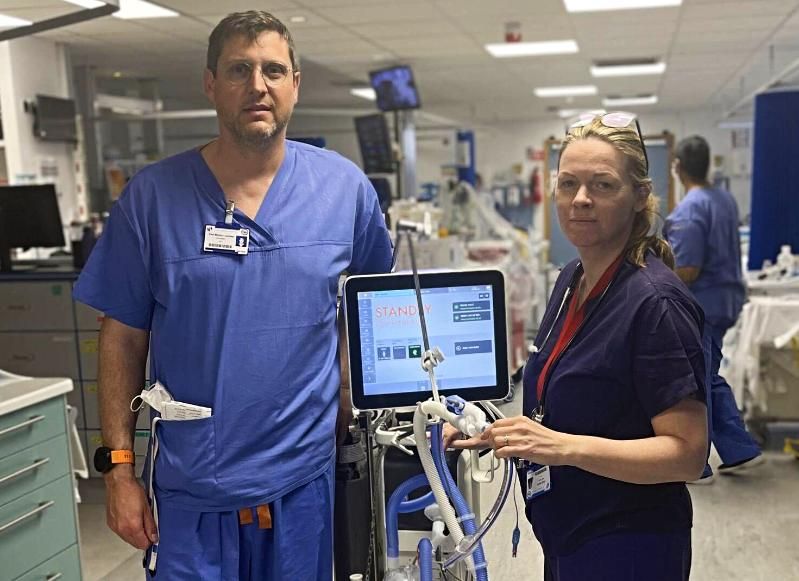
Trinity's Prof. Ignacio Martin-Loeches and Emily Naylor Jones.
Emily Naylor Jones, Co-Founder and Commercial Lead of the NOVAP Medical team, from Trinity’s School of Engineering, says: “Within hours of intubation, bacteria begin to stick to the internal surface of the tube, over time creating ‘biofilms’ of whole microbial communities.
"These biofilms prevent the host’s immune system from responding properly and limit the ability of antimicrobials to attack the bacteria, thus acting as persistent reservoirs for pathogen dissemination into the lungs. The biofilms continuously seed infections into the lower airway and current ETT technologies are relatively ineffective.
“Our innovation tackles this challenge at its source. Rather than trying to prevent biofilm from forming, we have developed a mechanically active endotracheal tube designed to remove it before it can lead to infection. The device has been designed to integrate into existing ICU practice, with the aim of making it simple to use and avoiding significant changes to existing workflows.
"We aim to demonstrate these advantages through our preclinical development and, ultimately, clinical evaluation.”
The team behind NOVAP Medical is uniquely placed to address those requirements as it brings together health care professionals with extensive ICU experience and a bioengineer who has worked in translating medical devices before.
Along with Emily Naylor Jones, who has 18 years of experience as an ICU nurse, Prof. Ignacio Martin-Loeches, Professor of Medicine in Trinity’s School of Medicine and Consultant in Intensive Care Medicine at St. James’s Hospital, is joined by Prof. Brooke Tornifoglio, Assistant Professor in Trinity’s School of Engineering.
“The idea for NOVAP came from our frontline experience in the ICU,” adds Emily Naylor Jones.
“We have seen first-hand the challenges of ventilator-associated pneumonia and recognise that, despite existing prevention measures, there is a major gap in endotracheal tube technology. Building on Professor Ignacio Martin-Loeches' research in ventilator-associated pneumonia, we began by examining the limitations of current tubes and exploring innovative design approaches that could prevent biofilm from forming in a way that would be practical for everyday clinical use and scalable for widespread adoption.
“Ultimately, what motivates us is knowing that preventing avoidable ICU infections can make a huge difference to a patient’s recovery and to their family. A solution that improves outcomes while fitting into existing clinical practice could make a huge impact.”
The team is currently in the second year of Enterprise Ireland Commercialisation Fund support and is building a clear pathway towards commercialisation. They hope to secure more funding in the near future and bring NOVAP into hospitals where it can improve patient care in the coming years.
“Winning IDEATE Ireland 2026 is a real endorsement of what we’re building at NOVAP,” added Emily Naylor Jones.
“Participating in the programme taught us that we’re solving a problem the market recognises, and it’s given us the clarity and confidence to take NOVAP to its next stage.”