Champion boxer Katie Taylor receives honorary degree from Trinity
Posted on: 19 June 2026
Katie Taylor, Sharon Shannon, civil rights lawyer Baroness Helena Kennedy and Sister Helen Prejean, the anti-death penalty activist who was depicted by Susan Sarandon in the film version of ‘Dead Man Walking’, were all honoured, as was Colm Tóibín, writer of some of the most successful Irish-authored books of the 21st century.
Five outstanding individuals, including champion boxer Katie Taylor and traditional musician Sharon Shannon, were conferred today with honorary degrees of Trinity College Dublin for their exceptional contributions to a wide variety of fields.
The civil rights lawyer Baroness Helena Kennedy and Sister Helen Prejean, the anti-death penalty activist who was depicted by Susan Sarandon in the film version of ‘Dead Man Walking’, were also honoured, as was Colm Tóibín, writer of some of the most successful Irish-authored books of the 21st century.
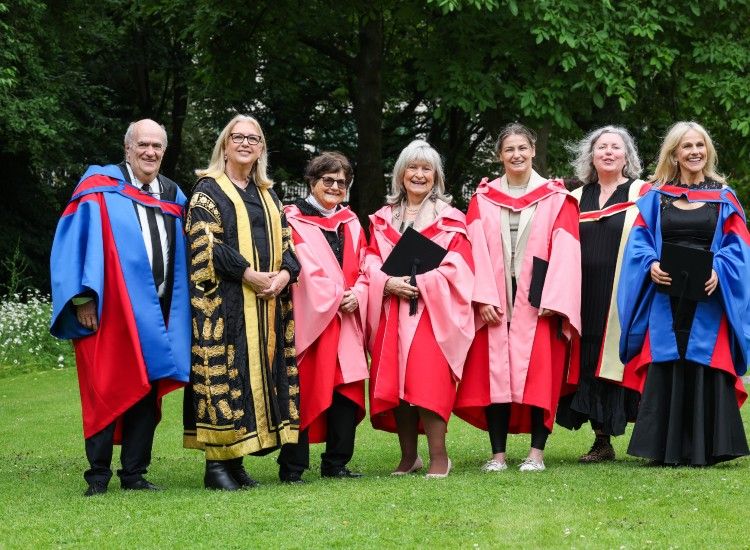
All five received Trinity’s highest honour from Chancellor Dr Mary McAleese at a ceremony conducted in Latin in the historic Public Theatre.
Earlier on Friday Katie Taylor took questions from an audience of students and staff, including members of the Boxing Club and students on the Trinity Access Programme, at a special ‘Morning with Katie Taylor’ event.
Further details on the awardees as follows:
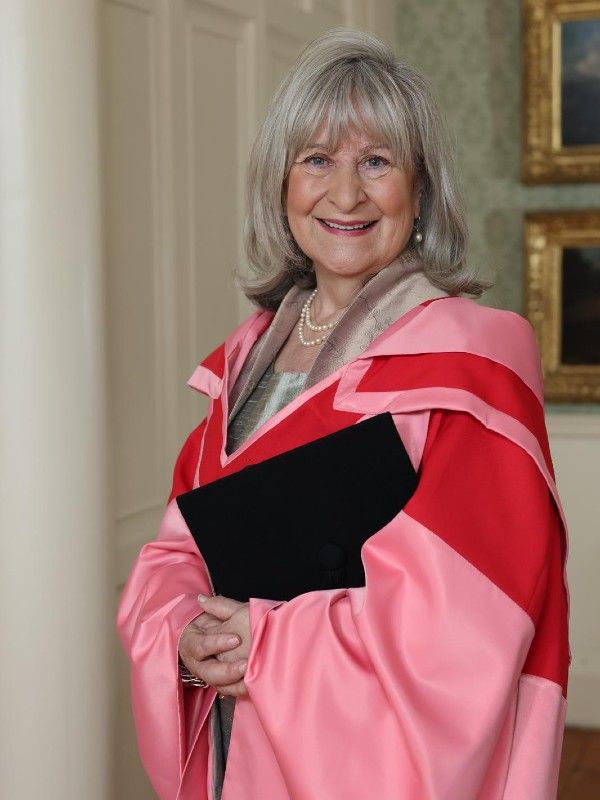
Baroness Helena Kennedy (Doctor in Laws)
Baroness Helena Kennedy has had an extraordinary impact on law, politics, and policy in
the UK and beyond. She is a barrister (Bencher of Gray’s Inns) in which context she represented one of the Guildford Four in their pursuit of justice and, more generally has dealt with many of the most prominent criminal and human rights law cases in the UK in the last fifty years. She is also a broadcaster; member of the House of Lords; the President of ‘Justice’ the law reform think-tank; Director of the International Bar Association’s Institute of Human Rights and Chair of the High-Level Panel of Legal Experts on Media Freedom; President of the School of Oriental and African Studies (SOAS); and member of the external advisory Council of the World Bank Institute.
Formerly, she was Chancellor of Oxford Brookes University; Chancellor of Sheffield Hallam University; Principal of Mansfield College Oxford; Chair of the British Council; Chair of the London International Festival of Theatre; and Chair of the Committee on Widening Participation in Further Education.
As a lawyer, she appeared in some of the most important criminal and judicial review cases of the last fifty years. In addition, she was one of the most prominent voices calling for equality for women practicing at the bar. It was her work that led to changes in policy in the Lord Chancellor’s Department and development of codes of practice at the bar. For her work in this regard, she received the Times Newspaper’s Lifetime Achievement Award in 1999.
As a member of the House of Lords, she was the most prominent voice arguing against encroachments on the right to jury trial. She was a founding member of Charter 88, the constitutional reform group that has called for a written constitution in Britain, a bill of rights and electoral, parliamentary and judicial reform – work that led directly to incorporation of the European Convention on Human Rights in UK law.
As an educator, she was a commissioner on the National Commission for Education and Chair of the Further Education Commission into Widening Participation, which produced the seminal report, Learning Works. In recognition of her work, the sector created the Helena Kennedy Foundation which provides bursaries to bring the most disadvantaged in society into higher education.
“Who else do you know who can, alongside her day job, chair the British Council, direct the Human Rights Institute, and singlehandedly rescue refugees from Afghanistan?” said the Public Orator Anna Chahoud in a tribute to Helena Kennedy (translated from Latin).
“Her energy and optimism are rooted in empathy for humanity and in faith in the law, whose rule is “the need to protect the humanity of each and every one of us.”
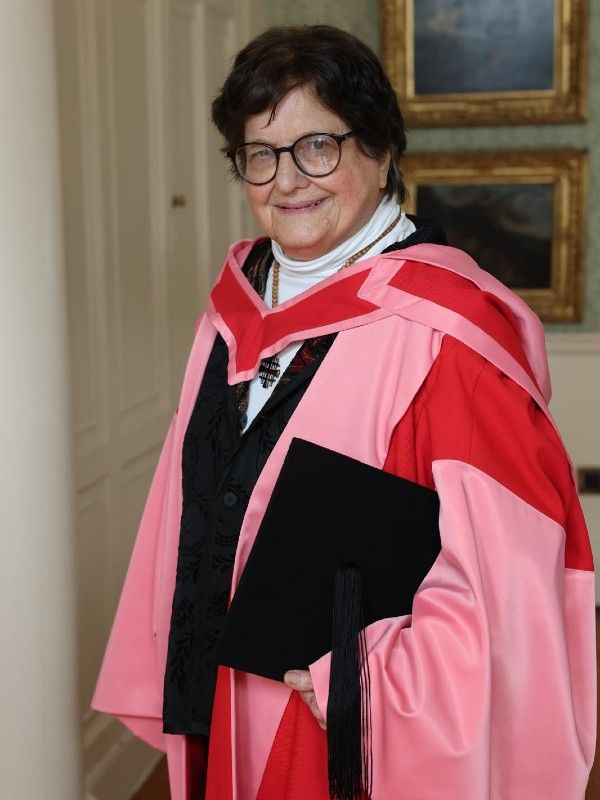
Sister Helen Prejean (Doctor in Laws)
Sister Helen Prejean is one of the most influential people in the last fifty years working in opposition to the death penalty and the promotion of the interests and dignity of prisoners. Her work in this area began in 1982 when she was asked to visit, on death row, a man named Elmo Patrick Sonnier in New Orleans who had been convicted of murder and had been sentenced to death. She became his spiritual adviser in the months prior to his execution and this led to her rooted and activist opposition to the death penalty (and at the same time she set up an organisation called Survive dedicated to providing counselling and care for the families of victims of violence.
Sister Helen, taking seriously the words of Jesus to visit those who were in prison, took on a broader role of visiting persons on death row and famously she published (in 1993) her accounts of this experience in her book Dead Man Walking, which was turned into a famous, award winning and highly influential film and latterly a play and an opera. Sister Helen took the view that the death penalty has a toxifying impact on all those involved – the prisoners,
obviously, but also prisoner officers, lawyers, and the families both of the condemned prisoner and their victims. Further, she has consistently pointed to the huge risk of innocent people being condemned to death – an issue she dealt with in another book The Death of Innocents: An Eyewitness Account of Wrongful Executions.
Since Dead Man Walking, Sister Helen has become a global and national figurehead for opposition to the Death Penalty. She formed the ‘Moratorium Campaign’ aimed at introducing a moratorium against the application of the death penalty in America. She is in constant demand as a speaker throughout the world in relation to this issue.
She has pointed out the connection between the death penalty and poverty in the United States, and she has focused more generally on the humanity and, consequently, the dignity of all – including those who are sentenced to die or are in prison. As she so memorably put it, ‘People are more than the worst thing they have ever done in their lives.’
She has received multiple awards, including the Laetare Medal by the University of Notre Dame (the oldest and most prestigious award for American Catholics), the Pacem in Terris award and an honorary doctorate from NUIG. She has been nominated for the Nobel Peace Prize.
The Public Orator Anna Chahoud said of Helen Prejean: “For over fifty years she has campaigned against the death penalty, in an uncompromising defence of life and justice. Her unforgettable book Dead Man Walking was the moving narrative of that first man whose life was taken before her, and that story reached every corner of the world through its powerful cinematic dramatisation.”
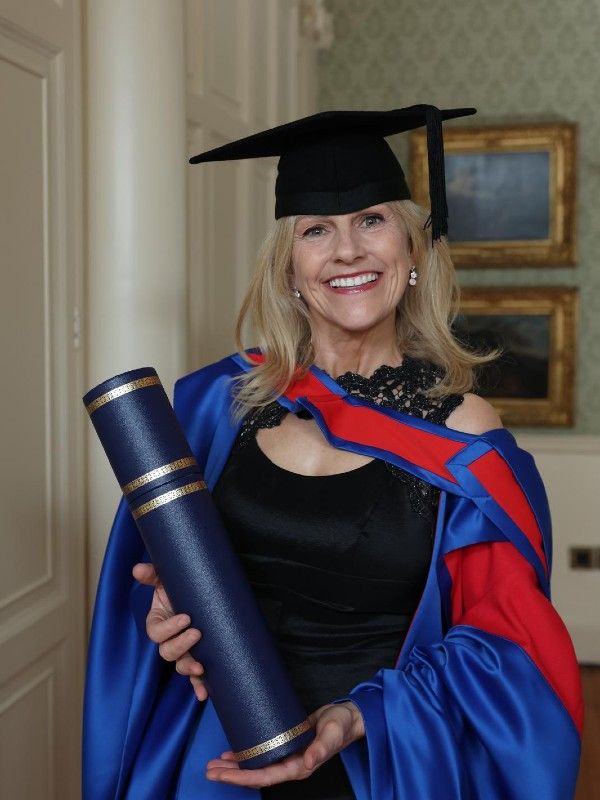
Sharon Shannon (Doctor in Letters)
Sharon Shannon is an Irish traditional musician, an accordionist, fiddler, and exponent
of the tin whistle and melodeon. She is nominated for this award for the manner in
which she has contributed to the reshaping of and the public appreciation for Irish
traditional music. She has made the genre more accessible and has contributed to its widespread popularity.
Over her 40-year career, she has released 20 albums as well as countless DVDs and
live concert recordings. Her first album, in 1991 (Sharon Shannon) is the bestselling album of Irish traditional music ever released in this country. She gained further huge exposure as her work was featured on the phenomenon that was the A Woman’s Heart album. She has had multiple famous collaborations (with, amongst others, Christy Moore, Donal Lunny (in one of her most famous pieces – Cavan Potholes), Mundy, Kirsty MacColl, Bono, Willie Nelson, Johnny Depp, Sinead O’Connor, Belinda Carlisle, John Prine, Paul Brady and, very famously, Steve Earle in their recording of Galway Girl). In particular, she had an extraordinary working
and performing relationship with the late Shane MacGowan. She is hugely supportive of other musicians; especially up and coming or emerging musicians, and she will always seek to support or collaborate with such musicians if this is in their interests.
Her solo career is equally prolific. She has had multi-platinum album sales. Her album Galway Girl went four times platinum in Ireland, and the title track won her the Meteor Award two years running for most downloaded song. She herself in 2009 won the Meteor Lifetime Achievement Award, the youngest ever recipient of this award. She has toured prolifically in Ireland but also in America, Europe, Africa, Australia, New Zealand, Saudi Arabia, Japan, and China. She has headlined at the Kennedy Centre in Washington DC and at the Wembley Arena.
She has played for (amongst others), US Presidents Clinton and Obama and the last three Irish presidents as well as Lech Walesa in Poland. She has been given an honorary doctorate by NUIG. Former President Michael D Higgins summed her up as ‘a national treasure.’
Dubbing Sharon Shannon a “living legend”, Public Orator Anna Chahoud said: “As the river grows crossing county borders, for fifty years this musician has remained faithful to the Irish traditions while crossing generic boundaries – rock and reggae, to name but a few – and collaborating with all prominent musicians in Ireland, always showing her unique skills with the accordion ... She has done an immense service to her country and to its cultural heritage, for the best thing that one can do with heritage is to make it alive again.
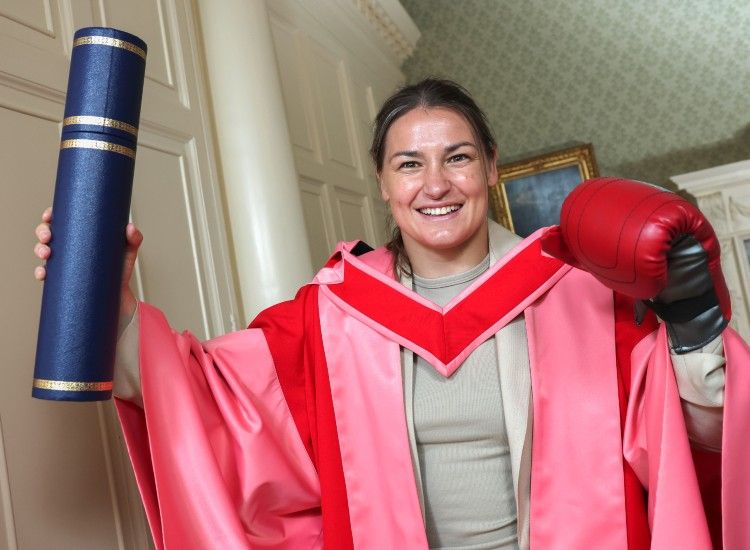
Katie Taylor (Doctor in Laws)
Katie Taylor has a legitimate claim to be Ireland’s greatest ever sporting champion. As an amateur, she won five consecutive gold medals at the Women’s World Championships, gold six times at the European Championships and gold five times at the European Union Championships. She won gold at the Summer Olympic Games in 2012 (and but for her efforts, women’s boxing would not even have been recognised as an Olympic sport) where she also carried the Irish flag at the opening ceremony. She turned professional in 2016, and her professional career has been one of unmatched success. She became WBA lightweight champion in July 2017 and followed this up by becoming IBF lightweight champion in 2018 and WBO and WBC lightweight champion in 2019. As well as defending her belts on multiple occasions, at this point she also moved up to super-lightweight. In 2019 she won the WBO super-lightweight belt and, in 2023 she challenged Chantelle Cameron, the holder of the other belts, to a contest to unify the belts. Having lost earlier in the year, she won her rematch in November 2023, which means she is the undisputed world super-lightweight champion.
In addition, she has played a formative role in enhancing women’s sport and especially women boxing both in Ireland and around the world. World Champion Chantelle Cameron, prior to her fight with Katie Taylor in 2023, said that she (Cameron) would not be in the position she was in were it not for Taylor because of what the latter had done for women’s boxing. Indeed, in this regard, Taylor stands as a beacon for women’s sport in Ireland and throughout the world, and because of what she has done for women’s boxing specifically and women’s sport generally, will go down in history as one of the most important women athletes of all time.
The Public Orator Anna Chahoud praised Katie Taylor as an “unrivalled champion”: “What this woman has accomplished is an ever-lasting monument to Irish values and valour. ..
“It is to her credit that boxing obtained full recognition as a sport in Ireland, and that female boxers may aspire to the same glory and the same prizes as their male counterparts. In this, too, she is an inspiring hero. And yet she has never lost her characteristic humility.”
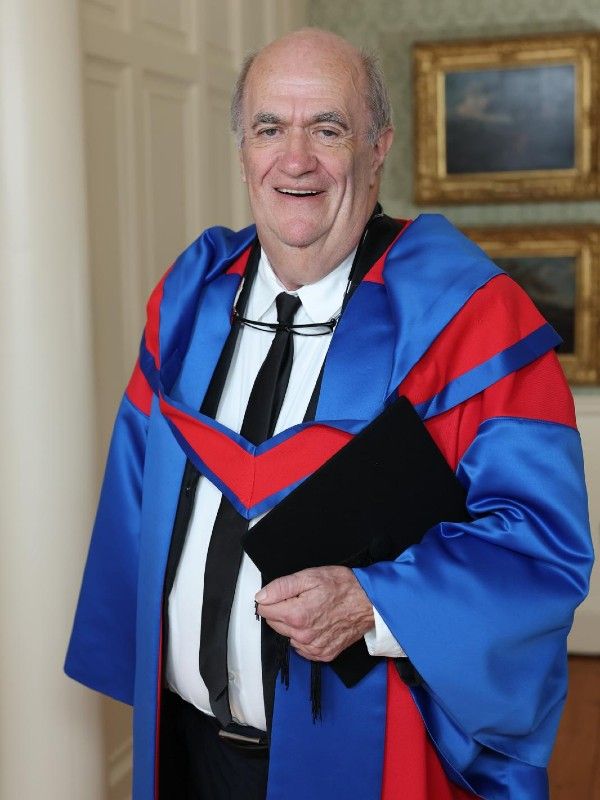
Colm Tóibín (Doctor in Letters)
Colm Tóibín is one of Ireland’s most important and prolific writers of the 21st century. He has written numerous novels and other important works that have been awarded many major literary prizes, including The South, Serpent's Tail, The Heather Blazing, The Story of the Night, The Blackwater Lightship, The Master, Brooklyn, The Testament of Mary, Nora Webster, House of Names, The Magician, and Long Island: A Novel. Tóibín has played a key role, at many important institutions around the world, in exploring creative writing, themes surrounding
Ireland and Irish identity, sexuality and more. He is the editor of the Penguin Book of Irish Fiction (1999) and many non-fiction books, including Bad Blood: A Walk Along the Irish Border (1994) and The Sign of the Cross: Travels in Catholic Europe (1994). His work has appeared in the London Review of Books, The New York Review of Books, Dublin Review, etc.
As perhaps Ireland’s most prominent living novelist, Tóibín is a central figure in Ireland’s intellectual and cultural life. His work offers intricate and complex representations of Irish society, of aspects of exile – central to the ‘Irish’ psyche, with religion and its legacies, the classical tradition in Ireland and more. His novels The Heather Blazing and The Blackwater Lightship revolve around Enniscorthy and aspects of Irish history.
He is currently the Irene and Sidney B. Silverman Professor of the Humanities, Columbia University, having previously been Professor of Creative Writing, University of Manchester; Chancellor of the University of Liverpool; Visiting Professor, Stanford University; Visiting Professor, Princeton University and Visiting Professor, University of Texas, Austin.
“Through authorship and academic leadership, he has been one of the most vocal advocates for the creative mind in our times,” said the Public Orator Anna Chahoud of Colm Tóibín. “This incomparable writer does not remain silent on the current perils posed to human creativity by Artificial Intelligence. True to himself, he is not optimistic about our chances of success. Let us give him our pledge that we will not easily trade away the gift that is unique to each of us.”
Media Contact:
Catherine O’Mahony | Media Relations | catherine.omahony@tcd.ie