
Scientists take to the skies to observe 2026 Solar Eclipse from Flying Observatory
Posted on: 10 August 2026
On 12 August a team of scientists from Ireland and Italy will take to the skies off Ireland’s west coast to observe one of nature’s most spectacular phenomena: a total solar eclipse. The mission will provide a rare opportunity to examine the Sun’s outer atmosphere, or corona, and gain new insights into how the Sun’s magnetic field shapes and influences it.
Scientists from Trinity, the Dublin Institute for Advanced Studies (DIAS), Technological University Dublin (TU Dublin), the Irish Air Corps, and Italy’s National Institute for Astrophysics (INAF) will fly an advanced solar telescope (E-CorMag) aboard an Irish Air Corps Airbus C295 aircraft to study the Sun’s atmosphere during the total solar eclipse.
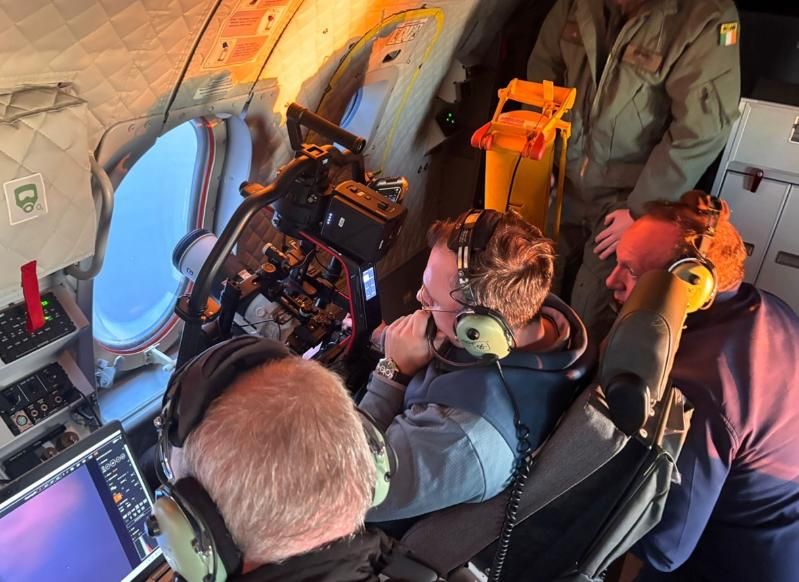
Members of the Irish Air Corps eclipse expedition from TU Dublin, TCD and DIAS on a test flight of the C295.
The next-gen E-CorMag, developed by INAF, has been built using spare flight components from two European Space Agency solar missions – Proba-3 and Solar Orbiter.
Although it sits far above the visible surface of the Sun, the corona can reach temperatures of around two million degrees Celsius: hundreds of times hotter than the surface below. And scientists still do not fully understand why this happens.
The E-CorMag has been designed to help answer that question by measuring the magnetic field of the corona. These magnetic fields are thought to play a major role in shaping the Sun’s atmosphere and releasing huge amounts of energy into space.
During a total solar eclipse, the Moon blocks out the Sun’s bright disc, briefly revealing the faint, glowing corona around it. So for just a few precious minutes, scientists get a natural window into a part of the Sun that is usually hidden from view.
During the observation, the aircraft’s bubble window will be opened, giving the telescope a clear view of the eclipsed Sun. This means the instrument can observe without looking through standard aircraft windows, which can blur or distort the images.
Flying also gives the science team a major advantage: the aircraft can be positioned to spend as much time as possible in the Moon’s shadow, while also reducing the risk of clouds blocking the view from the ground.
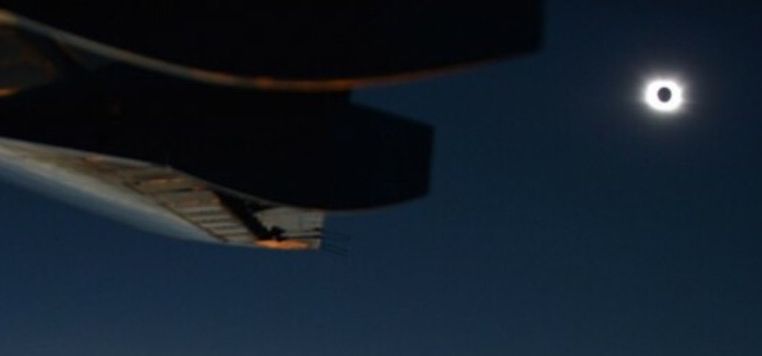
Totality from the CASA CN-235 during the 2015 solar eclipse. Credit Irish Air Corps.
The Air Corps eclipse expedition will complement measurements from space missions, including Solar Orbiter and Proba-3, providing an additional perspective on the Sun’s dynamic atmosphere. Together, these observations will contribute to a more complete understanding of the magnetic processes that govern the solar atmosphere and influence the space environment throughout the Solar System.
“The total solar eclipse gives us a unique opportunity to observe the sun’s atmosphere, called the corona, explained Joe McCauley, Senior Experimental Officer in Trinity’s School of Physics.
“Trinity is taking the lead on setting up and running the solar telescope that will be used to image the corona from an open window at 13,000 feet.”
Along with Trinity’s Joe McCauley, the Irish-Italian eclipse team includes Lucia Abbo, Gerardo Capobianco, Hervé Haudem (INAF); Ciarán O’Callaghan (TU Dublin); and Prof. Peter Gallagher (Director of DIAS Dunsink Observatory and Adjunct Professor at Trinity) and Dr Laura Hayes (DIAS, and Trinity alumna).
Media Contact:
Thomas Deane | Media Relations | deaneth@tcd.ie | +353 1 896 4685