
Elisabetta Magnanti, Trinity College Dublin and Mark Faulkner, Trinity College Dublin
Some medieval texts have barely survived. Beowulf, the Old English masterwork, exists today because of a single manuscript – one that narrowly escaped combustion in 1731. For such texts, the single manuscript is all important. The discovery of another copy would transform our understanding.
By contrast, a work like Bede’s Historia Ecclesiastica Gentis Anglorum (Ecclesiastical History of the English People) survives in more than 160 manuscripts. This volume of material has meant that scholars have tended to focus on just a few of the earliest copies, since these are most likely to preserve a text close to what Bede originally wrote. The result is that many later or less well-known manuscripts have received little detailed attention.
Now, however, computational methods that make it possible to analyse millions of words are changing that picture. Instead of relying on a narrow selection of manuscripts, we can begin to take the full breadth of the tradition into account. And that, in turn, has renewed the value of finding and studying additional copies.
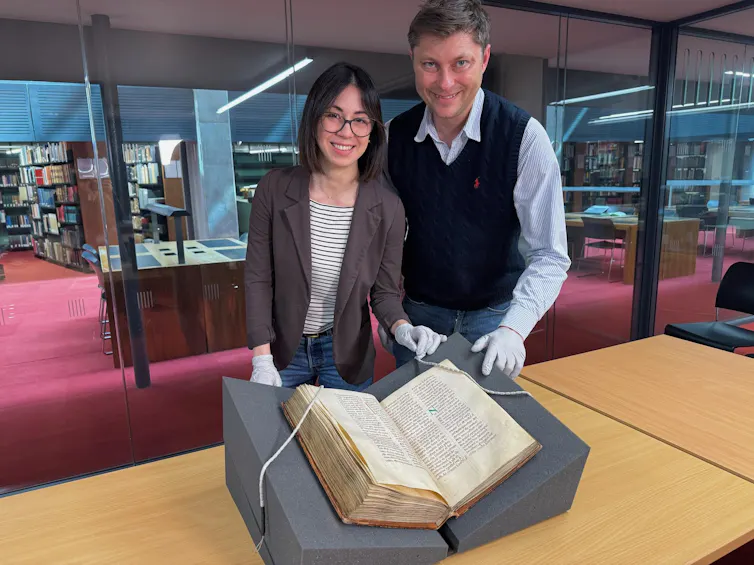
Our own work, motivated by the potential of studying many manuscripts but – for now at least – using traditional methods to locate them, has led to some unexpected discoveries, including, in Rome, a previously overlooked early copy of Bede’s Historia Ecclesiastica. Remarkably, this manuscript also preserves one of the earliest versions of Cædmon’s Hymn, the earliest known poem in English.
Lost and found
The Historia Ecclesiastica was completed in 731 by the Venerable Bede, an English monk often described as the father of English history. It proved to be one of the most influential works of the western Middle Ages. Copies circulated across Europe and the British Isles from the mid-8th to the 16th century.
One of us, Magnanti, was conducting an ongoing hunt for new manuscripts of Bede’s Historia Ecclesiastica, and discovered in the National Central Library in Rome a copy of the text made at the Abbey of Nonantola in the north of Italy, less than a century after Bede’s death in 735. The manuscript had long been presumed lost and, as a result, had never previously been examined in detail by academics.
We have just published details of this discovery in the journal Early Medieval England and its Neighbours.
Rather than being lost, the manuscript had in fact been moved from Nonantola to the church of Santa Croce in Gerusalemme in Rome by the 1650s. During the upheavals of the Napoleonic wars in the early 19th century, it was transferred again to the nearby church of San Bernardo alle Terme, from where it was subsequently stolen, along with other valuable manuscripts.
The book resurfaced in England almost two decades later, when it was acquired by Sir Thomas Phillipps, a 19th-century English book collector and self-described “velomaniac” (manuscript addict). Though Phillips died in 1872, the codex was not sold until 1948, when it entered the collection of the Swiss bibliophile Martin Bodmer. It then disappeared from view once again before being acquired by the National Central Library of Rome via the Austrian-born New York bookseller H.P. Kraus in the 1970s.
Cædmon’s Hymn

.jpg)
The newly rediscovered codex contains perhaps the fifth-oldest surviving complete copy of the Historia Ecclesiastica. As such, it is a hugely important witness to the transmission of Bede’s text to Europe in the century after he completed it.
Even more exciting, the manuscript proved to contain the third-oldest text of Cædmon’s Hymn. Cædmon’s story only survived thanks to Bede. He explains that Cædmon, an agricultural labourer working at Whitby Abbey in north Yorkshire, was at a feast when guests began to recite poems.
Embarrassed that he didn’t know anything suitable, Cædmon left for an early night. A figure then appeared to him in his dreams, telling him to sing about creation, which Cædmon miraculously did, producing his hymn – nine lines of intricately woven praise to God for creating the world.
Cædmon’s Hymn
Translated by Roy M. Liuzza
Now let us praise Heaven-Kingdom’s guardian,
the Maker’s might and his mind’s thoughts,
the work of the glory-father – of every wonder,
eternal Lord. He established a beginning.
He first shaped for men’s sons
Heaven as a roof, the holy Creator;
then middle-earth mankind’s guardian,
eternal Lord, afterwards prepared
the earth for men, the Lord almighty.
While admiring the hymn’s “beauty and dignity”, Bede baulked at including the original English in his Latin. Subsequent readers felt the absence, however, and supplied the original text, in the earliest cases adding it at the end of the Historia Ecclesiastica or in the margin. In the manuscript Magnanti discovered, the hymn appears in the actual text: the earliest such positioning by some 300 years.
Closer examination of the Rome Bede also revealed a major blunder: the scribes appear to have become confused and, between Books I and II of the Historia Ecclesiastica, switched to copying an entirely different text — a sermon on Christ’s descent into hell, prescribed for Easter Sunday preaching. This sermon had passed unrecorded in all the existing catalogues in which the manuscript is described, from 1166 to 2011.
Thanks to computational methods for transcription, collation and textual analysis, a fuller reconstruction of the manuscript tradition of Bede’s Historia Ecclesiastica may now be within reach. That makes discoveries like many the Rome manuscript has yielded just the tip of the iceberg.
Elisabetta Magnanti, Visiting Research Fellow, English, Trinity College Dublin and Mark Faulkner, Assistant Professor in Medieval Literature and Director, Trinity Centre for the Book, Trinity College Dublin
This article is republished from The Conversation under a Creative Commons license. Read the original article.