Connective Detective report highlights children’s role in shaping smarter cities
Posted on: 24 September 2026
A newly published report documents three years of a free smart city education programme that has reached approximately 800 primary school pupils across 18 schools.
The new report showing how primary school children can contribute to conversations about smart cities, connectivity and local community challenges was launched yesterday at Trinity College Dublin as part of EU Researchers’ Week.
The Connective Detective Report outlines key results from the first three years of The Connective Detective, a free smart city education programme developed by the Academy of the Near Future at Trinity College Dublin for pupils in fifth and sixth class.
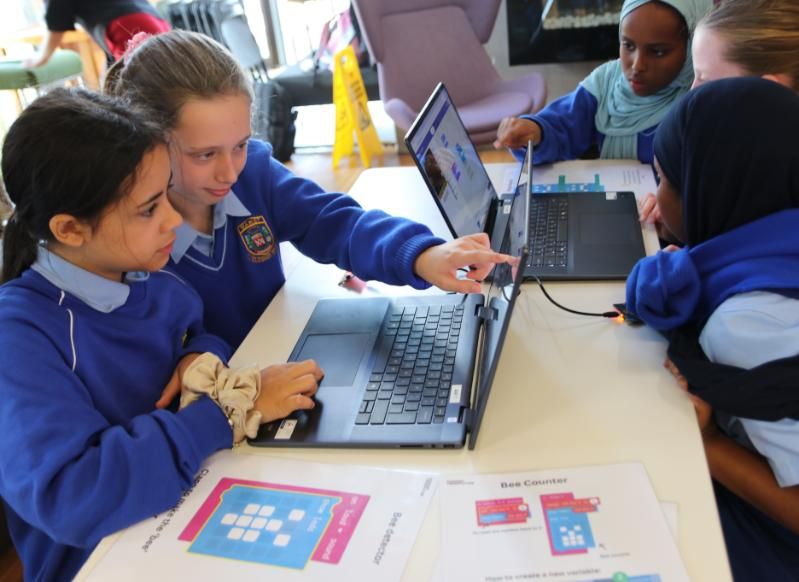
The programme uses hands-on activities to explain telecommunications, connectivity and smart city technologies, while giving children opportunities to identify problems in their communities and design their own technology-based responses.
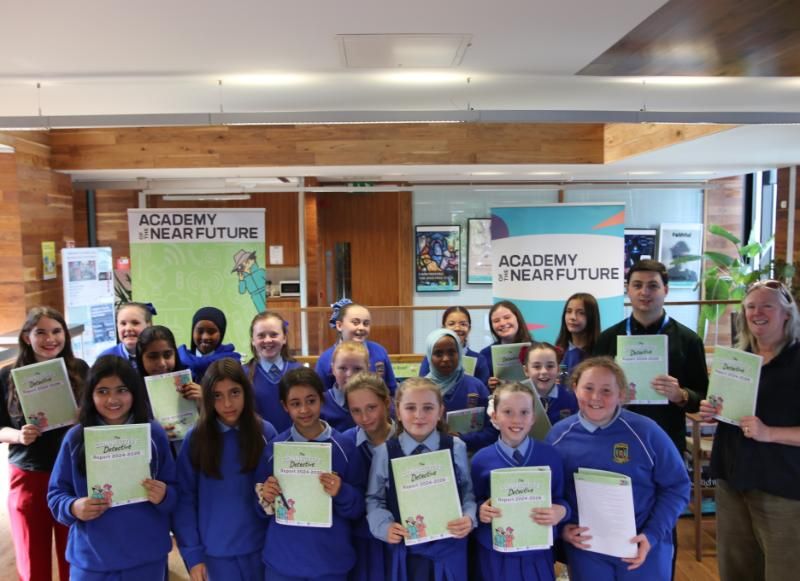
At the launch, pupils who previously took part in the programme presented their prototypes and spoke about their ideas.
One of the ideas featured at the launch responds to the decline in bee populations and the loss of trees and plants, which the pupils linked to increasing pollution. They designed a green roof filled with plants and flowers to support pollinators and improve the local environment. Their prototype also includes solar panels with integrated light sensors to generate renewable energy and a bee-counting sensor to track the pollinators visiting the roof.
Other ideas included cleaning robots and smart recycling bins, sensors to identify unsafe parking or monitor biodiversity, technology to support people experiencing homelessness, and designs for more accessible parks and youth spaces.
Report findings
- Approximately 800 pupils have participated in 121 school workshops since 2024
- 18 schools have taken part, 17 of which were DEIS schools
- Eight community workshops have reached approximately 560 participants, contributing to more than 2,500 engagements overall
- Over half of the programme’s participants were girls
- 46 per cent of student prototypes addressed pollution; 32 per cent focused on social challenges; and 22 per cent examined infrastructure
Giving children space and influence
Across four connected 90-minute workshops, pupils first built their knowledge of telecommunications and smart cities, then identified challenges in their local areas, developed prototypes and presented their ideas to classmates, researchers and city professionals.
Dr Ann Devitt, Associate Professor and Head of the School of Education at Trinity College Dublin, said: “At a time when technology is reshaping our world at an unprecedented pace, initiatives that help children understand technology, question it, influence it and use it for the common good have never been more important.”
Clara Butz, Project Lead for The Connective Detective, added: “Children are often underestimated because of their age, yet they have perspectives on their city that adults may overlook.
“Through The Connective Detective, we invited children to learn about connectivity and smart city development and, most importantly, to share their own ideas with us. By giving them the opportunity to be heard, they learned that their ideas matter and that they have a role to play in shaping the place they live which hopefully will stay with them as they grow into adults.”
The report also sets out how organisations outside Dublin can adopt the programme. A workshop bundle, facilitator training and licensing model are now available for councils, schools, research groups and industry partners interested in delivering The Connective Detective in their own areas.