
Scientists discover how to decode weather on faraway, deep-space worlds
Posted on: 15 September 2026
Scientists from Trinity have developed a powerful way to unravel the changing weather patterns on distant worlds. Using this approach, they discovered that the weather on a well-studied brown dwarf, “SIMP 0136”, previously linked with Northern Lights-like phenomena, is largely shaped by just two dominant processes: changes in temperature and the vertical structure of its clouds.
Using observations from NASA's James Webb Space Telescope (JWST), the team applied a statistical technique called Principal Component Analysis (PCA) to track how the object's light changes as it rotates. PCA simplifies complex data by identifying the main patterns that change together across the observations.
In this study, those dominant patterns are linked to weather-related changes in the brown dwarf’s atmosphere, which allowed their distinction from smaller fluctuations and random “noise” in the data.
Here, rather than relying on complex assumptions about its atmosphere, the method allowed the researchers to identify the key physical processes directly from the data. And these data showed minute changes in brightness of the planetary mass object as it rotated thanks to the exceptional sensitivity of JWST’s instruments.
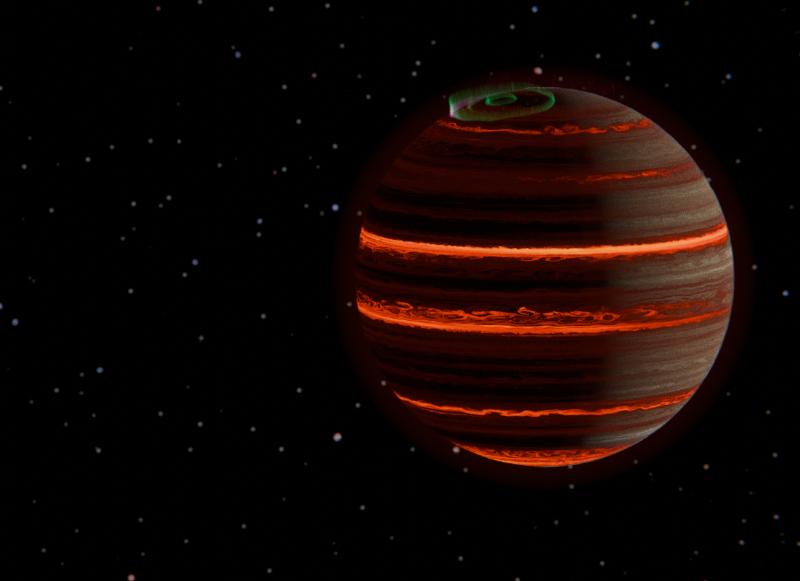 An artist’s impression of the extrasolar world, SIMP 0136 (credit Dr Evert Nasedkin).
Key insights
The vast majority of the atmospheric variability could be explained by only two dominant components, consistent with changes in temperature and the vertical structure of clouds.
This insight reveals an atmosphere whose observed changes can be explained by three recurring weather states that rotate in and out of view, producing a patchwork of hotter, thinner-cloud regions, alongside cooler areas with thicker, vertically extended clouds.
And the new research, just published in leading journal Astronomy & Astrophysics, suggests that, despite its apparent complexity, the atmosphere of SIMP 0136 behaves in a remarkably organised way, rather than reorganising randomly.
The brown dwarf is a world larger and hotter than a gas-giant planet, but not massive enough to shine like a star. Its atmosphere is dominated by huge, fast-changing cloud systems. In that sense, it is less like Earth and more like an extreme version of Jupiter, with planet-sized weather patterns constantly reshaping what astronomers see.
“We also discovered that these drivers of the weather patterns on SIMP-0136 persist over time, even as the detailed appearance of the atmosphere evolves over more than a dozen rotations,” said first author, Merle Schrader, PhD Candidate in Trinity’s School of Physics.
“In relative terms, SIMP 0136 is one of the easier brown dwarfs for us to capture high-quality data from. These data have been studied before by established methods, allowing us to compare some of the results from this new technique to what we already know about this object. The technique has also helped us develop a better understanding of what drives the weather on this faraway world and how these weather patterns interact and co-exist, but perhaps even more importantly, it shows how this approach can be further refined and applied to other, less well-known brown dwarfs in different parts of space.”
And in a seemingly incredible twist of cosmic fate, there is a personal link for Merle and her test subject, SIMP 0136, which is 20 light years from Earth. Some quick maths confirms that the very light that provided the data analysed in this paper, which was first observed by JWST in 2023, was emitted the very year that Merle was born.
“Light travels at around 300,000 km/s but, even at that speed, it took two decades to reach us, peering through the JWST lenses,” she said.
“When you consider light takes just over a second to reach the Moon after leaving Earth, that gives a sense of how far away SIMP 0136 is, and how incredible astrophysical progress has been. I think it’s amazing that we have been able to discern the intimate weather patterns of a distant world and map their interactions from our cosy little corner of the universe, when all we observe directly of these objects is a single pixel spread across the light spectrum.”
What is the potential impact of this research?
Understanding the weather on objects like SIMP 0136 is important because brown dwarfs provide a unique laboratory for studying the physics of giant exoplanet atmospheres. Unlike most exoplanets, they can be observed directly, allowing astronomers to test ideas about cloud formation, atmospheric circulation and heat transport under extreme conditions.
Prof. Johanna Vos, Associate Professor in Trinity School of Physics, said: “Our findings will transform how astronomers analyse future JWST observations. Since our approach rapidly identifies the dominant components of the atmosphere it offers an efficient first step before we begin computationally intensive modelling.
“Applying this technique to a wide range of brown dwarfs and giant exoplanets will help us better understand the diverse weather systems that shape worlds far beyond our Solar System.”
Even more broadly one of the reasons why there is interest in better understanding weather patterns on distant planets is that it tells us a lot about the atmospheres and chemical composition of those planets, which is an important step toward identifying the kinds of worlds where life could potentially exist.
This research was conducted as part of Webb’s General Observer Program 3548. This research was supported by a grant from the European Research Council (project “EXO-PEA”) and a Royal Society—Research Ireland University Research Fellowship.
The published study can be read at: https://doi.org/10.1051/0004-6361/202660109.
Media Contact:
Thomas Deane | Media Relations | deaneth@tcd.ie | +353 1 896 4685