
REHEATZ wins CHARM DEN 2026
Posted on: 22 October 2026
The Trinity-led transdisciplinary team behind REHEATZ, which works to recycle waste heat from food production in Zambia, has won this year’s CHARM-DEN competition.
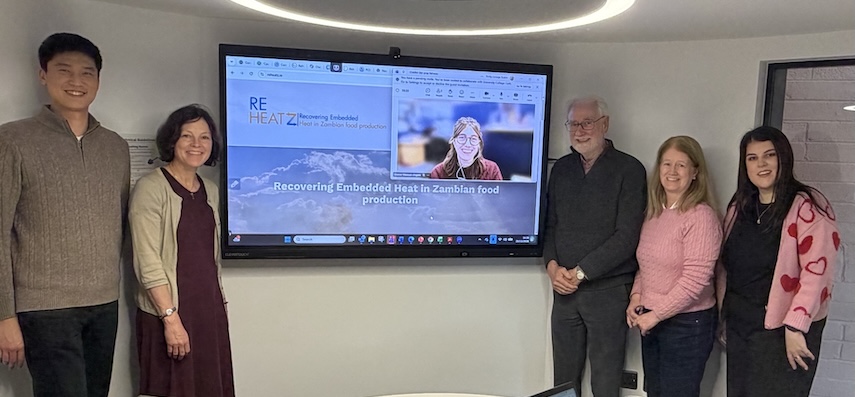
Some of the REHEATZ team with members of CHARM-EU and the judging panel
Funded by Research Ireland and Irish Aid, REHEATZ has developed novel technology to recover heat from wastewater created during industrial food production. The project was initiated in Trinity College Dublin and developed in partnership with the Southern African Institute for Policy and Research (SAIPAR), and Zambeef, a major Zambian food producer.
In Zambia, large volumes of hot water are used throughout the food production process. Currently, most of the thermal energy embedded in this hot wastewater is discarded.
Using REHEATZ’s system, recovered thermal energy from this wastewater can be reused. This reduces carbon emissions and cost while improving air quality for local communities. Collaborating with Build It International, an NGO in Zambia, the project has delivered social impact through vocational training and deployment of young Zambian construction trainees.

Zambeef and REHEATZ teams in Zambia
The REHEATZ system is already in place at Zambeef and the team plans to establish a spin-out venture to extend the technological and social impact of the project to apply the system in other industries across Zambia.
CHARM-DEN invites pitches from sustainability-driven projects developed at universities across the CHARM-EU European University Alliance. This year’s competition attracted six pitches from the Netherlands, Spain, Hungary, Germany and Ireland.
‘The vision for the REHEATZ spin-out is to pioneer the application of wastewater heat recovery systems in industry’ said Prof Paul Coughlan, Trinity Business School. ‘Starting from our first partnerships in Zambia, this project will bring huge benefits for industry, society and the environment.’
‘The REHEATZ project demonstrates the power of partnerships to translate research and innovation into practical solutions with real-world impact, said Dr Godfrey Hampwaye, SAIPAR. ‘By bringing together academia, industry, and local skills-development organisations, we are not only advancing sustainable energy solutions but also creating opportunities for young Zambians to develop their skills and participate in the green economy. It is through such collaborations that we can deliver lasting environmental and socioeconomic benefits.’
‘Winning CHARM-DEN shows the strength of the transdisciplinary relationships we have built with REHEATZ,’ said Eleanor Mancusi-Ungaro, former research assistant at Trinity College Dublin. ‘These relationships are not temporary or transactional, and we are grateful for our original funding from Research Ireland and Irish Aid, and more recent supplementary funding from the AIB Trinity Climate Hub, which together have given this work the energy to go forward.’
‘What makes REHEATZ particularly meaningful is that its impact extends beyond recovering waste heat and reducing energy use,’ said Laura Nkhuwa, SAIPAR. It is also investing in people, equipping young Zambians with practical green skills, building their confidence, and opening opportunities to improve their livelihoods. This is what inclusive climate innovation can look like in practice.'
Media Contact:
Catherine O’Mahony | Media Relations | catherine.omahony@tcd.ie