
Ireland’s first cement-free, 3D-printed geopolymer
Posted on: 15 July 2026
Researchers from Trinity’s School of Engineering have successfully demoed the geopolymer, showcasing its potential as a scalable option for circular construction.
The 3D printing of construction materials offers numerous benefits. It means typical projects can be completed in weeks rather than months, avoids the need for traditional moulds and formwork, and reduces waste. Construction is also highly automated, lowering manual labour costs, as printers build digital models layer-by-layer. They can also print complex curves and intricate geometries that can be impossible or too expensive to build traditionally.
In the trial, conducted at Harcourt Technologies Ltd. (HTL. Tech) with the help of their experts, the team demonstrated how its distinctly, red-brown material made with a bauxite refining residue, could be mixed, pumped, extruded and printed.
It contained no Portland cement and over 30% of its cement-like content came from local industrial waste, which might otherwise require treatment, long-term storage or landfill, further highlighting its sustainable credentials.
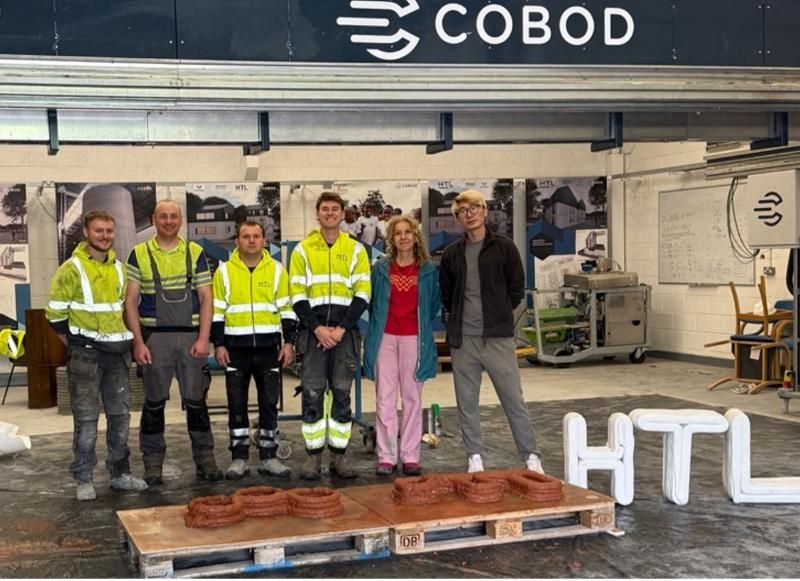 From left to right, the research team, Liam Whittle, Ivan Sorokivskyi, Vasyl Pylypiv, and Jandré Oosthuizen, HTL, with Prof. Sara Pavia and Dr Zehao Lei, Trinity.
Prof. Sara Pavia, Trinity, said: “Broadly speaking, this successful trial demonstrates how local industrial residues can be transformed into functional, adaptable and visually distinctive construction materials.
“And because the material and method of production and printing essentially delivers two environmental benefits: it reduces dependence on carbon-intensive clinker cements, and creates a high-value use for industrial residues. Our preliminary assessment suggests the material could reduce embodied carbon emissions by approximately 70% compared to conventional Portland cement (PC) concretes, which would be a big improvement.
“The significance of the material itself extends beyond cement replacement. It is a flexible binder platform whose composition, rheology, setting behaviour and early-age performance can be tailored to different manufacturing processes and construction applications.”
This work has its roots in a wider research project funded by Research Ireland, SISK, FLI Precast Solutions, McGrath Quarries, Techcrete and Roadstone. The industries bring together their expertise in material development, concrete production, precast manufacturing, construction delivery and digital fabrication, in a project that intends to progress low-carbon solutions from laboratory research to industrial use.
The lead industry (SISK) and the wider consortium contribute knowledge from across the construction supply chain, ensuring that development is guided by manufacturability, quality assurance, scale-up and eventual market adoption.
The next challenge is scaling the material from laboratory batches to the quantities and consistency required for industrial equipment. This introduces additional variables, but the material clearly has the potential to be a practical material.
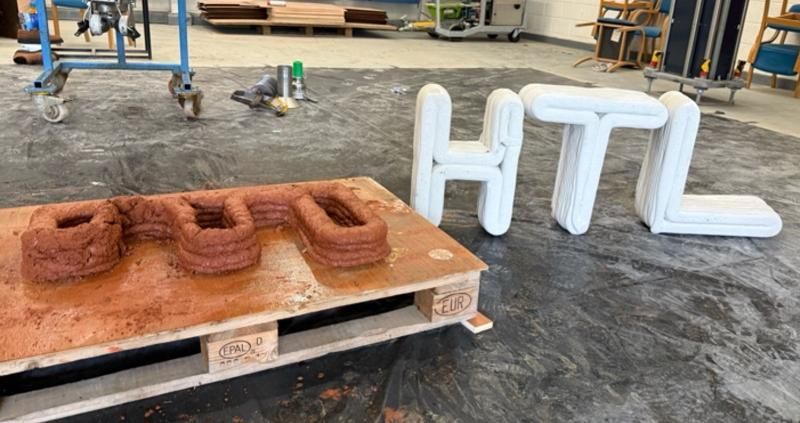
Specifically, the next steps will focus on mechanical performance, durability, reinforcement, long-term stability, process control and regulatory compliance.
Media Contact:
Thomas Deane | Media Relations | deaneth@tcd.ie | +353 1 896 4685