
From Lilliput to the Long Room: Trinity celebrates 300 years of Gulliver’s Travels
Posted on: 15 October 2026
The 300th anniversary of the publication of Gulliver’s Travels is being celebrated in Trinity College Dublin with an exhibition in the Long Room of the Old Library charting the extraordinary journey of one of the most celebrated works of world literature.
Written in Ireland and published anonymously in London on October 28th 1726, Swift’s brilliant satire went on to become a global literary phenomenon — it has never been out of print and has been studied, adapted, retold, and illustrated in countless ways, in many languages, both for adults and children.
 Drawing on the Library of Trinity College Dublin’s extensive collection of editions of Gulliver’s Travels, the Gulliver at 300 exhibition in the Long Room celebrates how Swift's masterpiece has delighted and intrigued readers of all ages across three centuries. An accompanying online exhibition can be viewed on the Library’s website.
Stephanie Breen, Assistant Librarian and co-curator of the exhibition, said: “The exhibition reveals how Swift’s often biting satire has been reprinted, retold and celebrated in many forms across 300 years. Exhibits range from some of the earliest editions to modern pop-up and comic books, and from cheap ephemeral booklets to lavish deluxe editions. The display also includes the only known surviving copy of a small abridgement, The Travels of Lemuel Gulliver, printed in Dublin in 1761.
“Lemuel Gulliver’s first voyage to the land of Lilliput is the one most familiar to audiences today thanks to adaptations for children’s literature, films and comic books. This exhibition, however, brings viewers on a journey to all of the lands Gulliver encountered — Lilliput, Brobdingnag, Laputa and beyond, and the Country of Houyhnhnms.”
Aileen Douglas, Professor of Eighteenth-Century Studies, School of English, and co-curator of the exhibition, said: “The first readers of Gulliver’s Travels were very taken with its satire of prominent political figures and the machinations of power. For readers today, fearful of being displaced by AI, Swift’s profound satire of human nature, especially pride in rationality and progress, resonates strongly.
“A further reason Gulliver’s Travels continues to speak to readers today is its powerful representation of a protagonist forced to adjust, not always successfully, to strange, alien, societies.”
 Helen Shenton, Librarian and College Archivist, said: “Marking the 300th anniversary of the first publication of Gulliver’s Travels, this exhibition illustrates Jonathan Swift’s masterpiece through a selection of visually striking holdings from the Library’s collection of editions of the work. Enhanced by the generosity of benefactors, the Library holds a world-renowned collection of Swift-related books and manuscripts.
“This collection includes hundreds of editions and popularisations of Gulliver’s Travels which we continue to collect and preserve for future generations, offering new opportunities for engagement and research.”
Jonathan Swift and Trinity College Dublin
Born in Dublin, Jonathan Swift (1667–1745) first entered Trinity College Dublin in 1682 as an undergraduate student and in 1702 took the degree of Doctor of Divinity. One of the finest antique busts in the Long Room, by Louis-François Roubiliac (1702–1762), depicts the celebrated Irish author and clergyman in his later years. The Library holds an exceptional collection of printed and manuscript items relating to Swift. For a range of digitised Swift collections see Digital Collections.
Gulliver at 300 is curated by Stephanie Breen, Aileen Douglas and Ian Campbell Ross. It is on display in the Long Room of the Old Library until the end of December 2026. Admission is included with the Book of Kells Experience tickets. See here to book tickets. An online exhibition can be viewed on the Library’s website.
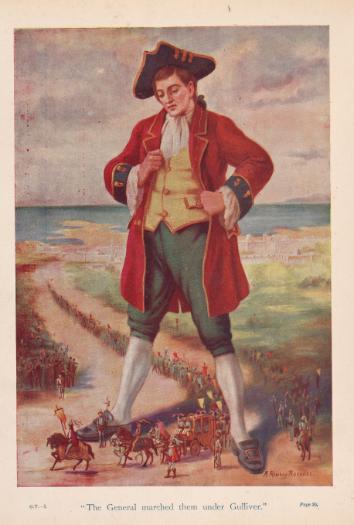
Image 1: The Lilliputian army marching between Gulliver’s legs, by R. Ramsay Russell (active 1876-1912), CC-BY, The Board of Trinity College Dublin
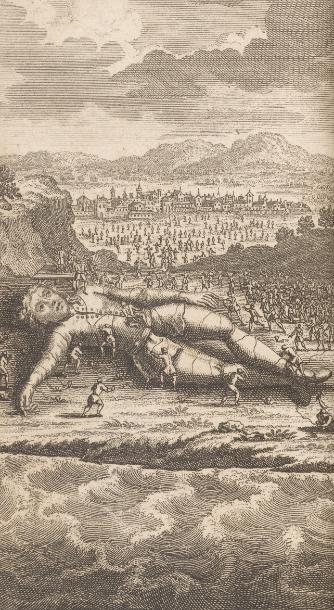
Image 2: An early 1727 French engraving depicting Gulliver bound and surrounded by tiny Lilliputians, CC-BY, The Board of Trinity College Dublin.
Media Contact:
Fiona Tyrrell | Media Relations | tyrrellf@tcd.ie | +353 1 896 3551