
New Irish language tool makes school more accessible for autistic children
Posted on: 29 September 2026
A new Irish language tool developed by researchers in Trinity College Dublin is allowing autistic children from Irish-language communities participate more fully in school and their communities.
Geabaire, the Irish for ‘chatterbox’, is a symbols-based tool which allows children who are non- or minimally-speaking to generate Irish words and sentences which are then spoken aloud by synthetic voices.
The tool is a “gamechanger for autistic children from Irish-language communities”, according to Professors Neasa Ní Chiaráin and Emily Barnes from Trinity College Dublin who are leading the Geabaire project at Trinity’s ABAIR research initiative.
The tool is being made available for free to coincide with the opening of 24 autism classes in Irish-medium primary schools this September. It is available for schools, users and their families at https://abair.ie/geabaire.
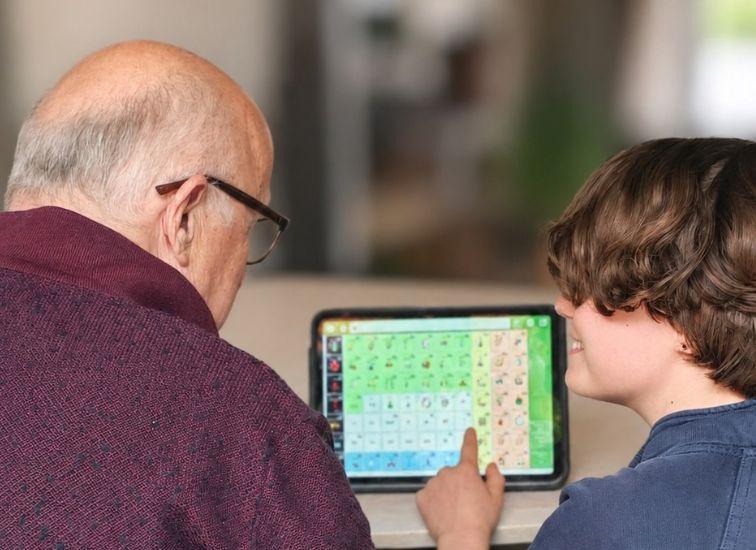
Geabaire is the first robust symbols-based communication support tool designed specifically for the Irish language. It has been built with a deep understanding of both the structure of the Irish language and its dialects.
The Geabaire project is also setting a global model — as one of the first Augmentative and Alternative Communication (AAC) systems designed from the ground up for a minority EU language, it demonstrates how speech and language technologies can serve minority and endangered language communities worldwide.
Geabaire came about when Julia Cummins, mother of two minimally speaking autistic children, got in touch with researchers at Trinity’s ABAIR research initiative to see if an Irish-language version of a speech-generating app could be developed.
“Our daughter could hear Irish all around her, but the English-language communication tool she used could not speak it for her. Once she enrolled in her local Gaelscoil, I knew that she really needed an Irish-language equivalent to participate fully in the language of her school, family, and community.
“Initially, we tried to simply adapt an English-language system. It quickly became clear that Irish could not be accommodated adequately — Irish has its own grammar, word order, idioms and dialects. We needed a communication system designed around the structures of Irish and its dialects from the outset.”
Before long Julia had become involved in the development of the new tool with linguistic, education and technology experts at Trinity. She is now undertaking a PhD examining how the development of this Irish language AAC system can provide principles that may be transferable to other minoritised and morphologically complex languages.
Unmet need in Irish-speaking community
Geabaire addresses “a genuine unmet need within the Irish-speaking community”, explains Neasa Ní Chiaráin, Assistant Professor in the School of Linguistic, Speech, and Communication Sciences.
“Geabaire ensures that children with complex communication needs can engage from day one of their educational journey. More broadly, Geabaire helps ensure that some of the most vulnerable members of the Irish-speaking community are not left behind as Irish speech and language technologies continue to evolve. It’s a powerful example of research combining with technological innovation to deliver social impact and improve language rights.”
Emily Barnes, Assistant Professor in the School of Education, said “This month, 24 new autism classes opened in gaelscoileanna around Ireland. Access to Irish-medium education is just the first step. True inclusion is being able to participate meaningfully in the life of the classroom and the school, and this is where Geabaire has a key role.
“Initial research shows how Geabaire is essential to accessing the curriculum and building friendships for children who use AAC. Every child is entitled to participate in Irish-medium education, and Geabaire supports the enactment of these linguistic and educational rights."
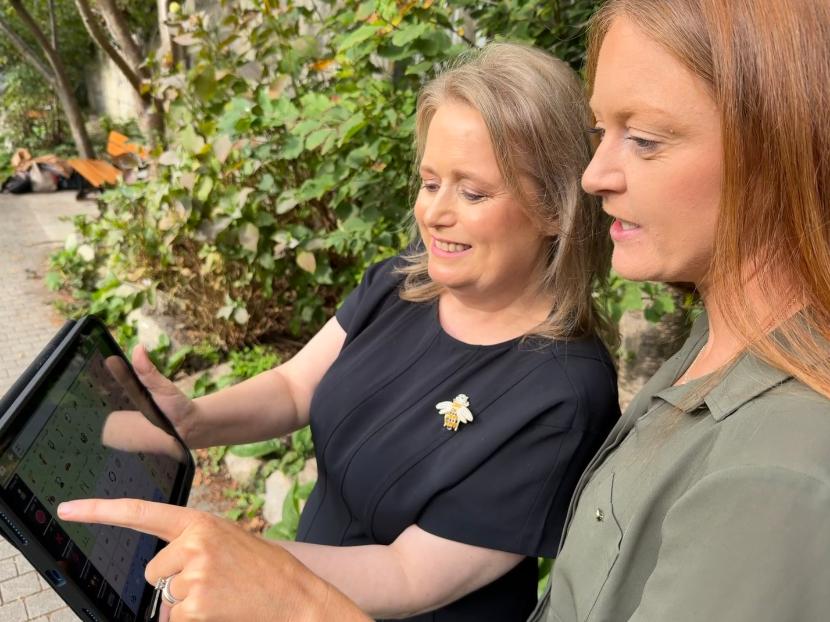
Julia Cummins and Neasa Ní Chiaráin explore the Geabaire tool
“Ultimately, the success of a language is measured not only by the number of people who speak it, but by who is enabled to belong within it,” Professor Ní Chiaráin adds.
“This is particularly important for Irish and other minority languages — they survive only when families use them in the home and communities keep choosing to use them every day. Every child, including those with complex communication needs, should have the opportunity to grow up hearing and using their own language in homes, schools, and communities.
“Too often, families are advised to change their home language because adequate tools don't exist to support them in their language. Geabaire is a step toward ensuring children don't have to change their language environment to access communication support."
The roll out of Geabaire is being supported by Gaeloideachas — the national organisation supporting the development of Irish-medium education). Bláthnaid ní Ghréacháin, Chief Executive, Gaeloideachas, said: “Geabaire will be really life-changing for children and young people being educated through Irish. From naíonra onwards, it will give them another voice — helping them express themselves in another way, connect with others, take part and feel that they truly belong.”
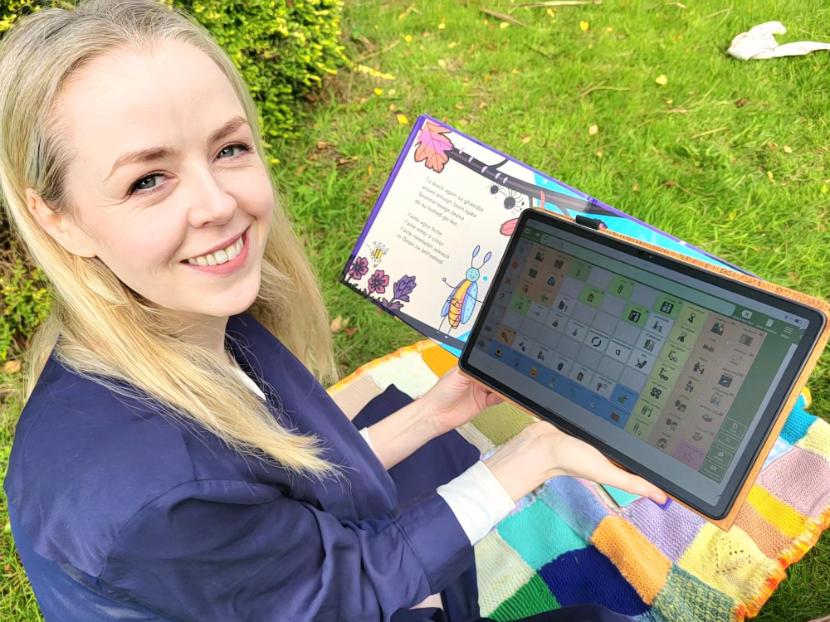
Emily Barnes says Geabaire supports linguistic and educational rights
“By making AAC available as Gaeilge, Geabaire is opening a new way and more opportunities for minimally speaking or non-speaking children to communicate, celebrate their identity, and thrive in Irish-medium education. Everybody deserves to have their voice heard, and Geabaire will help make that possible.”
Real-world Irish language tools for all
Based in the School of Linguistic, Speech and Communication Sciences, ABAIR focuses on developing a range of speech and language technologies, and providing them to the Irish-speaking community. The project is led by Professors Neasa Ní Chiaráin and Ailbhe Ní Chasaide.
ABAIR’s suite of real-world tools includes Irish text-to-speech technology (with regional dialects), automatic speech recognition, Irish-specific large language models trained on Irish language data and cultural knowledge, and applications for education and accessibility, including a screen reader for people who are blind or visually impaired.
All ABAIR technologies are built to reflect the multi-dialect nature of Irish as it is actually lived and spoken – they are sensitive to the structure of the Irish language, cater to the different dialects and are appropriate for a range of end users including children living in Irish-language communities, professionals, learners and disabled people.
While the target audience for Geabaire initially is autistic students in Irish medium education, it is hoped that it will benefit a broader range of users, including autistic children in English-medium schools who are learning Irish, explains Prof. Ní Chiaráin. Learnings from the Geabaire initiative can support the development of speech and language technology-based applications for other minority languages.
Geabaire is funded by An Chomhairle um Oideachas Gaeltachta & Gaelscolaíochta (COGG) and leverages the infrastructure and expertise of ABAIR, Trinity’s longstanding speech and language technology initiative funded by the Department of Rural and Community Development and the Gaeltacht.
Irish language version available here.
Media Contact:
Fiona Tyrrell | Media Relations | tyrrellf@tcd.ie | +353 1 896 3551