
Two Trinity researchers win prestigious European Research Council Advanced Grants
Posted on: 24 June 2026
Two researchers from Trinity College Dublin, Rhodri Cusack and Richard Layte, have been announced today [June 23] as recipients of European Research Council (ERC) Advanced Grants.
The duo are among just five researchers in Ireland to receive the coveted Advanced Grants awards from the ERC in this funding cycle. Advanced Grants give senior researchers the opportunity to pursue ambitious, curiosity-driven projects that could lead to major breakthroughs. The grants are part of the EU’s Horizon Europe programme.
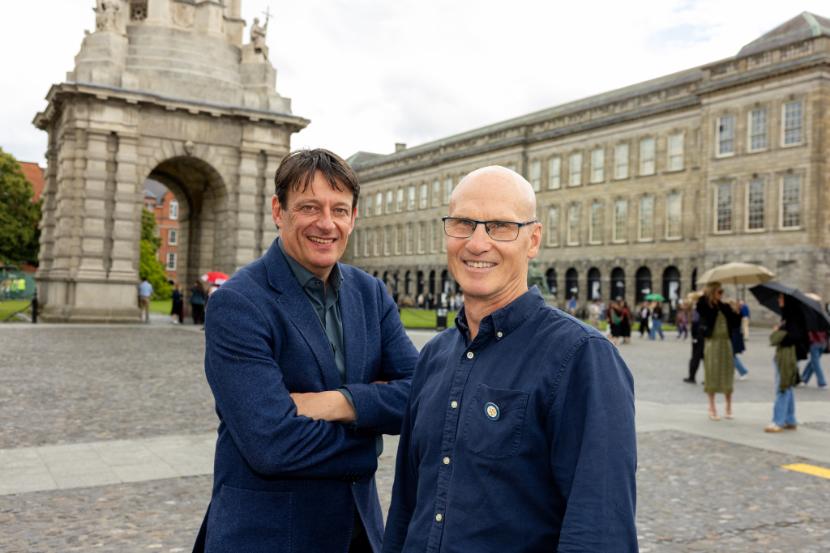
Richard Layte, Professor of Sociology, School of Social Sciences and Philosophy, has secured a €2.5 million grant for a project to investigate how our relationships with those around us shape us and the consequences this has for educational development, health and well-being.
The project, FLOURISH: Foundations of Life Course Outcomes in Relationships and Social Connection, will combine large-scale data on individuals from four countries followed from infancy to early adulthood with observation of and interviews with young people in schools to develop a rich understanding of the role of social connection in development and well-being.
FLOURISH will combine internationally validated measures of the same individuals over time in different countries to understand whether and how relationships within the family, school, community and wider society combine for better outcomes.
Rhodri Cusack, Thomas Mitchell Professor of Cognitive Neuroscience at Trinity’s School of Psychology and Director of the Trinity College Institute of Neuroscience (TCIN), has been awarded €3.5 million to investigate how human infants learn to understand the visual world during the first year of life.
The project, InfantNeuroAI: Development of Visual Cognition in Infants and Machines, will combine pioneering brain imaging methods with computational modelling to address one of science’s most fundamental questions: how do human infants learn to recognise people, objects, relationships and actions from the rich sensory information that surrounds them?
The research will build on Trinity’s world-leading programme of awake infant neuroimaging, using functional MRI (fMRI) and optically pumped magnetometer magnetoencephalography (OPM-MEG) to observe the developing brain in unprecedented detail. By comparing these measurements with computational models, the project aims to uncover the principles that allow infants to learn so rapidly and efficiently.
Dr Linda Doyle, Provost of Trinity College Dublin, said: “I wholeheartedly congratulate Rhodri and Richard on this career-defining achievement. ERC Advanced Grants recognise both ground-breaking research and the international leadership profile of awardees. It is striking that both projects focus on childhood and the 'hidden' processes of human development, aiming to illuminate how we are shaped by and make sense of our surroundings.”
Professor Sineád Ryan, Dean of Research at Trinity, said: “I am pleased to extend my warmest congratulations to Richard and Rhodri. In an increasingly competitive research funding landscape, their success in securing these ERC awards is particularly impressive. The importance of curiosity-driven research such as these projects cannot be overstated – not only for their contribution to expanding knowledge but for the profound impact they will have on our society. It is this curiosity that is the heart of research at Trinity, and indeed our institutional strategic plan Thrive, where the transformational power of research is harnessed for the benefit of us all.”
Rhodri Cusack, Thomas Mitchell Professor of Cognitive Neuroscience, said: “Human infants achieve something extraordinary. Within a remarkably short period, they learn to understand a complex visual world using only a tiny fraction of the data and energy consumed by modern AI systems. Yet we still know surprisingly little about how this happens.
“Through InfantNeuroAI, we will use new neuroimaging technologies to observe the development of visual cognition in the infant brain in unprecedented detail. By combining these measurements with advances in artificial intelligence, we hope to uncover the principles that allow infants to learn so efficiently. The findings could transform our understanding of early cognitive development while also inspiring a new generation of AI systems that are more adaptable, data-efficient and human-like.”
Richard Layte, Professor of Sociology, said: “The proverb that ‘it takes a village to raise a child’ holds that a child must interact with and be cared for by people outside of their immediate family if they are to develop into a healthy, well-adjusted and happy adult. Until recently it has not been possible to investigate the way that different kinds of social relationships contribute simultaneously to the development of the self and the mechanisms through which they do so.
“The FLOURISH project will test fundamental theories about the role of different types of social connection in the development of the self from infancy to adulthood and test new interventions which could help all to flourish in life.”
Media Contact:
Fiona Tyrrell | Media Relations | tyrrellf@tcd.ie | +353 1 896 3551