A look through Trinity's digital collections: an artistic history of St. Brigid
Posted on: 30 January 2026
St Brigid’s Day, often referred to by its pre-Christian name Imbolc, is celebrated on the 1st of February and heralds the start of spring in Ireland.
From medieval times through to the 1930s and 40s, creative representations of St. Brigid showcased in the digital collections of the library of Trinity College Dublin offer us a picture of how the historical celebration of Brigid as a pagan goddess and as a Christian saint have informed how we see her today.
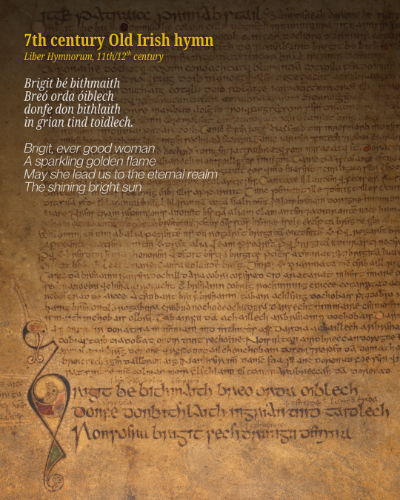 One of the oldest references to St. Brigid – a 7th century Old Irish hymn.
The Liber Hymnorum is the earliest manuscript in the Trinity Library, dating from 11th/12th century. It contains a substantial amount of Irish, and includes this hymn written in Old Irish which is translated as follows:
Brigit bé bithmaith
Breó orda óiblech
donfe don bithlaith
in grian tind toidlech.
Brigit, ever good woman
A sparkling golden flame
May she lead us to the eternal realm
The shining bright sun.
Known as Ultan’s Hymn, it shows Brigid in her aspect as Goddess -- linked to the sun and fire. She is seen as saint of the Leinstermen and as a pillar of Irish spirituality together with St Patrick. The further reference to Brigid as the Mother of Jesus is a folkloric one, as the "Mary of the Gaels" or "Foster-mother of Jesus".
The Library is home to a significant collection of over 200 medieval and early modern manuscripts written in the Irish language (Gaeilge); Irish is the oldest vernacular literature in Western Europe. View the online exhibition here.
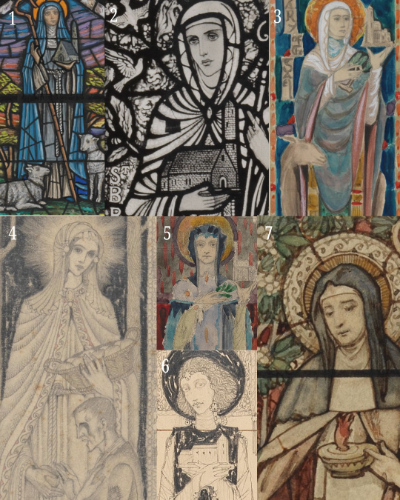 The iconography of St Brigid
The Clarke Stained Glass Studios Collection contains stained glass designs, colour schemes, opus sectile designs, architects' blueprints and plans, photographs, documentation about sales and orders, correspondence, financial records, staffing records, and research documentation related to stained glass work executed by the Clarke Studios, Dublin, from 1893 to 1972.
Within the collection, there is a selection of beautiful Brigid imagery, which allows us a particular insight into her saintly attributes – these are items associated with a saint and their story, which act as visual signals to indicate who they are.
Among the most common examples shown here are the cross, church, calf, lamp, and beggar -- icons that reflect her charitable acts and protection of the poor, her connection to farming and animals, and the foundation of her church and centre of learning along her status as Abbess of Kildare.
The images shown here are credited as follows:
- Church and Lambs: TCD MS 11182/11173. Colour design for single-light stained glass window of St. Brigid, for unidentified church. Attributable to William Dowling or Terence Clarke
- Australian Brigid. Cowra, NSW, TCD MS 11182/1400/96
- St Brigid, Mary of the Gael, with her calf, church and oak leaf: TCD MS 11182/802 Pencil drawing for single-light round-arched stained glass window of St. Brigid, for unidentified church. Att.David Clarke.
- Brigid and the beggar: TCD MS 11182/221 Coloured pencil drawing for unidentified single-light window of St. Brigid and the beggar, commissioned by E. W. Warren, solicitor from Gorey, Co. Wexford [on behalf of John Percy Phair, Anglican Bishop of Ossory, Ferns and Leighlin].
- Colour design for unidentified four-light stained glass window featuring Irish saints, with scenes from the saints’ lives at the base, and angels with sacred symbols in the tracery. Attributed to William Dowling.
- Pencil drawing for unidentified two-light stained glass window of SS. Brigid and Ita with their symbols, with scenes from the saints’ lives at the base, St. Brigid’s church and St. Ita’s jewels at the top, and God the Father in the tracery. Attributed to William Dowling. TCD MS 11182/497
- Lamp: TCD MS 11182/1201 https://doi.org/10.48495/b2773w291 dated 1917 Colour design for single-light stained glass window of St. Brigid [mistakenly captioned as St. Attracta], with Gothic architecture at the canopy and base, commissioned by Reverend Ryan for St. Margaret’s Church in Finglas.
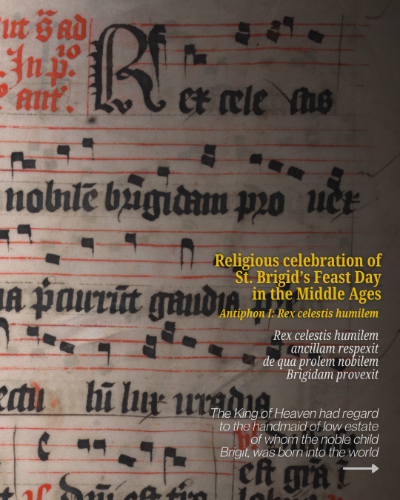 Celebration of St. Brigid’s Feast Day in the Middle Ages – Antiphon 1
Brigid was afforded such high status in the Irish Middle Ages, that her feast day on 1st February was celebrated with elaborate religious ceremonies, known as “Offices”, which comprised of readings, music, and prayer, many of which told of her performance of miracles.
The Offices of St. Brigid are preserved among rare medieval manuscripts which are available to explore online as part of the Manuscripts for Medieval Studies Project and the Virtual Trinity Library programme.
Irish saints’ offices are the subject of the Amra project, under the direction of Dr Ann Buckley, who is investigating music, texts, and the wider context of the history of their religious cults celebrated in Ireland and throughout medieval Europe.
To read more on this innovative and important project see this Trinity News & Events piece.
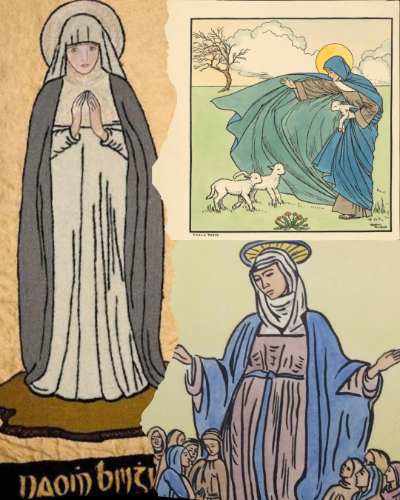 20th Century art – Cuala Press
St. Brigid was also celebrated in the visual art of Cuala Industries, a female run arts and crafts cooperative in the early 20th century, founded by Elizabeth and Lily Yeats. Among the 111 hand-coloured, photoengraved prints and cards in Trinity’s Cuala Press Prints collections, are a number of references to the saint.
Pictured here are Pamela Colman Smith’s design in embroidery showing the saint in a linear style, with the Gaelicised caption ‘Naomh Brighid’ in Gaelic type, and two illustrative pieces – the first dating from the 1920s combining art by Kathleen Verschoyle, with poetry by Winifred M. Letts and the other by renowned Irish modernist, Evie Hone, commissioned in the 1930s.
The Cuala Press Project is a collaborative research project between Trinity Irish Art Research Centre and the Library of Trinity College Dublin. Funded by the Schooner Foundation, the project is supporting the conservation, research and public access to Trinity's Cuala Press holdings.
Read more on Cuala prints connection to St. Brigid in this illuminating Trinity News & Events piece by Dr Billy Shortall, research fellow at the Cuala Press Research Project.
---
The Virtual Trinity Library is opening up the unique and distinct collections of the Library of Trinity College Dublin, catalysing research and safeguarding the iconic treasures of the Library of Trinity College Dublin for generations to come. This ambitious initiative is to catalogue, conserve, digitise and research these unique collections of national importance making them accessible to a global audience, from schoolchildren to scholars.