What do we know about nicotine use in Trinity?
Tobacco & Vape Free Trinity, 10 Years of Evidence and Impact, 2016 – 2026
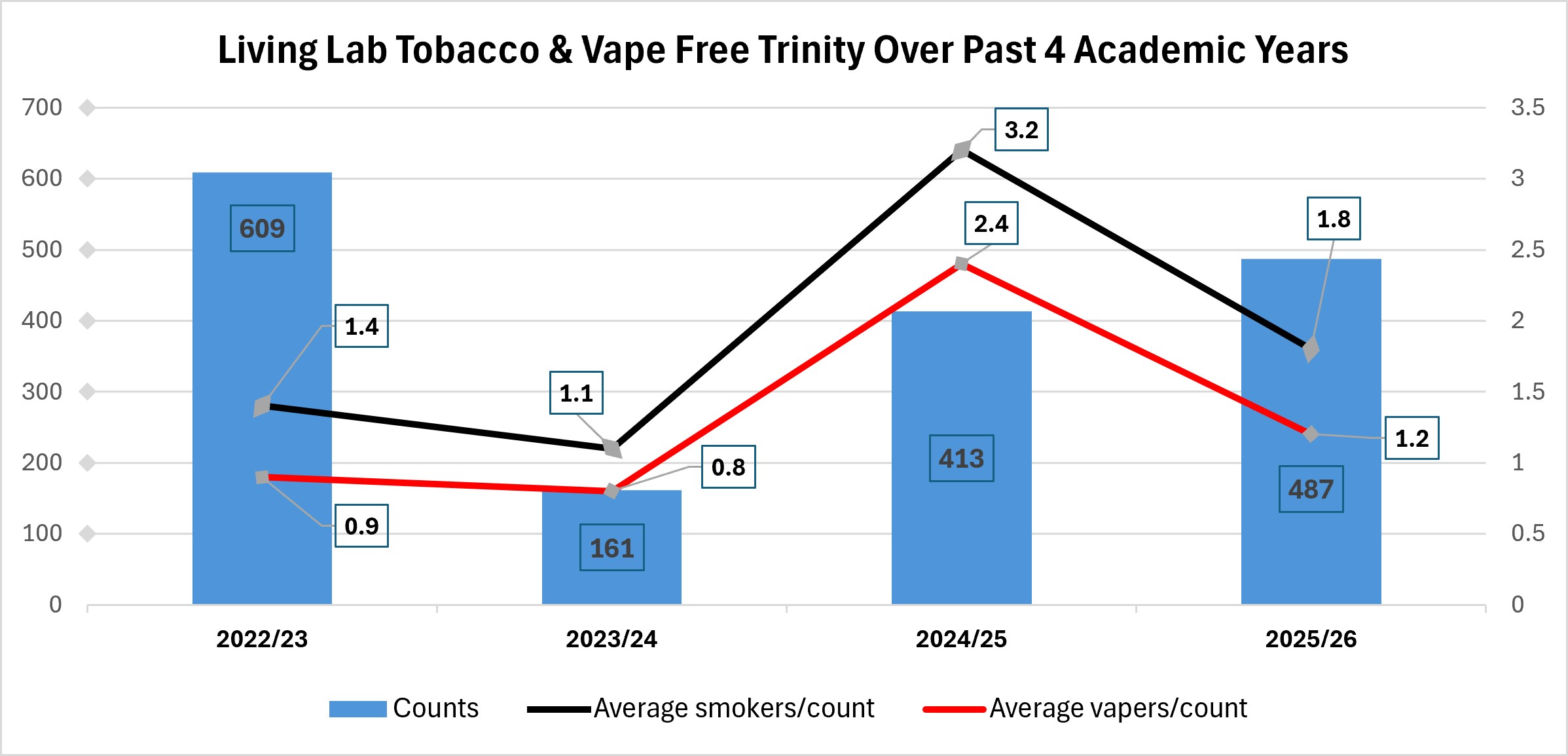
Over the past decade, Trinity College Dublin has taken action to drive impact for all people and for the environment by moving towards a Tobacco and Vape free campus. Our current monthly and annual data demonstrates the trend in smoking and vaping observed on campus (see below graphs). Trinity College Dublin became a Tobacco-Free campus in 2016 after a six-year negotiation period.
Healthy Trinity employs student ambassadors to count smoking and vaping in a campus circuit focusing on seven zones 6-8 times per week during term.
Originally Trinity recorded observed smoking on campus only, however in 2022 Trinity included vaping in its living lab circuits. This campus living lab data collection supported efforts to enable Trinity to upgrade its policy and to become a Tobacco and Vape-Free Campus. Vape free Trinity was launched on 18th March 2026.
Current Data Update:
- Yearly data: The cumulative annual data demonstrates a downward trend from 2.4 vapers per check in 2024/2025 to 1.2 vapers per check in 2025/2026 and in smoking from 3.2 smokers per check in 2024/2025 to 1.8 in 2025/2026.
- Monthly data: The monthly breakdown of observed smoking and vaping on campus over four years 2022-2026 demonstrates the downward trend in more detail.
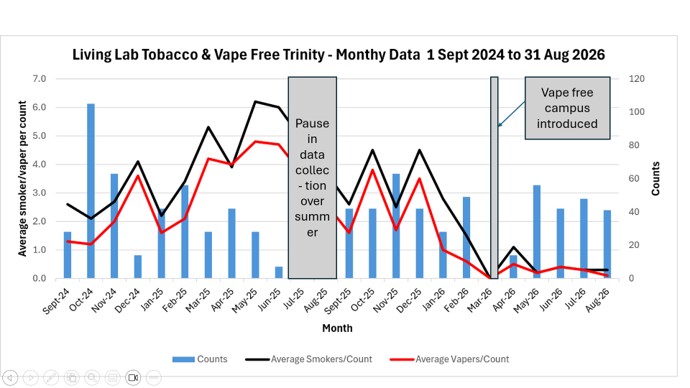
- Over time we will understand better the impact of including vaping in the tobacco and vape free Trinity policy.
Past Living Lab Updates
Is vaping an issue in Trinity?
/filters:format(webp)/filters:quality(100)/prod01/channel_3/media/tcd/healthy-trinity/images/ObservedVaping.jpg)
Yes. A vaping prevalence survey taken in 2023 by 2,683 students and staff (RR=12%) found vaping is highly prevalent. 1539 (57%) had vaped at least once and 838 (31%) currently vaped. 42% of current vapers were dual cigarette and e-cigarette users. 57%, n=1013, supported on-campus restrictions. Factors for lifetime/current vaping included younger age, undergraduate status, cigarette smoking (AOR current=9.3, 95% CI 6.1, 14.2), and disposable vape use (AOR current = 3.18, 95% CI 1.6, 6.2)
Vaping observed on campus (right) as part of Tobacco Free Trinity's Livng Lab found an increase from 0.9 vapers per check (609 checks) in 2022/2023 to 2.1 vapers per check in 2024/2025 (350 checks). In 2024/2025, 1,749 nicotine users were observed on campus, with 42% (n=728) using e-cigarettes. 59% of vapers (n=430) were using disposable vapes.
The Tobacco Free Trinity has called for a ban on disposable vapes here and a phasing out of e-cigarettes inline with Australia's e-cigarettes policies here.
Tobacco Free Trinity: Does it work?
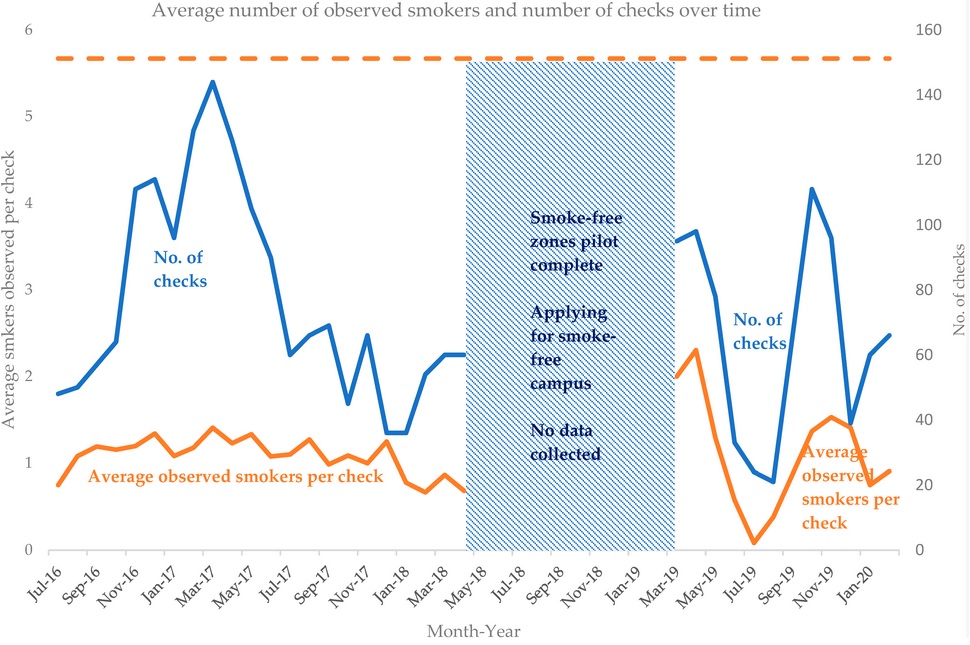
Yes, from July 2016 to February 2020, Trinity achieved a reduction in smoking of 79%. You can read more in our Living Lab paper here. Interestingly, after becoming a tobacco free campus, frequency of observed smoking increased somewhat but by December 2019, returned to similar frequency to the Tobacco Free Zones pilot.
Data are collected by Healthy Trinity Ambassadors who walk the campus 8 times per week during term time (4 times outside of term time) reminding people of the policy and counting how many people are smoking. It's part of Healthy Trinity's Living Lab approach to health promotion.
Tobacco Free Zones: Did they work?
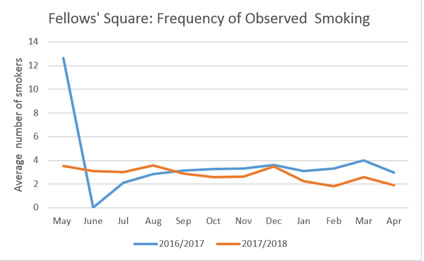
Yes! Tobacco Free Zones were piloted from July 2016 to March 2019. During the first two years of the pilot there was an 83% reduction in smoking in them. A report on two year of tobacco free zones from 2016/2018 is here and from the first year of the zones from 2016/2017 is here.
We're grateful to those who respect the the Tobacco Free Zones policy. It means a cleaner campus and fresh air for all.
How many undergraduates in Trinity smoke?
Smoking rates are low
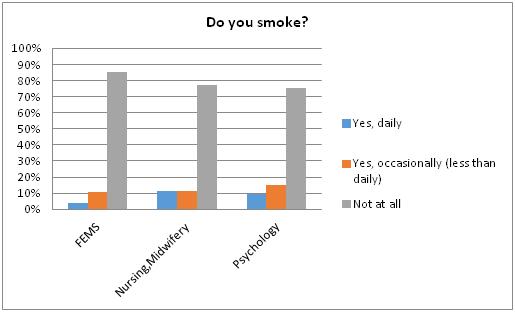
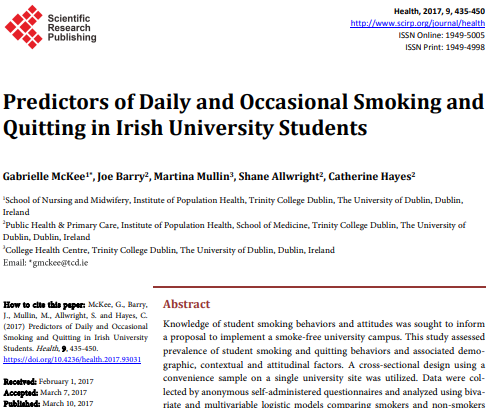
Research published in 2017 shows that only 7% are daily smokers and 12% are occasional smokers.
Support Non-Smokers
Over half of those who smoke, plan to stop in the next six months and rates of smoking are much lower in Trinity than they are amongst young people in the rest of Ireland.
Fresh Air for All
Nearly half of those who responded say they’ve been affected by second hand smoke at buildings.
How Did Your School/Faculty Do?
This survey was done by Trinity researchers from the Institute of Population Health. 840 students, either junior freshman or junior sophister, from the Schools of Nursing & Midwifery and Psychology and the Faculty of Engineering, Maths and Science completed the survey in October 2013. The chart above shows smoking rates for each of the schools.
If you’ve any comments on this article/post please email healthp@tcd.ie