
Why rural Ireland holds the key to transport decarbonisation
Posted on: 31 March 2026
Recently published research explores the decarbonisation of transport and the particular challenges that exist in Ireland due to our population density and geography, and outlines some solutions.
By Assoc. Prof. David McCloskey and Prof. Brian Caulfield
The research article, conducted through a collaboration between the Schools of Physics and Engineering, and published in the journal Sustainable Energy, Grids and Networks, can be read here.
The problem:
Ireland’s heavy reliance on imported oil has long exposed its economy to geopolitical instability, and recent global tensions have sharpened this vulnerability. Nowhere is this dependence more entrenched than in transport, where roughly 95% of energy demand is still met by oil-derived fuels.
And while the transition to electric vehicles (EVs) is accelerating and offers a pathway to both decarbonisation and energy independence, new research from Trinity reveals that electrification brings its own set of overlooked challenges—particularly for rural electricity networks.
The study’s most important contribution is its shift in focus from EV adoption itself to the capacity of the underlying infrastructure to support it. While much public discourse assumes electrification is primarily a matter of consumer uptake and charging availability, this research highlights that the low-voltage (LV) distribution grid—especially in rural Ireland—may become the critical bottleneck.
The crux of the matter:
Prof. Caulfield, from Trinity’s School of Engineering, says: “A central finding is the identification of spatial inequities in Ireland’s energy transition. By analysing capacity data, the study reveals a troubling overlap: areas with the fastest growth in EV adoption—often commuter belts and rural regions—are also those with the least available grid capacity.”
More than half of substations are already operating under constraints, effectively limiting new connections. This highlights that the energy transition is not geographically neutral; without intervention, rural communities are at risk of being left behind despite having the greatest potential for emissions reductions.
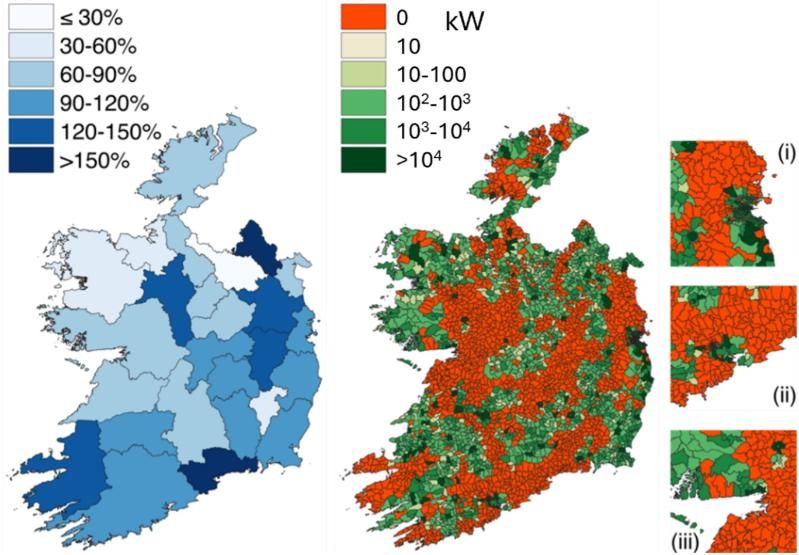
Figure 1: Left: Change of new BEV registrations 2021-2024 (%) per county showing fastest growing regions. Right: Available demand capacity from ESB availability capacity map with insets on Dublin (i), Cork (ii), and Galway (iii).
Additionally, the problem of synchronised demand is discussed. Traditional electricity networks were designed around the principle of load diversity, meaning it was unlikely that multiple households would use high-power appliances simultaneously. Rural clusters of homes were therefore typically served by relatively small transformers.
However, EVs—and related technologies like heat pumps—fundamentally disrupt this model. Charging an EV requires sustained high power over several hours, unlike short bursts from appliances such as kettles or showers. When households respond to off-peak pricing incentives by charging vehicles at the same time, this creates prolonged, concentrated demand that existing infrastructure was never designed to handle.
The research demonstrates that even modest EV uptake can overwhelm rural systems. In a typical cluster of six homes, just two households charging EVs simultaneously can push a transformer beyond its limits, leading to overheating and premature failure. This insight is significant because it challenges the assumption that grid stress will only emerge at high levels of EV penetration. Instead, the tipping point may arrive much sooner, particularly in rural areas where infrastructure is already constrained.
The solutions (and a policy insight)
The policy implications are substantial. Traditionally, infrastructure investment has been prioritised based on population density, favouring urban areas. However, the research shows that this approach may be counterproductive for transport decarbonisation. Rural households travel longer distances and are more dependent on private vehicles, meaning electrification in these areas delivers disproportionately high emissions savings.
The study therefore introduces a crucial policy insight: targeting grid upgrades in lower-density regions could yield greater climate benefits than focusing solely on cities.
Encouragingly, the research also identifies practical solutions. One of the most impactful is the role of smart charging. Rather than allowing EVs to charge simultaneously, coordinated systems can stagger demand across longer time windows. The study shows that such strategies can dramatically reduce stress on infrastructure, including cutting transformer temperatures by up to 80°C. This is a critical finding because it demonstrates that software-based solutions can complement—or even delay—the need for expensive physical upgrades.
Conclusions
Ultimately, the research underscores that Ireland’s transport electrification is at a pivotal moment. The country has the opportunity to reduce emissions, enhance energy security, and shield households from volatile fuel prices. However, without proactive upgrading, the very success of EV adoption could strain the grid to breaking point—especially in rural areas where the benefits are greatest.
Assoc. Prof. McCloskey, from Trinity’s School of Physics, says: “Many new technologies – such as aggregated or local smart charging, virtual power plants, or vehicle to grid – exist and have been successfully deployed in other countries. Faster adoption to new concepts and flexibility will pay dividends in years to come by reducing infrastructure upgrade costs.”
The key impact of this work is its clear message: electrification must be matched by infrastructure readiness and smarter energy management. By highlighting hidden constraints and offering actionable solutions, the study provides a roadmap for ensuring that Ireland’s transition to clean transport is both equitable and sustainable.
Prof. McCloskey and Prof. Caulfield co-authored a similar piece for RTE Brainstorm, which can be read here.