
Trauma-informed, gender-sensitive care crucial for women
Posted on: 20 February 2026
New Trinity study is first of its kind in Ireland to specifically focus on women to address the disproportionately poor physical health of this population when compared to the general population.
A study published by Trinity College researchers from the School of Medicine in the journal BMJ Open, explored the effect of an exercise programme in a Dublin day centre for women who are dealing with challenging issues.
The success of this physiotherapy-led programme was in its trauma-informed design, based on understanding past trauma experienced by the women which made it difficult for them to access mainstream healthcare services. The strength-based exercise programme with protein supplementation: Low-threshold Exercise And Protein for Women (LEAP-W), ran for 10 weeks and was set in ‘Jane’s Place’, a bespoke service for women at Merchants Quay Ireland.
The programme was flexible and low threshold (minimal barriers to entry), with an ethos of ‘come as you are’. It had a women’s health focus and was tailored to the health needs of the women. 33 participants were recruited to the study. Interviews were conducted following the programme, with 20 programme participants and key stakeholders from MQI. The feedback was overwhelmingly positive and endorsed its unique approach.
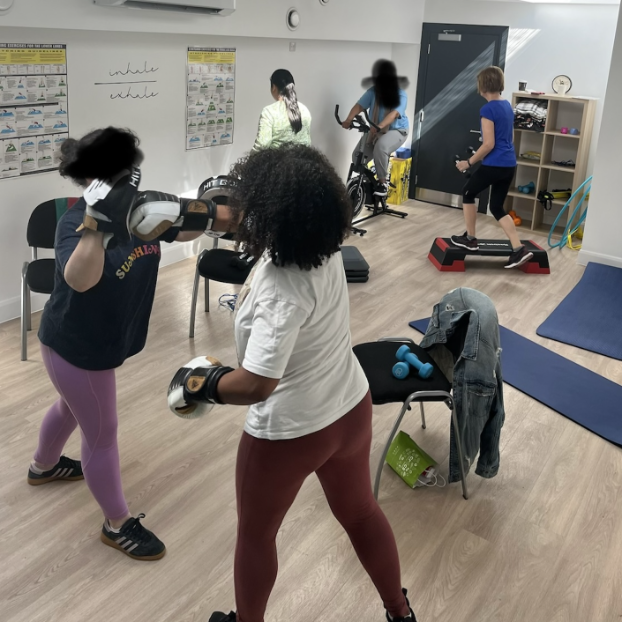
Jane’s Place’, a bespoke service for women at Merchants Quay Ireland
Key findings
Findings revealed that LEAP-W was feasible evidenced by its safety, acceptability and high retention in certain subgroups, and high adherence to the exercise and protein supplement; its impact was demonstrated by improvements in multiple domains (strength, balance, pain and mental health). Three main themes emerged from the qualitative inquiry, namely (i) The power of exercise, (ii) Challenges to engagement and (iii) The LEAP-approach, driven by a trauma-informed and low threshold approach. Study participants discussed their life challenges and the barriers they experienced in accessing mainstream healthcare services and reported that this programme was different because it was accessible. Women who took part appreciated the opportunity to participate in an exercise programme which was designed to meet their needs, and they participated well. Thus, the design and approach of this programme was considered key to its success. This research concluded that targeted exercise interventions with trauma-sensitive and flexible design can be successfully delivered and yield extensive impact in women who experience homelessness, addiction, and mental health challenges. This paper calls for service re-design when considering delivering interventions to this population.
Feedback from the interviews
‘’It gave me strength that I never knew I had.’’
‘’I found exercise was a healthier way to cope with your problems.’’
‘’It was amazing for me because it gave me a chance.”
Participating in the programme appeared to have a positive effect on substance use: ‘’The fact that they were there at the programme meant they weren’t using that day.”
The peer support was very much valued: “It just helps each other you know, supporting each other.”
The women-only setting was valued too, as some women had a history of domestic violence: ‘’I reckon if there has have been men, I wouldn't have been so open, definitely I would have pulled back.’’
Why this research matters
People experiencing homelessness are excluded from mainstream healthcare services and experience poorer health when compared to the general population.. They have complex healthcare needs which are associated with early onset of illness and disability, premature ageing and death, thus need to be addressed urgently. Women in particular are an overlooked group within homelessness who have unique needs and thus require a different approach.
Author of the study Dr. Fiona Kennedy, Discipline of Physiotherapy, Trinity College Dublin, states:
“Multiple risk factors for geriatric conditions such as frailty and sarcopenia were found in this relatively young female group, including a proportion of women with poor nutritional status, low grip strength and low physical functioning and who experienced chronic pain. This is stark considering participants had a mean (SD) age of 41(±11) years, demonstrating the requirement for early targeted intervention.
This paper calls for urgent improvements in service design to better support the complex needs of women who experience severe and multiple disadvantage.
We hope this research will inform policies and practices that enable a trauma-informed and gender sensitive approach to women who experience homelessness, addiction and mental health challenges to enable them to access fair and equitable services and to improve health outcomes and longevity."

Dr. Fiona Kennedy
New steps for this research
This study shows that women who are homeless can engage well and gain many benefits from a gender-specific exercise programme. Ideally more research needs to be conducted with larger sample sizes to provide more definitive data.
This study was supported by the Irish Research Council and postgraduate research funding from Trinity College Dublin. The Principal Investigator was Dr. Julie Broderick, formally Trinity College Dublin.
READ: You can read the full paper “Exploring the impact of targeted exercise in women experiencing homelessness, addiction, and mental health challenges. A mixed methods feasibility study”, at the following link: https://bmjopen.bmj.com/content/16/2/e103060
Media Contact:
Ciara O’Shea | Media Relations | coshea9@tcd.ie | +353 1 896 4204