
“Tiny but beautifully formed”: Bronze Age spindle whorl connects ancient city of Troy to Ireland
Posted on: 24 March 2026
A tiny Bronze Age spindle whorl, excavated from the ancient city of Troy, will take centre stage in Trinity College Dublin this week as experts and artists gather to examine the biography of the only artefact from the ancient city of Troy in Ireland.
A free public lecture will be given by Professor Rüstem Aslan, Director of Troy Excavations on the evening of Thursday 26th March. Professor Aslan will talk about the discovery of spindle whorls in Troy and early excavations on the site.
Speaking in advance of his lecture Professor Rüstem Aslan, Director of Troy Excavations said: “Heinrich Schliemann’s early excavations at Troy illuminate not only the legendary history of the city but also the material traces of everyday life, with small yet significant objects such as spindle whorls offering insight into the practices and labour of ancient women.
“This modest terracotta artefact exemplifies the enduring connections between Troy and Ireland, demonstrating how ancient narratives continue to resonate and captivate audiences today.''
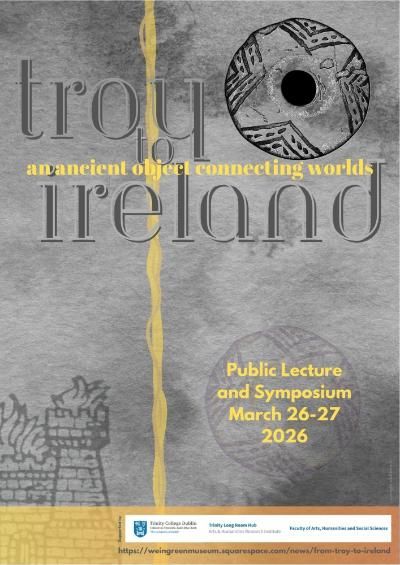 On Friday 27th a symposium will explore the historical and cultural biographies of the Trojan spindle whorl. Acting students from The Lir Academy will perform readings from Homer; an experimental archaeologist will demonstrate spinning using a replica of the spindle whorl and creative works, inspired by the Trojan whorl, will be showcased by two Turkish artists and writers. Find out more about the lecture here.
Academic papers will also be delivered on the topics of the material culture, archaeology and ancient script of Troy.
“The spindle whorl at the heart of this story is a small clay object used to weight a hand-held spindle when spinning thread,” says archaeologist Professor Christine Morris from Trinity’s Department of Classics.
“This tiny but beautifully formed terracotta object connects us to the ancient worlds of Anatolia and Greece and Homer’s epic poems. It also provides a tangible link to the European excavators captivated with these legendary tales and the woman who brought it to Ireland.
“Thousands of similar objects have been found at Troy and other Bronze Age sites. They are the material witnesses to a key activity embedded in daily life – the spinning and weaving of wool to make clothing and other textiles, often described as 'women's work'. Beyond the practical dimension of this important work, spinning and weaving hold complex meanings in the mythologies and ideologies of many cultures.”
The spindle whorl was gifted to Trinity in 2024. It was originally excavated by German archaeologist Heinrich Schliemann and was given by him to Lady Augusta Gregory when she visited Athens in 1880. It now forms part of Trinity’s Weingreen Museum of Biblical Antiquities – a teaching museum that gives students hands-on experience with everyday objects from the ancient societies they study.
Curator of the museum Dr Zuleika Rodgers, Department of Near and Middle Eastern Studies, said: “For our students, working with artefacts creates a memorable and sensorily rich learning experience. In handling objects from everyday life like the whorl, students feel they are somehow in touch with the past and the lives of the women who used them.
“The origins of the museum lie in the commitment of Jacob Weingreen, Erasmus Smith Professor of Hebrew at Trinity, to develop a teaching collection for students to introduce them to the material culture of the ancient Mediterranean, Middle Eastern and North African worlds they are studying.”
More about Schliemann, Lady Gregory and the Irish connection
Early excavator of the site of the ancient city of Troy Heinrich Schliemann met Lady Augusta Gregory and her new husband Sir William Gregory when they visited Athens in 1880. As she records in her diary, Schliemann gifted her “a whorl from Troy” and this small clay object journeyed with her to Ireland. It was recently gifted into the care of the Weingreen Museum by Colin Smythe, a Trinity alumnus and honorary degree recipient, who is the agent for the literary estate of Lady Gregory (and other Irish authors) and was given the whorl by her family.
More about Troy, the Trojan War and excavation
The ancient city of Troy is best known as the location of the Trojan War, as recounted by Homer in the Iliad. Sparked, according to myth, by the abduction of the Spartan queen Helen by Paris, prince of Troy, the war raged between the Greeks (called Achaeans by Homer) and the Trojans for ten years around the plain and city of Troy. Eventually the city of Troy falls and the Greeks emerge victorious, returning to their Greek homes (one such return being the story of Odysseus' long journey back to Ithaca), taking with them the now-captured Trojan women, including Hecuba and Andromache. Though a story of war, women play a prominent, if often tragic, part in the narrative.
Troy, the physical location where this narrative takes place was identified, and then excavated, in the late 19th century CE is the hill of Hissarlik in the modern region of Çanakkale in Turkey, at a strategic location near the Dardanelles. The first excavator of this Bronze Age site was Heinrich Schliemann who worked there in the 1870s when Turkey was under Ottoman rule; excavations by American archaeologists followed later and the current director of excavations is Professor Rüstem Aslan. Today, the historical importance of Troy is recognised by its status, since 1998, as a UNESCO World Heritage site.
Media Contact:
Fiona Tyrrell | Media Relations | tyrrellf@tcd.ie | +353 1 896 3551