SEAGROW project to advance sustainable seaweed cultivation and ecosystem restoration across EU waters
Posted on: 17 January 2026
Europe is backing a new flagship initiative to help scale sustainable seaweed cultivation while strengthening marine ecosystems across European waters.
Through the European Maritime, Fisheries and Aquaculture Fund (EMFAF), the European Union has awarded funding to SEAGROW (Seaweed in Ecosystem Enhancing Aquaculture for Growth and Sustainability). The project is coordinated from Ireland by Óir Na Farraige, an Irish regenerative, nature-positive aquaculture company developing scalable seaweed farming systems that improve productivity while enhancing marine ecosystems.
Partners met in person for the first time this month for a kick off meeting hosted in Trinity, bringing together Irish and European partners to launch the collaboration and begin delivery on SEAGROW’s work. The project aims to improve productivity, environmental performance, and economic viability of seaweed cultivation and integrated aquaculture systems, supporting sustainable marine food production, biodiversity protection, and climate resilience.
With a total eligible project value of approximately €1.4 million, SEAGROW is supported by EU funding at a rate of 70% under EMFAF. The project is made up of partners from five different EU countries.
Richard Donnelly, Interim CEO at Bord Iascaigh Mhara (BIM), Ireland’s seafood development agency, spoke of the agency’s support of the SEAGROW project, noted how closely it aligns with its seaweed strategy. He said: “The SEAGROW project, being led by Óir na Farraige, directly aligns with BIM’s Irish Macro Algal Cultivation Strategy to 2030, a strategy that is essentially a roadmap for industry to develop their processing capabilities. The project’s use of innovative seaweed cultivation technologies in Ireland with a focus on improving productivity and performance directly speaks to the need to increase the volume of farmed seaweed to ensure a sustainable and economically profitable industry in Ireland.”
Innovation grounded in evidence
SEAGROW will demonstrate advanced seaweed cultivation approaches designed to increase yield per hectare while reducing material use, labour intensity, and production costs within existing licensed marine space.
Working with Trinity College Dublin, the project will generate robust environmental and biodiversity data to inform best practice and evidence-based decision-making. Integrated aquaculture interactions will also be assessed to explore opportunities for diversified and resilient coastal livelihoods.
Researchers at Trinity, led by Prof. Nessa O’Connor, Professor in Zoology in the School of Natural Sciences, will develop methods to identify the ecological impacts of regenerative ocean farming (ROF). These tools will form an international standard for excellent practice and allow ocean farmers to define and highlight their role improving the ecological status of our coasts.
Growing commercially important species, such as seaweeds and bivalve shellfish, can enhance local biodiversity, remove harmful nutrients from the water column and even provide a buffer against the harmful effects of climate change. Researchers will quantify these ecological interactions so that this information can be used to label ROF-products and reflect the benefits of their regenerative practices. This new scientific evidence-based label will allow customers to make informed choices about the sustainability of the products they select.
Prof. O’Connor said: “Regenerative ocean farming represents a paradigm shift away from traditional aquaculture practices. By working in harmony with nature, and restoring rather than merely exploiting resources, we could have a truly sustainable food production system. We actually know surprisingly little about how practices, such as seaweed farming, could enhance biodiversity. This information is vitally important to expand markets and scale-up the emerging regenerative ocean farming movement.”
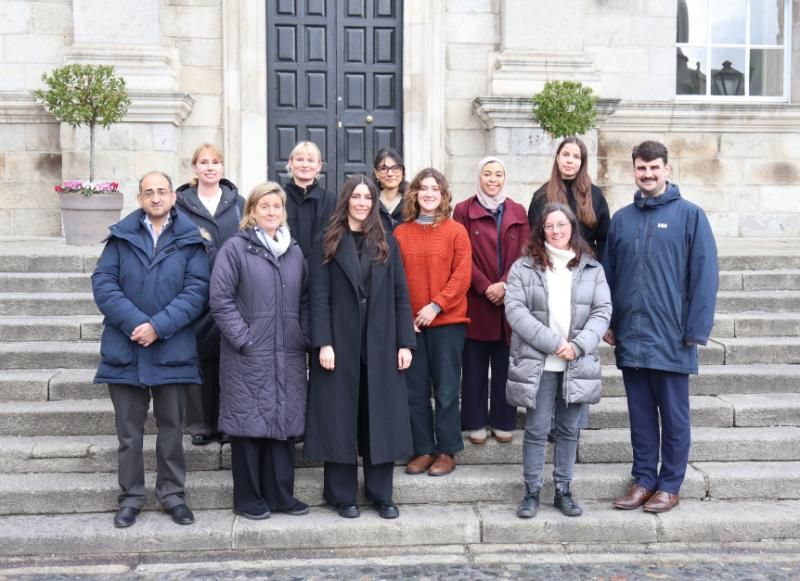
Project partners at the kick-off meeting in Trinity.
Building Europe’s regenerative aquaculture capacity
Over its lifetime, SEAGROW will deliver practical tools and evidence to support the responsible scaling of regenerative aquaculture across Europe, including:
- Standard operating protocols for regenerative ocean farming
- Environmental and biodiversity assessment frameworks
- Decision-support tools to inform sustainable aquaculture development
- Feasibility studies for expansion into the Mediterranean and Black Sea basins
The project also includes a Europe-wide outreach programme, with stakeholder engagement activities in partner countries and at EU level.
Industry perspective
“In Ireland, we have a word — fite fuaite — meaning intertwined,” said Gareth Murphy, Managing Director of Óir na Farraige and Chair of the Irish Seaweed Association.
“SEAGROW brings together science, industry, and European collaboration to strengthen how we produce food from the ocean while protecting marine ecosystems. This project is about building practical evidence and scalable models that can support sustainable growth while maintaining high environmental standards in Ireland and across Europe.”
A European collaboration led from Ireland
A core challenge facing aquaculture is how to increase output and reduce unit production costs while still operating within environmental limits and increasingly constrained marine space. SEAGROW brings together a European collaboration to help address this challenge, managed from Ireland and implemented with partners in Portugal, the Netherlands, Bulgaria, Malta, and Ireland. Together, the consortium combines operational experience, scientific assessment, and policy expertise to support more productive and environmentally responsible seaweed cultivation.
The project consortium includes:
Óir na Farraige (Ireland) – Project coordinator, leading overall project management and operational deployment of regenerative aquaculture systems; Trinity College Dublin – Environmental and biodiversity impact assessment; Atlantic International Research Centre (Portugal) – Scientific synthesis and policy linkage; Sea Going Green (Netherlands) – Communications, dissemination, and stakeholder engagement; Via Pontica Foundation (Bulgaria) – Feasibility assessment and stakeholder engagement in the Black Sea region; AquaBioTech Group (Malta) – Life-cycle assessment and regulatory assessment including compatibility with marine protected areas; Clear Seas Aqua (Ireland) – Operational and farm-design expertise.
Read more about the project on its dedicated website.
Media Contact:
Thomas Deane | Media Relations | deaneth@tcd.ie | +353 1 896 4685