
Trinity-ADAPT team’s AI-enhanced, maritime vessel detection system wins Research Ireland's Defence Innovation Challenge
Posted on: 25 February 2026
Researchers from Trinity and the ADAPT Research Ireland Centre for AI-Driven Digital Content Technology won the Maritime Situational Awareness Challenge after creating a system that will strengthen Ireland’s naval security.
The researchers, led by Prof. Marco Ruffini and Dr John Kennedy, pooled their leading expertise with Defence Forces Liaison Cdr Cathal Power to develop project “Sea-Scan”.
The project represents an important opportunity to enhance Ireland’s ability to monitor maritime activity, including the detection of so-called “dark” vessels, strengthening both national security and economic resilience.
The Sea-Scan team will now develop their real-time vessel detection system to support early warning and offer improved situational awareness. Beyond security, the system also has potential applications in environmental monitoring, contributing to a broader national resilience.
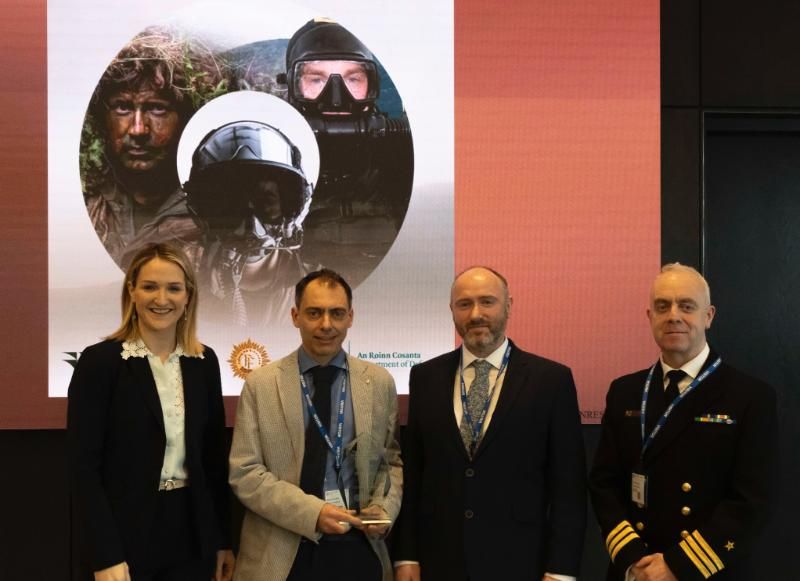
Professor Marco Ruffini, from Trinity’s School of Computer Science & Statistics and the ADAPT Centre, and Sea-Scan Co-Lead, said: “Maintaining strong awareness of activity in Ireland’s maritime domain is essential, particularly given the country's role as an island nation and a key Atlantic gateway for digital connectivity. As subsea communications and energy infrastructure continue to grow in strategic importance, so too does the need for continuous, reliable monitoring of the surrounding maritime environment.”
“Over the past year, we have demonstrated the potential to detect and characterise vessel activity using existing subsea fibre infrastructure, showcasing a robust sensing capability embedded within operational communications assets and enabling effective vessel monitoring and subsea infrastructure protection. This research lays the foundation for future capabilities that can complement existing maritime surveillance systems and support both national and European resilience.”
Dr John Kennedy, from Trinity’s School of Engineering, and Sea-Scan Co-Lead, added: "SeaScan brings together an exceptional team of researchers, and we are proud of our success in the highly competitive Research Ireland Challenge. We are excited to develop this technology to its full potential, enabling Trinity College Dublin and ADAPT to deliver tangible impact in maritime security.”
"The core SeaScan technology also offers powerful capabilities for real-time monitoring of marine environments. With growing awareness of the impact of anthropogenic noise on marine life, SeaScan has the potential to make a significant contribution to the development and management of Marine Protected Areas (MPAs)."
Prof. Sinéad Ryan, Dean of Research at Trinity, said: “I offer warm congratulations to Marco, John and their collaborators on winning this Challenge. Sea-Scan will strengthen national security and resilience, and enhance our ability to monitor, protect and respond to threats within Ireland's maritime domain. Beyond security, the system also has potential applications in environmental monitoring, contributing to a broader national resilience.”
“The project offers an excellent example of how exceptional research and technological innovation can deliver practical, real‑world solutions while also showcasing the importance of multidisciplinary collaboration in pooling diverse expertise to think — and deliver — creatively.”
The aim of the Research Ireland-Defence Innovation Challenge is to develop new technologies, aligned with national defence policy, that have strong potential to deliver significant beneficial societal impact for Ireland.
The national initiative is aimed at unlocking the power of research to develop innovative solutions to enhance the capabilities of the Defence Forces at a time of increased global focus on defence readiness.
Challenge-based research funding encourages researchers to work directly with those most affected by the problems they seek to address, demonstrating the value and potential of collaborative research to address the challenges faced by Irish society as a whole.
Minister Helen McEntee said: “Innovation is critical to ensuring our Defence Forces have the tools they need to operate effectively in an increasingly complex environment. AI-driven technologies like Sea-Scan will significantly enhance maritime situational awareness, supporting the Naval Service in safeguarding our waters and responding swiftly to emerging challenges. This investment reflects our commitment to modernising defence capabilities and embracing innovative solutions for the future.”
Dr Diarmuid O’Brien, CEO, Research Ireland, said: “Challenge-based research funding encourages researchers to work directly with those most affected by the problems they seek to address. The teams being funded today have developed their solutions through close collaboration with Defence Forces personnel.
The Sea-Scan team are developing a high-quality solution to a complex problem that will deliver a transformational capability for the Irish Defence Forces. The MASH team have developed an impressive and innovative solution that balances speed and quality, offering a structure that can be assembled quickly without complex tools. I congratulate both teams and look forward to seeing them deliver their solutions to issues which are of critical national importance.”
Media Contact:
Thomas Deane | Media Relations | deaneth@tcd.ie | +353 1 896 4685