Legal aid reform under the spotlight at School of Law and FLAC conference
Posted on: 14 January 2026
Trinity’s School of Law in collaboration with FLAC (Free Legal Advice Centres) hosted a high-level conference on civil legal aid reform in Ireland this week.
The first ever review of Ireland’s Civil Legal Aid Scheme was published in July 2025. The conference, entitled, 𝗖𝗶𝘃𝗶𝗹 𝗟𝗲𝗴𝗮𝗹 𝗔𝗶𝗱: 𝗙𝗿𝗼𝗺 𝗥𝗲𝘃𝗶𝗲𝘄 𝘁𝗼 𝗥𝗲𝗳𝗼𝗿𝗺, brought together Ireland’s access to justice stakeholders and experts to respond to the Review and reflect on how meaningful reform can be achieved in this area.
Speakers included:
- Minister Jim O'Callaghan TD
- The Chief Justice, The Hon. Mr Justice Donal O’Donnell
- Prof. Fiona Donson, UCC/FLAC
- Síofra O’Leary, Former President of the ECtHR
- Eilis Barry, CEO FLAC
- EU Commissioner Michael McGrath
Co-organiser of the event, Professor Gerry Whyte, School of Law, said: “In December 1968 a conference on legal education, hosted by Trinity’s Law School, was an important catalyst in the development of legal aid in Ireland as it prompted the establishment of the Free Legal Advice Centres (FLAC) in April 1969. I hope that this conference, with its focus on reform of the legal aid scheme, be equally impactful.”
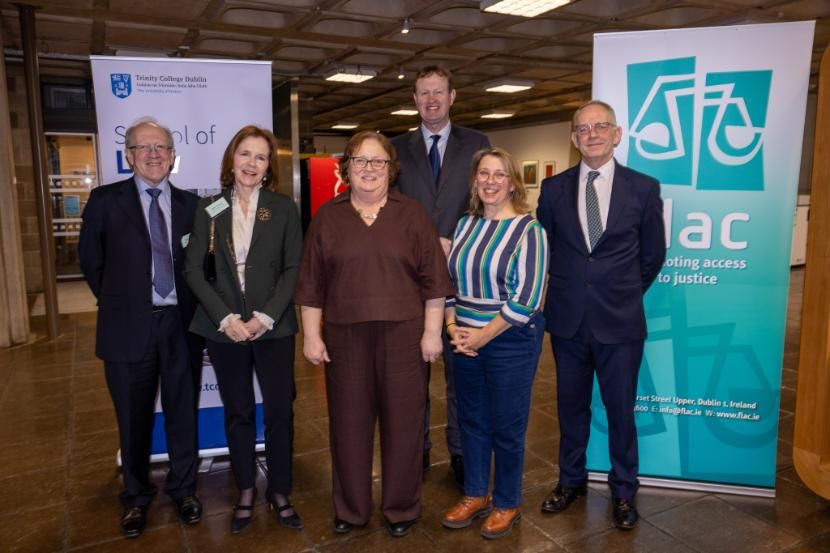 Prof. Gerry Whyte; Prof. Síofra O’Leary; Eilis Barry; Minister for Justice, Home Affairs & Migration, Jim O’Callaghan; Prof. Fiona Donson and Prof. Neville Cox
FLAC Chief Executive, Eilis Barry, commented: “Our civil legal aid system is in crisis. The Civil Legal Aid minority report highlighted that the system is failing to meet significant levels of legal need, particularly among people and communities experiencing poverty, deprivation and discrimination. There are a number of reasons for this crisis. First and foremost, civil legal aid is not treated as a fundamental right, a core social service or an investment that will benefit and save money for individuals, communities, the courts and the State. It should be.
“The implementation of the EU Migration Pact will lead to a very significant increase in the Legal Aid Board’s work during 2026. There is a real risk that this will push the legal aid system from a state of crisis to one of collapse unless radical reform is instituted.”
European Commissioner for Democracy, Justice, the Rule of Law and Consumer Protection, Michael McGrath added: “Justice must be accessible to be real. Access to justice is a pillar of the rule of law and essential for democratic trust, social cohesion and the effective protection of fundamental rights. The Free Legal Advice Centres in Ireland have been a long-standing beacon for promoting access to justice and demonstrates Ireland’s tradition of legal aid and civil society engagement.
“Today’s event allows us to reflect on the Irish contribution to a shared European promise - upholding the right to an effective legal remedy and to necessary legal aid as protected in Article 47 of the EU Charter of Fundamental Rights.
“Civil society organisations, like FLAC, play a crucial role in protecting and advancing access to justice. They support those who would otherwise risk going unheard, help turn rights into lived realities, and ensure the rule of law is applied in practice where it matters most. Member States have a clear responsibility to ensure that national legal aid systems work in practice. The Commission will continue to support, monitor and coordinate these efforts to ensure access to justice delivers for all across the Union.”
Media Contact:
Fiona Tyrrell | Media Relations | tyrrellf@tcd.ie | +353 1 896 3551