IrelandQCI team demonstrates quantum-secure communications with Dublin City Council
Posted on: 17 February 2026
Researchers from the CONNECT Centre headquartered at Trinity, working with partners in the IrelandQCI project, successfully demonstrated quantum-secure communication at Dublin City Council headquarters today as part of the project’s first engagement with a local authority.
The demo took place under the IrelandQCI (Ireland Quantum Communication Infrastructure) project, the €10 million DIGITAL Europe EuroQCI initiative to build a national quantum communication infrastructure for Ireland, which is co-funded by the European Commission and the Irish Government’s Department of Culture, Communications and Sport.
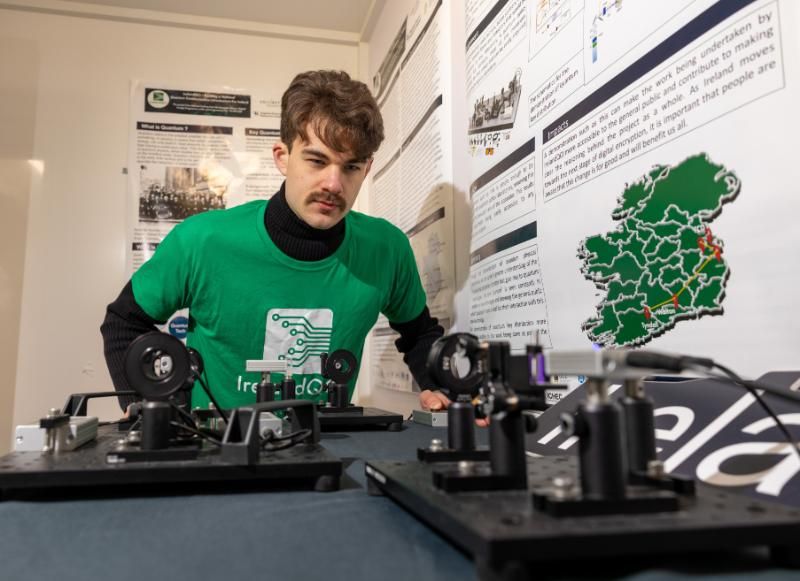 Enzo Moser, Quantum Specialist, Trinity, on board the IrelandQCI Quantum & Answers Trailer at Dublin City Council.
The project is coordinated by the Walton Institute at South East Technological University on behalf of CONNECT, and is part of EuroQCI, a wider EU effort which sees the European Commission working with 26 Member States, as well as the European Space Agency, to deploy a continent-spanning, secure quantum communication infrastructure.
IrelandQCI is made up of a consortium of academic and industry partners, including six national universities, and industry partners ESB Telecoms and Asiera (formerly HEAnet.)
IrelandQCI is developing a quantum key distribution (QKD) infrastructure along a major backbone network connecting Dublin to Cork via Waterford. This will integrate cutting-edge quantum technologies with existing classical fibre systems to future-proof Ireland’s communications networks against cyber threats.
Quantum communications: the future of cybersecurity
For governments and cities, early adoption of quantum-secure communications is key to ensuring long-term resilience across critical public services, including Government, healthcare, finance, energy, and emergency response.
This first Government use case involved collaborating with the IrelandQCI partners including Asiera, who deployed quantum communication systems on the existing Dublin City Council municipal fibre network. This demonstrates how local authorities can strengthen cybersecurity, enabling the use of their own publicly owned networks to provide connectivity for critical infrastructure, citizen data, and digital city services requiring the utmost protection.
The demo
The test involved creating a highly secure connection between two strategic Dublin City Council locations with the expertise of project partner Asiera. During the trial, the IrelandQCI consortium of partners successfully tested quantum-based security technology in a real operational environment, showing that it works reliably under everyday conditions.
This trial was delivered as part of the Smart Docklands programme of advanced technology trials, a joint initiative between Dublin City Council and the CONNECT Centre.
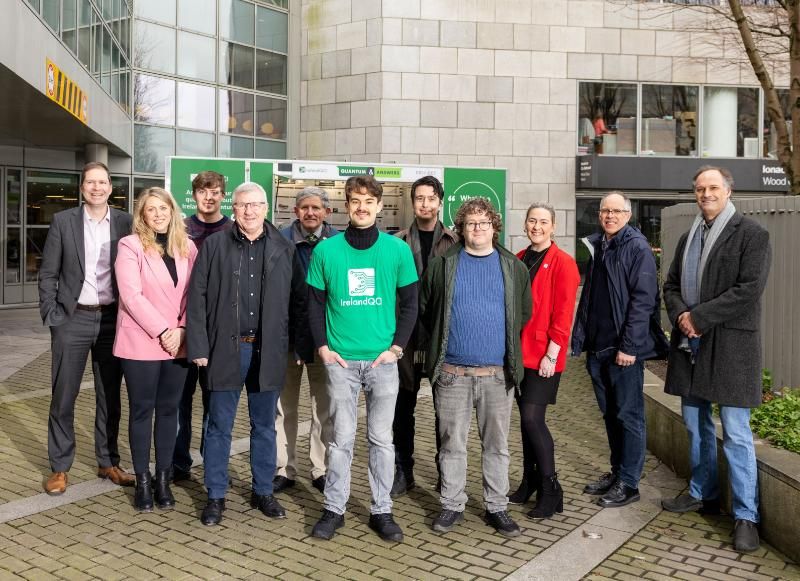 Pictured (l-r): Jamie Cudden, Dubin City Council; Sinéad Whelan, Walton Institute, SETU; Niall Quigley, Trinity; John Regan, ESB Telecoms; Pat Kelly, CONNECT Research Centre; Enzo Moser, Trinity; Colm Browning, Smart Docklands; Dan Sweeney, Asiera; Nicola Graham, Dublin City Council; Eoin Kenny, Asiera; Prof. Dan Kilper, CONNECT Research Centre, IrelandQCI project partner.
Professor Dan Kilper, Director, CONNECT Centre, Trinity, said: “This work highlights the importance of coordinated research, industry, and public sector engagement in building secure future communications systems. Quantum-secure communications will be critical to protecting public services in the years ahead, and this milestone shows how research and innovation can directly strengthen national and local digital resilience.”
Jamie Cudden, Executive Manager, Dublin City Council, said: “A robust, reliable and future-proof communications network is fundamental to delivering smarter, responsive and secure public services. This initiative was delivered through our Telecoms Innovation programme and Smart Docklands to explore the future of communications infrastructure. We are delighted to be able to support this forward-looking partnership.”
The demo also tested next-gen encryption methods designed to remain secure even in the age of quantum computers. By combining quantum security with advanced classical encryption, the system provides multiple layers of protection, helping to keep sensitive information safe as it travels across the network, from local systems through to wider digital services.
Dr Deirdre Kilbane, IrelandQCI Project Lead and Director of Research at Walton Institute, South East Technological University (SETU), recognised the combined efforts it took to achieve today’s successful demonstration, adding: ‘’This is an exciting advancement for the IrelandQCI project, which has the ultimate aim of deploying a long-range quantum communication network between Dublin and Waterford, and on to Cork.
“Today’s demonstration at Dublin City Council shows another important aspect of the project which is end-user engagement with government and industry. Our consortium partners, comprised of several national universities and industry partners ESB Telecoms and Asiera, are delighted to share their expertise as we work towards securing and encrypting communication networks across Ireland. We intend to work with further government and industry end users, bringing the benefits of quantum communication technologies to wider Irish society.’’
This collaboration between IrelandQCI and Dublin City Council illustrates Ireland’s growing expertise in quantum communications and its proactive approach to cyber resilience. As the EuroQCI (European Quantum Communication Infrastructure) initiative progresses, Ireland’s early successful demonstrations ensure it will remain a trusted and connected node in Europe’s emerging quantum internet.
Media Contact:
Thomas Deane | Media Relations | deaneth@tcd.ie | +353 1 896 4685