
Why are there no gigantic dragonflies terrorising the skies today?
Posted on: 25 March 2026
Gigantic dragonfly-like insects – the “griffinflies” – ruled the skies around 300 million years ago, but they have long been consigned to evolution’s graveyard.
Scientists believed these insects, which grabbed their oxygen without complex lungs – instead taking it via simple diffusion from the air – grew so big because oxygen concentrations were much higher in the atmosphere in the distant past.
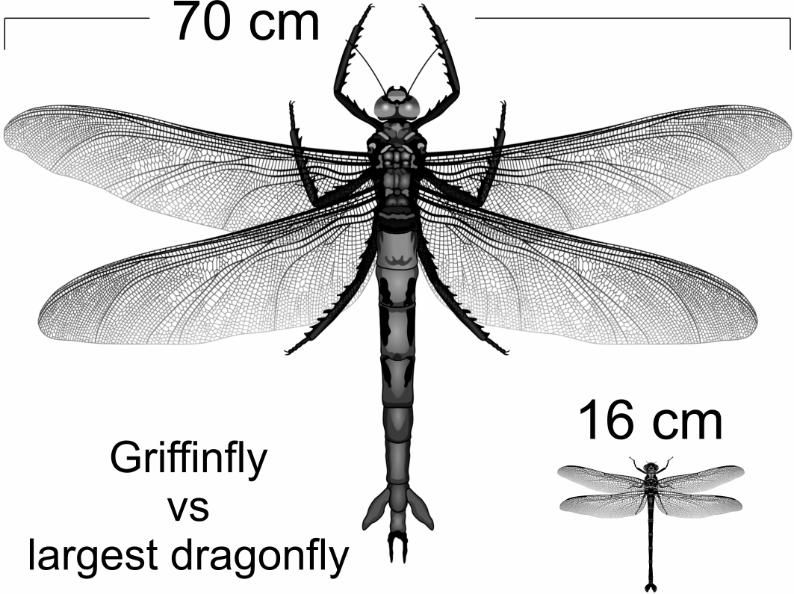 A schematic comparing the size of 300-million-year-old griffinflies with modern-day dragonflies.
Now oxygen concentrations are much lower, scientists reasoned there wasn’t enough oxygen available to fuel this anatomy.
But research published today in leading international journal Nature debunks this long-held theory – new microscopy and anatomical mapping techniques imply that insects could get sufficient oxygen from current atmospheric conditions to still grow huge.
So why don’t they? And what can this tell us about other animals and their evolution?
“The natural world and the weird and wonderful creatures in it never cease to surprise us,” said Dr Nicholas Payne, a co-author, from Trinity’s School of Natural Sciences.
“We found that the specialist structures that supply oxygen in insect flight muscles typically only take up 1% of anatomical space in most species, and this ratio hardly varies across living insects, ranging from the smallest to those with a mass around 10,000 times larger."
“This indicates that flying insect size is unlikely to be constrained by atmospheric oxygen levels as the insects could easily compensate for different levels by adjusting the number of these specialist structures in the muscle, as they take up so little space.”
“Ultimately, it’s a bit of a headscratcher as to why living insects don’t really invest a lot into their oxygen supply infrastructure as they get larger, and it also raises a bunch of questions about other animals going forward.”
“Right now there’s a lot of debate about how climate change is pushing oxygen from our oceans and whether this might cause fish to ‘shrink’ in the future, for example. Those debates centre around geometry, and how evolution may be shackled by anatomical limits, as the insect study considered."
“But clearly we still have a lot to learn about how oxygen impacts animal size — and predicting how animals will evolve is one of science’s abiding challenges.”
To read the newly published research, visit the journal website.
Media Contact:
Thomas Deane | Media Relations | deaneth@tcd.ie | +353 1 896 4685