
Meet “Damhán Alla” – the newly christened spider-like feature on Jupiter’s Moon Europa
Posted on: 02 December 2025
Irish planetary scientists have christened a spider-like feature on Jupiter’s icy moon Europa as “Damhán Alla”, which translates to “spider” or “wall demon”.
First observed by NASA’s Galileo spacecraft, a newly published study invoking commonly found features on Earth’s frozen lakes explores how the feature may have formed from briny water eruptions beneath the ice, offering clues about subsurface liquid water and the potential for life on Europa.
The scientists behind the research – and subsequent naming – are led by University of Central Florida physics Professor Lauren Mc Keown, a Trinity College Dublin alumna, and include Dr Jennifer Scully, another Trinity alumna, as well as others from NASA’s Jet Propulsion Lab (JPL), Brown University and the Planetary Science Institute. They have just published their findings in The Planetary Science Journal.
Using Earth’s lake stars as analogues, combined with field observations, lab experiments and modelling, the researchers hope to gain valuable insights into how this enigmatic icy feature formed, which could have implications for future missions that might land on Europa and other icy, airless worlds.
Prof. Mc Keown’s interest in space began as a teenager when she first learned about the Cassini spacecraft, which explored Enceladus, a small icy moon of Saturn.
“I was fascinated by animations in an RTE News story showing a water plume shooting miles above the moon’s surface and the possibility that liquid water, or even an ocean, might exist there,” said the Churchtown, Dublin native. “It encouraged me to explore NASA’s website to learn more about icy planetary surfaces and eventually pursue a career in planetary science at Trinity College Dublin.”
“During my PhD with Dr Mary Bourke, a professor at Trinity, I pursued a dream project, funded by the then Irish Research Council, investigating the role of ice sublimation as a driver of surface change on Mars. I also got to intern at NASA and Mary connected me with NASA scientists, including her collaborator, Dr Serina Diniega, who I eventually ended up working with for my postdoc at NASA JPL.”
“There are only a handful of Irish planetary scientists – and Jen had conducted some very prominent research on the Dawn mission and also went to Trinity – so I knew of her, but we didn’t meet until a conference in the US. It was so great to have a friend from home when I arrived at JPL and I was so excited to get to work together on this project to investigate whether Europa’s Manannán crater `spider’ feature formed in a similar manner to Earth’s lake stars. Jen conducted geomorphological analysis of the feature using images from Galileo and I ran analogue experiments and field tests to examine our hypothesis.”

Prof. Lauren Mc Keown beside icy water in which the radial pattern of a "lake star" can be seen. Image: Prof. Lauren Mc Keown.
Prof. Mc Keown and team learned that the Europa community had informally dubbed the Manannán feature a “spider”, so she wanted to give it a new name to differentiate it from similar spider-like features on Mars that form via very different gas flow processes, while also preserving the feel.
“Because Jen and I are Irish, and because many landforms on Europa already have Irish and Celtic names – including the crater in which the feature is located, which refers to the Irish mythology `Son of the Sea’ – we decided to call it the Irish word for spider; Damhán Alla. I love, miss and am so proud of my home, so I am delighted to acknowledge my Irish roots in this work.”
While the “spiders from Mars” form when dust and sand are eroded by gas escaping from below a seasonal dry ice layer, Prof. Mc Keown and colleagues believe Europa’s “asterisk-shaped” feature may have formed after impact, when liquid brine within the icy shell extruded through broken-up ice from impact to form a pattern similar to Earth’s lake stars.
Lake stars are radial, branching patterns that form when snow falls on frozen lakes and holes form in the ice, allowing water to flow through the snow, melting it and spreading in a way that is energetically favourable.
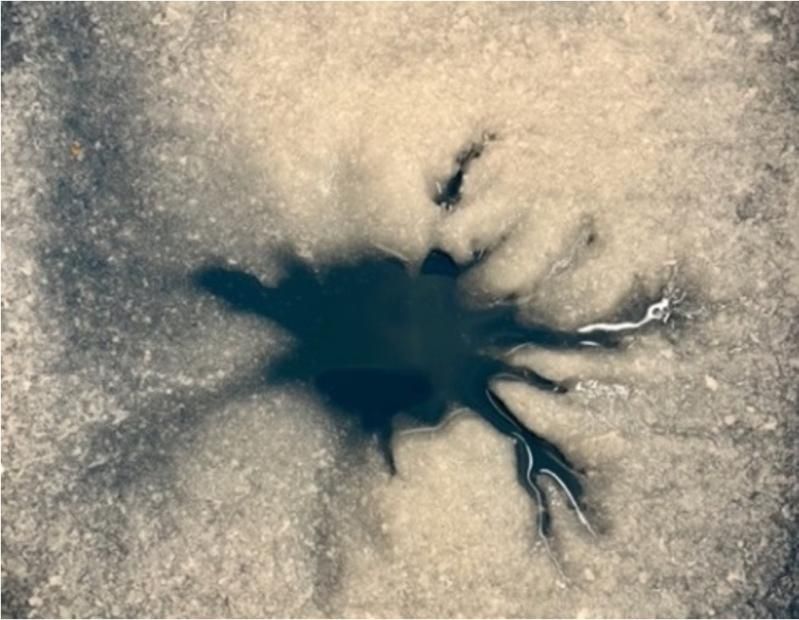
A small dendritic “lab star” developed by flowing liquid water through Europa granular ice simulant in a cold glove box at NASA JPL. Image: Prof. Lauren Mc Keown.
Dendritic patterns like these are common in nature, appearing in Lichtenberg figures created by lightning strikes, in beach rilles where tides flow through sand, and in many other systems where fluid flows through porous surfaces.
Observations of Europa’s icy feature have so far been limited to images from the Galileo spacecraft, but Prof. McKeown’s team hopes to resolve this question with higher-resolution imagery from the Europa Clipper mission, a NASA spacecraft scheduled to arrive at the Jupiter system in April 2030.
“The significance of our research is really exciting,” she says. “Surface features like these can tell us a lot about what’s happening beneath the ice. If we see more of them with Europa Clipper, they could point to local brine pools below the surface.”
Looking ahead, Prof. Mc Keown plans to investigate how low pressure affects the formation of these features and whether they could form beneath an icy crust, similar to how lava flows on Earth beneath an almost solid overlying crust.
She is setting up a new lab at UCF, called the FROSTIE (Facility for Research Observing Simulated Topography of Icy Environments) Lab, where she is designing a low-pressure chamber specifically for these experiments. Working with students, she will create icy simulants while continuing to collaborate with teams at JPL.
And Prof. Mc Keown hopes this tale of Damhán Alla and its wider implications will inspire more Irish researchers to jump into planetary science research.
“I would love to see our small Irish planetary contingent grow even more and I would be excited to meet future early career Irish planetary scientists. I hope that this work captures the interest of Irish people and inspires them to look more closely at frozen lakes if it snows this year or next,” she adds.
“Lake stars are really beautiful, and they are pretty common on snow or slush-covered frozen lakes and ponds. It is wonderful to think that they may give us a glimpse into processes occurring on Europa and maybe even other icy ocean worlds in our solar system.”
Media Contact:
Thomas Deane | Media Relations | deaneth@tcd.ie | +353 1 896 4685