
OpenIreland testbed transitions to ADAPT; expands into AI-driven network sensing
Posted on: 15 January 2026
The OpenIreland testbed, a nationally significant and internationally connected research infrastructure supporting experimental research in open, programmable networking, is entering a new phase within the ADAPT Research Ireland Centre at Trinity.
This transition secures long-term sustainability for the testbed while strengthening its core research on artificial intelligence and machine learning applied to network control, in line with ADAPT’s focus on AI-driven digital technologies. As part of this evolution, OpenIreland is expanding its scope to include network-enabled sensing, reflecting the growing role of networks not only in transporting data but also in sensing and understanding the world around them.
Located within ADAPT in the School of Computer Science and Statistics at Trinity, the OpenIreland testbed demonstrates how modern, AI-enabled network infrastructure can operate as an active sensing platform. Beyond traditional data transfer, the testbed enables real-time monitoring and analysis of environments, physical infrastructure, and complex systems, showcasing how AI and machine learning can be applied to network sensing as a natural extension of intelligent network control.
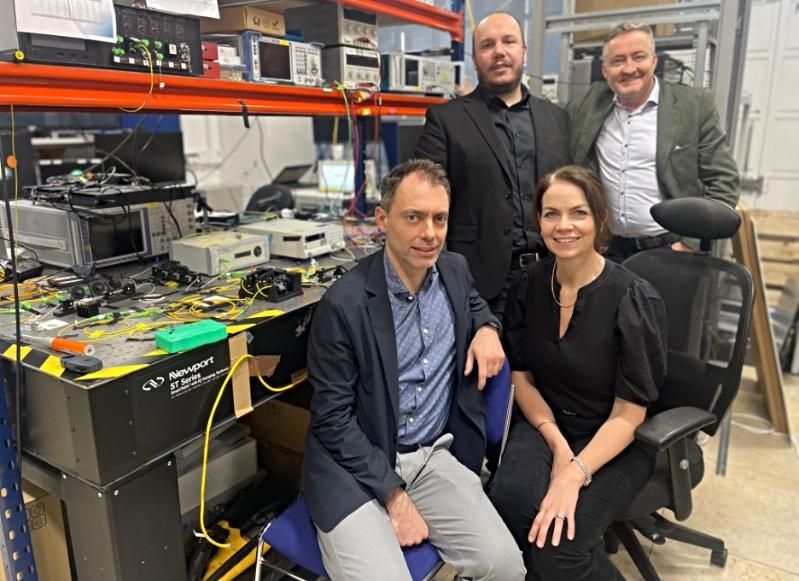
A defining feature of OpenIreland is its use of fibre-based infrastructure, which provides a shared foundation for experimentation. Traditionally, fibre networks have been used to transmit large volumes of data quickly and reliably. Now that same infrastructure is being used in new ways, enabling researchers to explore how networks can also detect changes, measure conditions, and support real-time analysis.
By enabling sensing directly over the network, researchers can combine optical, wireless and software-driven technologies to study how distributed systems behave, respond and adapt. This shift makes the research more relevant to real-world challenges, where communication, monitoring and intelligence increasingly need to work together.
This evolution to networking and sensing opens new research opportunities across domains such as smart infrastructure, environmental monitoring, resilient systems and AI-driven optimisation, while retaining the testbed’s original strength in open, programmable network experimentation.
The research team has engaged in collaborative experiments with a wide range of academic partners, including Dublin City University (DCU), University College Dublin (UCD), Federal University of Espírito Santo (UFES, Brazil), Chalmers University of Technology, Tallinn University of Technology, Politecnico di Milano, and the University of Bristol.
The availability of shared, real-world research infrastructure is also a key factor in successful industry engagement. To date, collaborations have involved organisations such as NTT, NEC, Intel, and ESB, alongside leading research institutes including Fraunhofer, NICT (Japan) and IMEC. Additional industry collaborations, including with Dell-EMC and Telefónica, are currently in development.
The testbed builds on significant national investment in advanced telecommunications and networking research in Ireland, supporting long-term capability development and international collaboration.
Speaking about the infrastructure, Professor Marco Ruffini, said: “What we’re seeing with OpenIreland is a natural progression from networking research towards integrated networking and sensing. By building on a fibre-based infrastructure, we can support experiments that combine communication, sensing and intelligent systems in ways that are highly relevant to both research and industry. Having this kind of open, shared infrastructure within ADAPT makes it much easier to collaborate internationally and to engage companies early in the research process.”
As OpenIreland continues to grow, it will play an increasingly important role in supporting experimental research, international collaboration and industry engagement, while contributing to Ireland’s visibility in next-gen network and sensing technologies. The testbed exemplifies how shared research infrastructure can drive innovation and enable new forms of collaboration across academia, industry and society for the benefit of all.
Media Contact:
Thomas Deane | Media Relations | deaneth@tcd.ie | +353 1 896 4685