
Irish Cancer Society invests in groundbreaking TSJCI research
Posted on: 20 March 2026
To coincide with Daffodil Day 2026, it is a good time to explore four research projects at the Trinity St James’s Cancer Institute (TSJCI) that have been funded by the Irish Cancer Society.
Cancer research at the Trinity St James's Cancer Institute (TSJCI) changes lives. Supporting the important funding efforts of the Irish Cancer Society, not only at Daffodil Day, but throughout the year allows this exceptional research to continue.
Here three Principal Investigators write about these research projects, led by their clinical leaders.
1. Enhancing immunotherapy efficacy with electric fields for paediatric brain tumours by Claire M.Gardiner
Principal Investigators: Eimear Mylod and Clair M. Gardiner (pictured)
Funding scheme: Irish Cancer Society Cancer Research Seed Funding Award 2024

Brain tumours can be devasting for patients and their families. They are difficult to treat and innovate multi-modal treatment approaches are required. Immunotherapy has heralded some of the most significant breakthroughs in cancer treatments in living memory e.g. immune checkpoint drugs and new cell therapies e.g. CAR-T are having big impacts in the clinic. Immunotherapy clinical trials involving CAR-T and newer CAR-NK cells are even showing promise with hard-to-treat brain cancers.
Currently, brain tumours are treated using a combination of surgical debulking (depending on location), conventional chemotherapy and radiotherapy. There is also a novel FDA approved treatment for adults called Tumour Treating Fields (TTF) in which patients wear a cap fitted with electrodes. Electrical currents are passed through the tumours and disrupt cancer growth. This TTF treatment is not yet approved for children although off-label use show a favourable safety profile. If we want to combine immunotherapy and TTF, we need to know that they can work together. This work investigated how TTF impact of NK cells. We found that it did not affect their viability of their ability to make cytokine. It also boosted their ability to kill cancer cells. This is exciting and warrants further investigation to see if combining TTF and NK cell based immunotherapy for paediatric brain tumours can improve outcomes.
The Trinity St James’s Cancer Institute (TSJCI) is proud to support two excellent clinical leaders in cancer survivorship who are delivering projects aimed at improving the quality of life of patients undergoing cancer treatment. Both initiatives are co-led by Academic Principal Investigator Dr Emer Guinan, (pictured), Associate Professor in Cancer Rehabilitation and Survivorship at TSJCI.

2. Developing a Patient-Centred Clinical Pathway for Managing Frailty in Older Adults Initiating Cancer Treatment in Acute SACT Hospitals written by Emer Guinan
Principal Investigator: Dr Emer Guinan
Funding scheme: Irish Cancer Society Cancer Nursing Research Award 2025
Elizabeth Meade is an experienced Advanced Nurse Practitioner in Oncology at Midland’s Regional Hospital Tullamore (MRHT) and a recent graduate of the MSc in Cancer Survivorship at Trinity College Dublin. As part of her MSc research with Dr Guinan, Elizabeth identified that 80% of patients aged over 65 commencing systemic anti-cancer therapy (SACT) at MRHT had positive frailty assessments, indicating significant physical and psychological needs.
In March 2026, Elizabeth began work on an Irish Cancer Society Cancer Nurse Research Award. This project will examine how pre-treatment frailty affects cancer treatment outcomes and will engage key stakeholders in designing a patient-centred pathway to better assess and address frailty among patients aged over 65 attending MRHT. The findings will inform the development of an evidence‑based, stakeholder‑informed pathway with potential applicability across many acute SACT hospitals nationally.
3. The Effect of Aerobic Exercise Immediately Before Infusion Therapy on Cardiorespiratory Fitness in Cancer Patients: A Randomized Controlled Trial written by Emer Guinan
Funding scheme: Irish Cancer Society AHP Cancer Research Award 2024
Aoife McGovern is a Clinical Specialist Physiotherapist in Oncology at the Beacon Hospital with a strong interest in integrating exercise into cancer care. In 2024, she received the Irish Cancer Society Allied Health Professional Cancer Research Award to deliver the PACE‑CRC trial at the Beacon Hospital, which is exploring innovative ways to embed exercise within treatment pathways for patients undergoing chemotherapy.
The trial, which opened in September 2025, randomly assigns participants to one of two groups; an educational session with the Clinical Specialist Physiotherapist, offering advice and resources to support physical activity during chemotherapy, or a supervised exercise intervention, delivered on an exercise bike located on the oncology day ward while patients wait for their infusion, maximising convenience and minimising patient burden.
This pragmatic design aims to provide a patient‑centred, feasible model for incorporating exercise into routine cancer treatment. The results will inform safe, scalable approaches to exercise integration across a variety of clinical settings.
4. Pelvic Health in Oncology: The Role of Rehabilitation written by Grainne Sheill
Principal Investigator: Dr Grainne Sheill
Funding scheme: Irish Cancer Society Cancer Research Networking Award 2025
Pelvic health can be significantly affected in individuals diagnosed with cancer. Surgery, radiotherapy, chemotherapy and hormonal therapies may lead to challenges such as urinary or faecal incontinence, pelvic pain, sexual dysfunction, lymphoedema and changes in bowel or bladder control. These symptoms can deeply impact physical function, emotional wellbeing and overall quality of life, making timely and specialised pelvic health rehabilitation a crucial component of cancer survivorship care.
The Trinity St James’s Cancer Institute received an Irish Cancer Society Networking Award to organise a dedicated event on pelvic health rehabilitation, held at St. Luke’s Hospital in Rathgar. The event brought together 40 clinicians, researchers and patient advocates to highlight the vital role of pelvic rehabilitation across prostate, colorectal and gynaecological cancers. The programme featured presentations exploring evidence‑based approaches to managing pelvic dysfunction after cancer treatment, alongside engaging panel discussions centred on clinical cases. A patient representative shared her personal experience of pelvic rehabilitation and the impact it had on her recovery and quality of life. The event highlighted the importance of accessible, specialised pelvic health services for cancer survivors across Ireland.
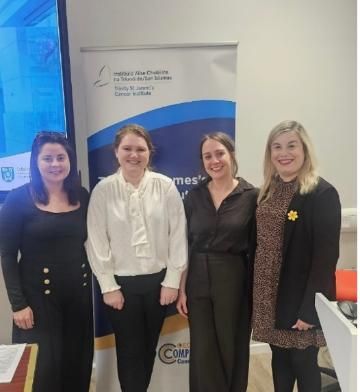
Event Organisers: left to right, Grainne Walsh (SLRON), Dr Grainne Sheill (TSJCI), Louise Kelly (TSJCI), Dr Claire Kilty (Irish Cancer Society)
Media Contact:
Ciara O’Shea | Media Relations | coshea9@tcd.ie | +353 1 896 4204