Trinity geneticists seek new treatments for devastating childhood dementia
Posted on: 27 January 2026
European Rare Diseases Research Alliance funding of €440,000 will allow the team to seek new treatments for Multiple Sulfatase Deficiency, an ultra-rare, deadly, inherited disorder where the body can't properly break down fats and sugars.
MSD develops within the first two years of birth and ultimately leads to a devastating and toxic buildup in cells, especially the brain, causing progressive neurological decline. While severity of the condition can vary, the average life expectancy is just 13 years of age, with many children dying much younger.
Here, working in collaboration with an EU consortium led by paediatrician Prof. Lars Schlotawa at the University Medical Centre Gottingen (UMG), Germany, scientists from the Smurfit Institute of Genetics in Trinity will work to better understand how the disease works and assess potential new treatments.
Trinity’s Dr Gergo Porkolab, postdoctoral research fellow and co-PI on the grant, said: “I’m delighted we have secured this funding to further our understanding of what is a truly devastating disease. We are now well positioned to explore potential therapeutic strategies for patients in the future.”
Prof. Matthew Campbell, Head of the Genetics department at Trinity and Chair of Neurovascular Genetics, added: “We are incredibly excited to host this project in our lab in the Genetics department at Trinity. Within the next three years, we are going to see some major developments in this field and Trinity scientists will be at the forefront.”
MSD research has been spearheaded in the past by Alan Finglas, a co-founder and research manager of MSD Action Foundation/SavingDylan.com. Alan’s son Dylan was born with the condition in 2012 and sadly passed away in March 2025.
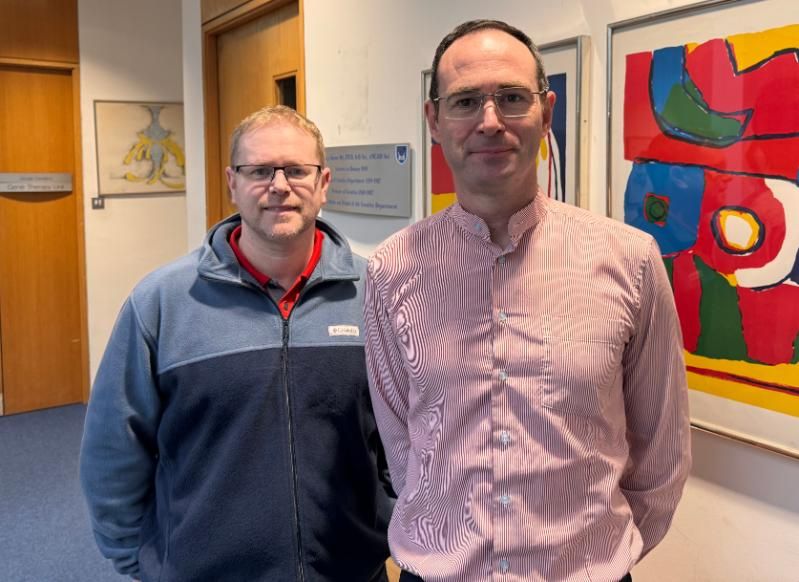 Alan Finglas and Prof. Matthew Campbell in Trinity's Smurfit Institute of Genetics. Image: Prof. Matthew Campbell.
Speaking today about the new funding Alan Finglas commented: “I’m delighted to be involved in this consortium that will lead one of the largest ever research projects focused on MSD. The coming together of the research teams was years of work, networking and unwavering dedication by Prof. Schlotawa.”
“It gives me great confidence that we may have effective treatments for patients in the years to come and I am delighted that Trinity are playing a major role. This research represents a tremendous legacy for Dylan and all other patients and families that have been battling against MSD.”
As part of the project in Trinity, a postdoctoral researcher will screen the efficacy of novel drugs to treat the neurological effects of MSD. There was much preliminary research on MSD in recent years that enabled this project. MSD Action Foundation assisted with funding and collaborated to characterise new pre-clinical models that are essential for this study.
Also, in other critical preliminary research, The Health Research Board and MSD Action Foundation co-funded the screening of a drug repurposing library of 5,600 drugs on MSD cells at Fraunhofer and UMG.
Prof. Campbell added: “There are over 50 drug hits from this that must be narrowed down robustly, developed into drug formulations and tested further on MSD models in the lab. We expect that some drugs will translate to real and meaningful therapies for patients in the future, and there is hope that some of the drugs could also help related conditions.”
Media Contact:
Thomas Deane | Media Relations | deaneth@tcd.ie | +353 1 896 4685