Celebrations to mark 250 years of modern languages at Trinity
Posted on: 30 January 2026
A series of events will be held throughout the year to commemorate this historic initiative. The ‘Languages 250 at Trinity (1776-2026)’ programme will showcase the important work of the School of Languages, Literatures and Cultural Studies and promote the cause of modern language education on the island of Ireland.
The School of Languages, Literatures and Cultural Studies last night kickstarted a year of celebrations to mark 250 years of modern languages in Trinity.
Trinity College Dublin was the first university in these islands to introduce the study of modern continental languages. In 1776 Trinity appointed professors in French, German, Spanish and Italian. They were the first university Chairs in modern languages and, in the case of the Chairs in French and German, the oldest continuous Chairs in these languages in the world.
The establishment was spearheaded by the newly appointed Provost John Hely Hutchinson, motivated by his desire to equip college graduates with language skills for foreign travel and cultural engagement, opening them up to the exciting possibilities of Enlightenment Europe.
Last night’s opening ceremony in Trinity Long Room Hub featured an address by Pat Cox, President, Jean Monnet Foundation and former President of the European Parliament.
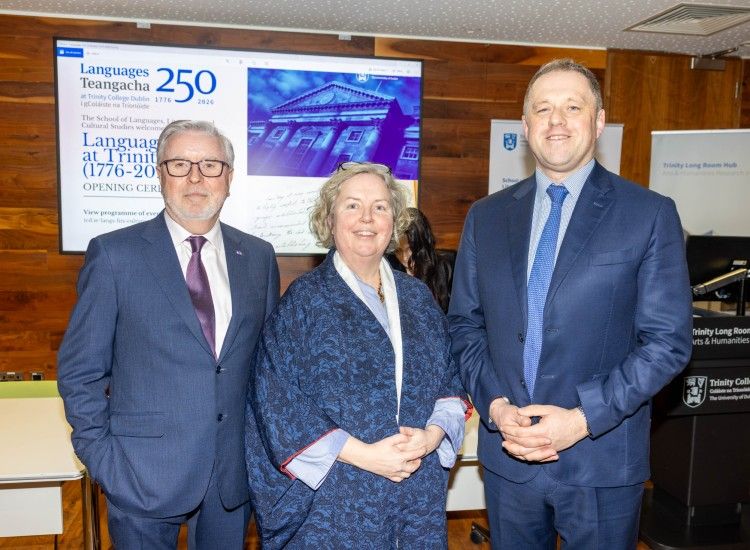 Pat Cox is pictured above on left with Provost Dr Linda Doyle and Thomas Byrne, T.D, Minister of State for European Affairs
Pat Cox said: “We are marking one of the world’s and Ireland’s most enduring academic traditions, the institutionalisation of modern language teaching in French, German, Italian and Spanish established through professorships here at Trinity College Dublin 250 years ago.
“Beyond history, the marketplace, career opportunity, and technological aids, fluency in a foreign language builds a self-enriching bridge to new cultures, literature, cinema, networks and friendships, offering a different prism through which to view the world. A shared language confers a sense both of connection and belonging even in the most trying of contexts.”
Provost of Trinity College Dublin Dr Linda Doyle responded:
“Trinity is immensely proud of its 250-year-old tradition in modern language education and remains committed to the promotion of modern languages to create a more open, tolerant, and culturally diverse world.”
Starting in January, a series of events will be held throughout the year to commemorate this historic initiative. The ‘Languages 250 at Trinity (1776-2026)’ programme will showcase the important work of the School of Languages, Literatures and Cultural Studies and promote the cause of modern language education on the island of Ireland.
Highlights include a conference on ‘Translation in Ireland: Past and Future’ in May and in October a conference on ‘Modern Languages in Irish Life’. Also in October, the Hely-Hutchinson memorial lectures will be delivered by Professor Yves Citton, Université Paris 8 (Vincennes-Saint Denis) and author Ulrike Draesner.
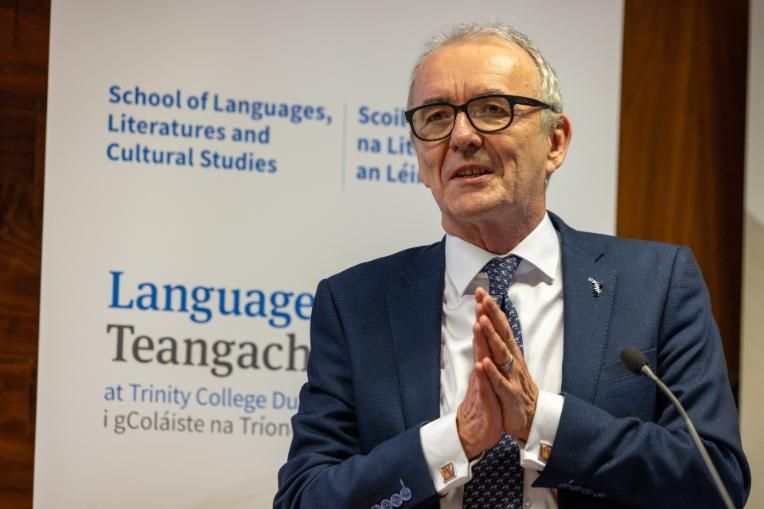
Michael Cronin, Chair of French 1776 (above), said:
“The celebrations in 2026 represent a unique opportunity to honour Trinity College’s pioneering role in modern language education, and to build on this legacy to further deepen and strengthen Ireland’s European connections.”
Mary Cosgrove, Professor of German 1776, said:
“The origins of the Chairs of Modern Languages some 250 years ago was a matter not just of institutional, but of national and international significance: their establishment put Trinity, and Ireland, on the map as a pioneer of Modern Languages education at the highest level. In this history, Trinity emerges as a radical, modernising force.
“The advent of the Chairs was furthermore in line with a revolutionary spirit and progressive sensibility as proclaimed in the American Declaration of Independence of 1776: the Chairs’ emergence indicates the start of a democratising shift, in the university context, from the ancient to the modern, from the study of classical languages to the learning of vernacular and foreign languages.”
Timeline: Chairs of Modern Languages in Trinity:
4 August 1774: Newly appointed Provost John Hely Hutchinson outlines his proposal to the Board of Senior Fellows that ‘it would be highly useful to have Professors of the modern Languages established in the college’
August 1775: R. Antonio Vieyra Transtagano arrives in Trinity to teach Spanish and Italian (Vieyra is the author of a Portuguese-English dictionary and a Portuguese grammar)
September 1775: Anthony D’Esca arrives in Trinity to teach French and German (Voltaire scholar, born in Berlin)
29 October 1776: Letter from King George III confirming appointment of two professors and granting sum of £200 per annum from the royal estates in Ireland to be divided equally between them ‘and to commence from the 29th day of September last.’
15 January 1777: Vieyra and D’Esca granted honorary degrees of LL.D.
26 January 1786: Rev. Frances Bessonnet appointed Professor of French (due to death of D’Esca in January 1785). Lt. Col. James Philip Hamilton appointed Professor of German.
1790-1801: Francis Amyot: Professor of French and German
1802-1841: Charles Willomier – Professor of French and German
1824: Evasio Radice – Professor of Italian and Spanish
1842-1866: Ignatius George Abeltshauser – Professor of French and German
1849: Basilio Angeli – Professor of Italian and Spanish
1866-1907: Albert Maximilian Selss – Professor of German
1862: Augusto Cesare Marani – Professor of Italian and Spanish
1869: Robert Atkinson – Professor of Romance Languages (French, Italian and Spanish combined)
1907: Maurice Alfred Gerothwohl – Professor of Romance Languages
1907: Robert Alan Williams – Professor of German
1909: Thomas B. Rudmose-Brown – Professor of Romance Languages