
Need for human rights approach in dementia care highlighted
Posted on: 11 December 2025
A panel discussion on the theme of dementia and human rights was held this week to mark the launch of a new book 'Human Rights in Dementia Care: A Good Practice Guide' co-authored by Professor Suzanne Cahill, School of Social Work and Social Policy.
Speakers at the event were Professor Eamon O’Shea (Chair), Director of the Centre for Economic and Social Research on Dementia at University of Galway; Professor Suzanne Cahill, School of Social Work and Social Policy, Trinity; Dr Helen Rochford Brennan, Global Dementia Ambassador; and Dr Fiona Kelly, former Lecturer in Nursing, School of Health Sciences, Queen Margaret University, Edinburgh.
The book, written by Prof Cahill, Dr Fiona Kelly and Dr Helen Rochford Brennan, has been written for health care professionals and for family caregivers. Its aim is to provide the tools required to enable paid and unpaid caregivers to use a human rights-based approach in dementia care.
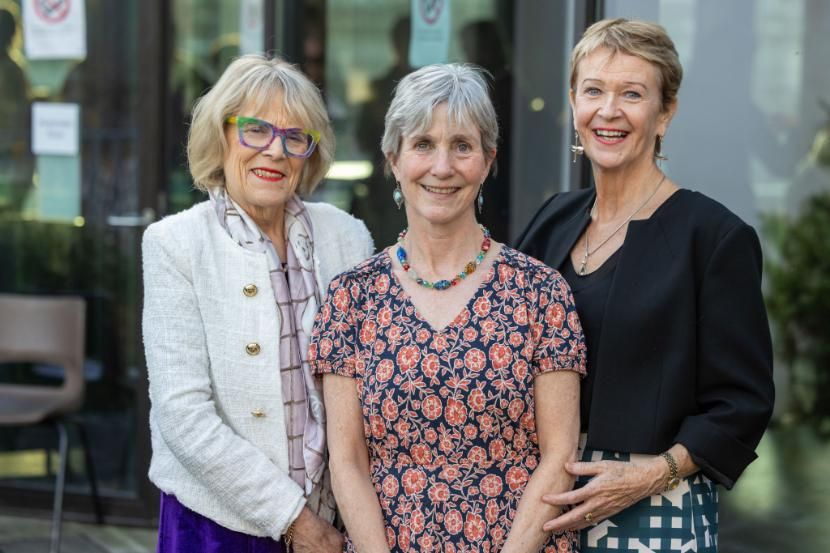
Dr Helen Rochford Brennan, Professor Suzanne Cahill and Dr Fiona Kelly
Professor Suzanne Cahill said: “The conventional thinking about dementia is that it is a cognitive brain disorder, that causes memory loss and progressive cognitive and functional decline. In this book we challenge conventional thinking and argue that dementia can also be seen as a disability and viewed through a human rights lens. The disability framing is important as it forces us to think about fairness and equality issues and what we in society can do, to help to improve the individual’s quality of life.
“The human rights lens is also important as in the past, the person diagnosed was often marginalised, stigmatised and reduced to the status of a non-person with many if not all of their human rights removed. Examples of such rights include the rights to participation, autonomy, choice, non-coercive practices, privacy and family life and dignity-enhancing care.
“Drawing on the research evidence, first person narratives and using case studies and reflective exercises, the book encourages the reader to think about the person not as a “patient” but as a “rights holder”, and as an active participant in their own health and social care.”
Andy Heffernan, Chief Executive of The Alzheimer Society of Ireland, added: “Human Rights in Dementia Care powerfully illustrates how a rights-based approach can be applied from diagnosis through to end-of-life care. Grounded in lived experience, practical models, and the application of international conventions, this book is an essential guide. It challenges us all—constructively and positively—to reflect on and transform our approach to dementia care in Ireland.”
Media Contact:
Fiona Tyrrell | Media Relations | tyrrellf@tcd.ie | +353 1 896 3551