
Sitting and sedentary behaviour
How sedentary are you?
As well as aiming to meet the physical activity guidelines it is important to also try and minimise the amount of time spent sedentary. Adults gain additional health benefits by breaking up periods of prolonged inactivity.
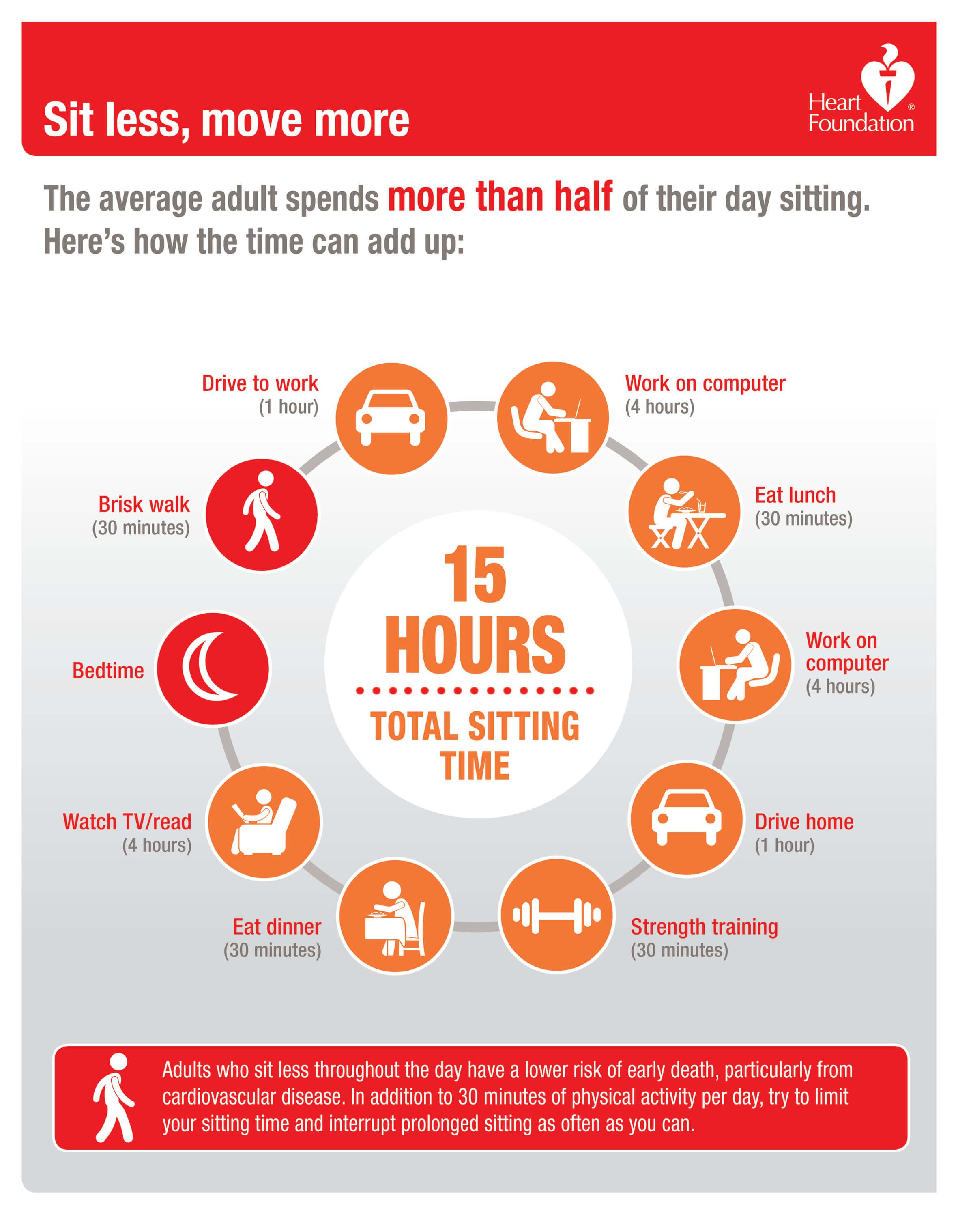
It may be useful to consider a single day and track your physical activity and sedentary behaviour pattern over this time period. We have data to suggest that Trinity students sit for greater than eight hours each day. Pictured is an example of an adults total daily sitting time. How do you compare?
Often the results of assessing your sitting can be surprising. In the example, even though the adult walks for 30 minutes and completes a 30-minute strength training session, they still spend 15 hours of the day sitting. If this pattern is consistent throughout the week, the person would meet the physical activity levels however still be classified as sedentary. This highlights the importance of considering both physical activity levels and sedentary behaviour when reviewing your lifestyle.
Use this online calculator from the Irish Heart Foundation to calculate your sitting time.
Escape your Chair Challenge
We really like the Irish Heart Foundation's Escape your chair challenge. Read more here.
/filters:format(webp)/filters:quality(100)/prod01/channel_3/media/tcd/healthy-trinity/images/escape-your-chair.jpg)
Frequently Asked Questions about Sedentary Behaviour
Sedentary behaviour is becoming increasingly recognised as a public health problem which needs to be targeted. Reducing your sedentary behaviour can decrease the risk of all-cause mortality, cardiovascular disease, the incidence of Type 2 diabetes and some cancers.
People of all ages should avoid periods of prolonged sedentary behaviour and should minimise the amount of time being sedentary by replacing sitting with activities of light intensity or for additional benefits, by activities of moderate to vigorous intensity. This is relevant to all people, even those who are classified as physically active.
| At College / Work | While Travelling | At Home |
|---|---|---|
| Stand up and move around between lectures and classes | Walk or cycle if possible | Set an alarm each hour prompting you to stand and move |
| If working in the library stand up and take a break from your computer every hour | On public transport offer your seat to someone who really needs it | Limit your day screen-time |
| Set an alarm on your laptop to remind you to stand up and move | Stand for a portion of your daily commute | Stand up and move around during your favourite TV shows |
| Try standing while reading or on your laptop | Get on / off public transport one stop earlier than your destination and walk | Do some light exercise during ad breaks |
| Listen to recorded lectures on your headphones while walking around | Plan regular breaks for long car journeys |
Stand while you read |
| Do some chair exercises | Listen to podcasts of music while moving around or cleaning | |
| Have standing or walking exercises | Move around when on calls / texting | |
| Walk around during your lunchbreak | Do some housework when watching the TV |