

HAU44033/34 Images Between Nature and Cosmos in the Early Modern World
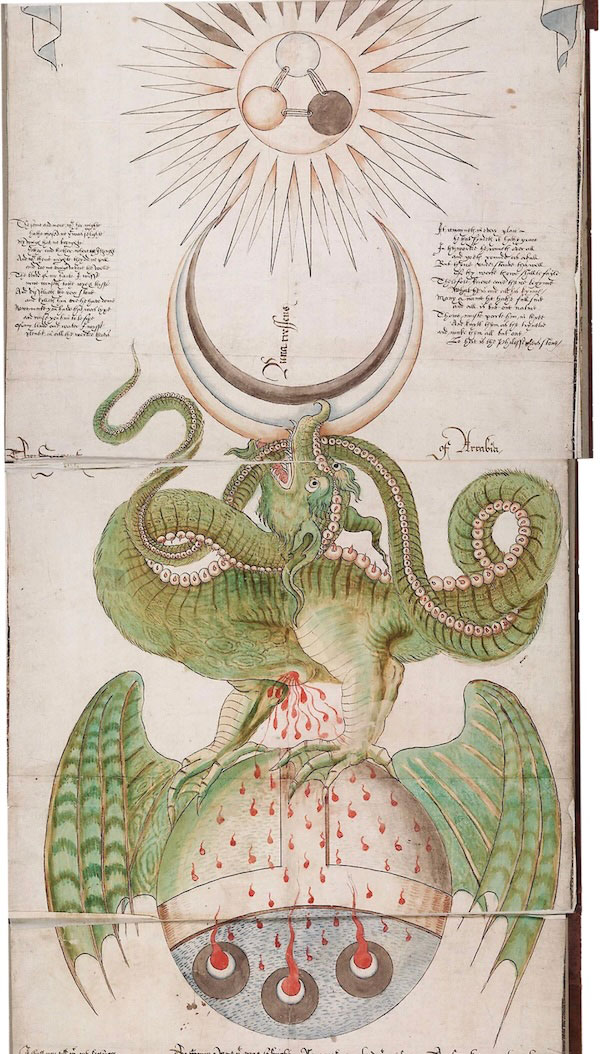
This module examines how images were used to visualise transformation and reveal hidden natural phenomena along the Early Modernity. Bringing together histories of art and science, it explores how visual culture shaped understandings of processes that were often considered invisible, mysterious, or inaccessible to direct observation. Throughout, the module investigates the production and circulation of global knowledge, considering how ideas, materials, and visual practices travelled across cultures and were reshaped through exchange.
During the first term, the module focuses on images of alchemical transformations and laboratories as they appear in manuscripts, printed treatises, and works of art. Students will examine the visual language of alchemical practice considering how artists and practitioners developed images to communicate material transformations and theories of nature. It will also explore alchemy's relationship to artisanal knowledge, including glassmaking, metalworking, and goldsmithing. The module also introduces the religious, philosophical, and esoteric traditions that informed these visual cultures and considers why such interconnected forms of knowledge were later marginalised within academic histories.
The second term turns to optic instruments, investigating images as visual technologies that transformed understandings of space, the natural world, and the unknown. Through selected case studies, students will explore how art works and maps negotiated observation, imagination, and scientific inquiry, while examining the political, cultural, and epistemological negotiations involved in the construction and representation of space. Particular attention will be given to the role of cartography in the visual construction of global knowledge and to the ways maps participated in processes of exploration, exchange, and empires.
During the first term, the module focuses on images of alchemical transformations and laboratories as they appear in manuscripts, printed treatises, and works of art. Students will examine the visual language of alchemical practice considering how artists and practitioners developed images to communicate material transformations and theories of nature. It will also explore alchemy's relationship to artisanal knowledge, including glassmaking, metalworking, and goldsmithing. The module also introduces the religious, philosophical, and esoteric traditions that informed these visual cultures and considers why such interconnected forms of knowledge were later marginalised within academic histories.
The second term turns to optic instruments, investigating images as visual technologies that transformed understandings of space, the natural world, and the unknown. Through selected case studies, students will explore how art works and maps negotiated observation, imagination, and scientific inquiry, while examining the political, cultural, and epistemological negotiations involved in the construction and representation of space. Particular attention will be given to the role of cartography in the visual construction of global knowledge and to the ways maps participated in processes of exploration, exchange, and empires.
- Module Organisers:
- Dr Vanessa Portugal
- Duration:
- Semesters 1 and 2
- Contact Hours:
- 2-hour seminar per week
- Weighting:
- 20 (10 + 10) ECTS
- Asessment:
- Continuous assessment (50%) and examinations (50%)
Learning Outcomes:
Upon the successful completion of this module students should be able to:
- Demonstrate a critical understanding of the relationships between artisanal crafts, scientific laboratories, and artistic studios, and their roles in the production of visual and material knowledge.
- Critically analyse visual, textual, and material sources from multiple disciplines, applying appropriate methodologies to support art historical interpretation.
- Contextualise the religious, scientific, philosophical, and political frameworks that shaped representations of nature and hidden phenomena, developing historically informed interpretations of images.
- Evaluate theories of visual culture and image-making to examine the agency of images as vehicles for the production, mediation, and transmission of knowledge across cultures.
- Analyse the spaces and environments in which visual practices took place—including laboratories, workshops, studios, and cartographic sites—to interpret their social, material, and epistemological functions.
- Assess the enduring influence of early modern scientific, artistic, and esoteric practices on later visual cultures, including their legacy in eighteenth-century thought and nineteenth-century movements such as Spiritualism and the Theosophical Society.