

Dr Cheryl Tan on Nineteenth-century Fortepianos, rediscovering Clara Wieck-Schumann’s unpublished repertoire, and revitalising musical scholarship
Tan has come to Trinity with a wealth of experience in both performance and academic disciplines across the UK and the US. Her current focus is the early years of pianist and composer Clara Wieck-Schumann. Talking with researchMATTERS, Tan discusses how Wieck and her female contemporaries shaped the musical canon in ways that have long gone unrecognised, drawing on her own experience with fortepianos – historical pianos from the nineteenth century and modern reconstructions – to offer direct insights into this forgotten music.
Clara Wieck-Schumann and the Forgotten Decades
Clara Wieck’s early career in the 1820s and 1830s coincided with the later life of Beethoven and the early careers of Chopin and Mendelssohn. Much of the music closely associated with this period of Wieck’s life has, according to Tan, often been dismissed by nineteenth-century and twenty-first-century critics alike as overly “virtuosic” and “frivolous.” Tan focuses on the genre of variations, which was a key focus of Wieck’s early career, and likewise indispensable to the careers of her successful male contemporaries.
“Scholars have called the variations that emerged at this time ‘ornamental’, ‘superficial’, ‘trivial’, and I’d like to actually put a name to them in my work,” she continues. “If we go by their published titles, we’d know them as concert variations, brilliant variations, grand bravura variations, but we just don’t use these names, which I think is bizarre because they tell us so much about the culture and what was being written.”
Tan highlights how different the culture of musical performance was at the time: people would queue up as soon as new scores based on popular operas were released, because there was no way for an audience member to reproduce the music they had previously heard. “The piano was a ubiquitous instrument, and at this time, in the absence of recording technology, one of the ways to re-experience this music is to play it for yourself. The tradition of composing adaptations, or ‘second-hand music’, on popular themes was not new. Around 1820, however, composers started performing highly virtuosic piano versions of popular opera themes, and created a new ecosystem around which music could be experienced and spectated. Publishers and virtuosos did not hesitate to make a huge profit from this!”
A key aspect of Tan’s postdoc is publishing modern editions of these works. Many of them have, surprisingly, been out of print for 200 years: in the classical western canon, it’s very rare for music in the mainstream repertoire not to be republished or reworked into new editions for so long, she explains. She focuses on the virtuosic works by Austria-born, French-naturalised composer Henri Herz. “This music was so popular in its heyday. Clara Wieck performed them extensively, but then she got married to the famous German composer Robert Schumann and this music virtually disappeared from her repertoire. Scholars often highlight this, and our understanding of this music often just stops there.” When working on unpublished scores from Clara Wieck’s pre-marriage years, Tan noticed that they look very different to the music she later performed as Clara Schumann. Later in her career, she was a huge advocate of Beethoven, Bach, Chopin, Mendelssohn, Schumann himself, and later still Brahms: names we readily recognise today. But that wasn’t always the case: in her early career, she focused on showy live music, often composed by her contemporaries.
 Fortepianos and Physical Experimentation
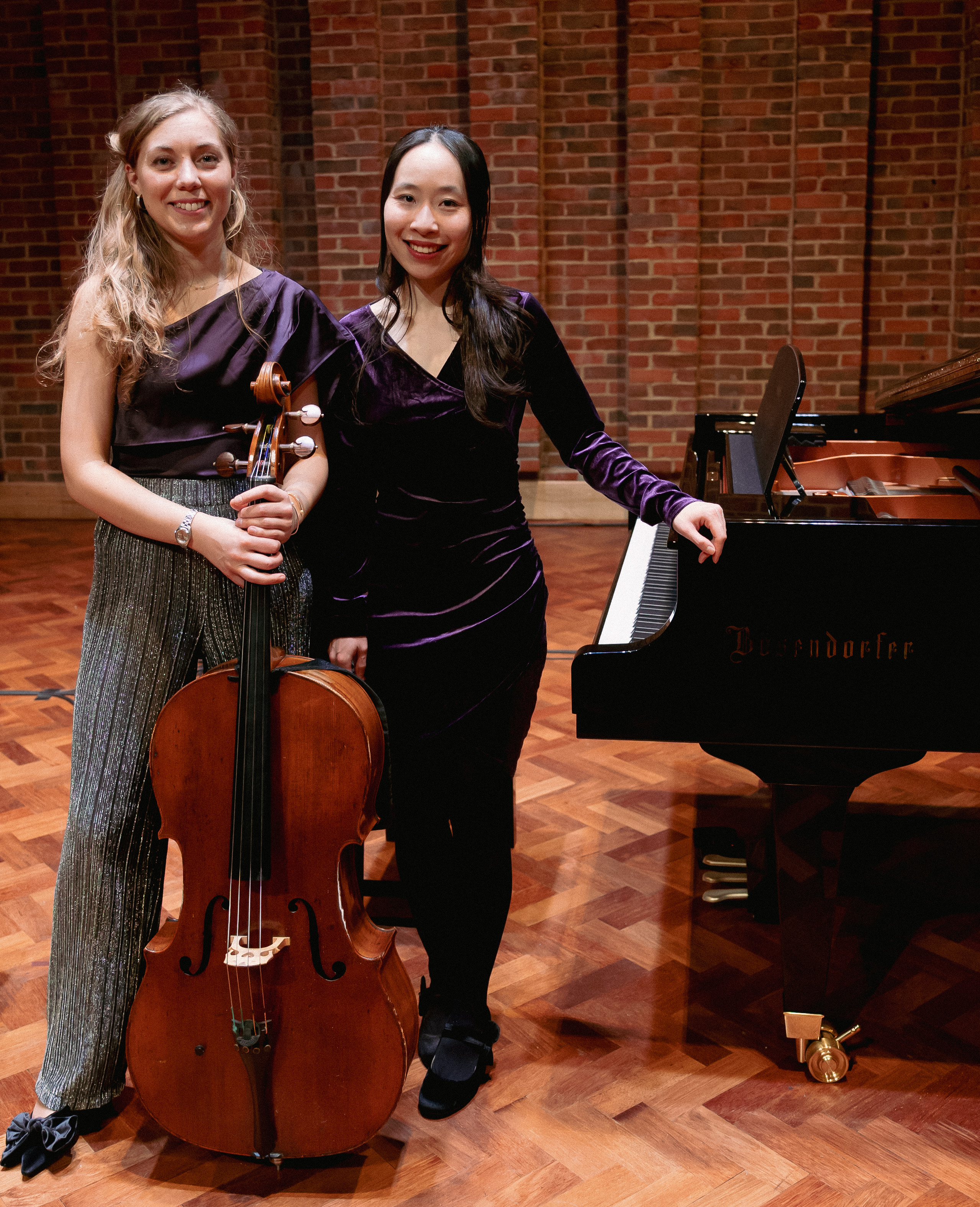
Tan herself is a professional pianist, and has delivered international recitals as one part of the Glamorgan Duo (pictured right) along with Tabitha Selley, cellist and fellow graduate of the Royal Welsh College of Music and Drama, Cardiff. “I often play lecture recitals,” says Tan. “I like to talk about the context and play snippets from a piece, to illustrate the performance, especially when using historical instruments.” This, she highlights, puts the instruments into dialogue with scholarship and historical research.
Last August they played at the Royal Irish Academy of Music’s Whyte Hall as part of The Expansive Canvas, a conference jointly held by Trinity and the RIAM. This year, they performed a mixed recital on both fortepiano and modern pianos at the University of Southampton, where Tan has held a lecturing post, working with postgraduate students. They performed as part of the annual Artistic Temperaments festival. Open to the public, the university brings out all of the fortepianos they have for the festival’s outreach activities, professional performances, talks and lectures. Tan organised an exchange for Trinity students to Southampton, where students had an opportunity to perform on these fortepianos and take lessons on them. She points out how it was an excellent opportunity - especially because the entire island of Ireland does not currently have readily playable nineteenth-century pianos, although historical instruments are held at institutions such as Maynooth University and the TU Dublin Conservatoire.
Tan has taken incredible opportunities to play on the kind of contemporary models that Wieck herself would have used. In fact, she has even played on Wieck’s original piano in the Robert Schumann House in Zwickau, Germany. Fortepianos are different in various ways to the pianos we use today: perhaps most notably in control over their sound production. “Everyone starts off on modern piano,” according to Tan, “and fortepianos remain a relatively niche area. One key difference is that the keys are lighter, requiring greater sensitivity to shape variations in sound. There are many ways of differentiating sound on other keyboard instruments like harpsichords and organs, but in terms of what we call touch – how your finger meets the key – the piano is uniquely responsive: contact alone can itself create so many tonal colours. That’s why I love it so much – you can do so much with just your fingers.”
The early piano’s delicate nature means that they are both difficult to access, preserve and maintain. Tan recounts an event as a Doctor of Musical Arts candidate at Cornell, in which she prevented a disaster happening: “we’ve got two rooms for our fortepianos. I got there one morning and it felt like the tropics. It turned out the temperature and humidity control had stopped working overnight and they had to evacuate all the pianos! I’m just glad I went to practise that morning otherwise no one might have known for days and the instruments could have been severely damaged.”
Tan has herself gained valuable experiences with nineteenth-century instruments thanks to her dedicated supervisors and teachers, some of whom even came out of retirement to offer individual guidance during her time at Cornell. Among them was internationally renowned fortepiano pioneer Professor Malcolm Bilson. Around the year 2000, he recorded all of Beethoven’s sonatas on historical instruments, along with his students, in Carnegie Hall. “I wish I had been there when all these amazing people were around,” Tan muses. “But the fact that I could have something of the same experience as them is really life changing, and I hope to carry the tradition on. Whatever resources I can access throughout my career, I’m going to make the most of it.”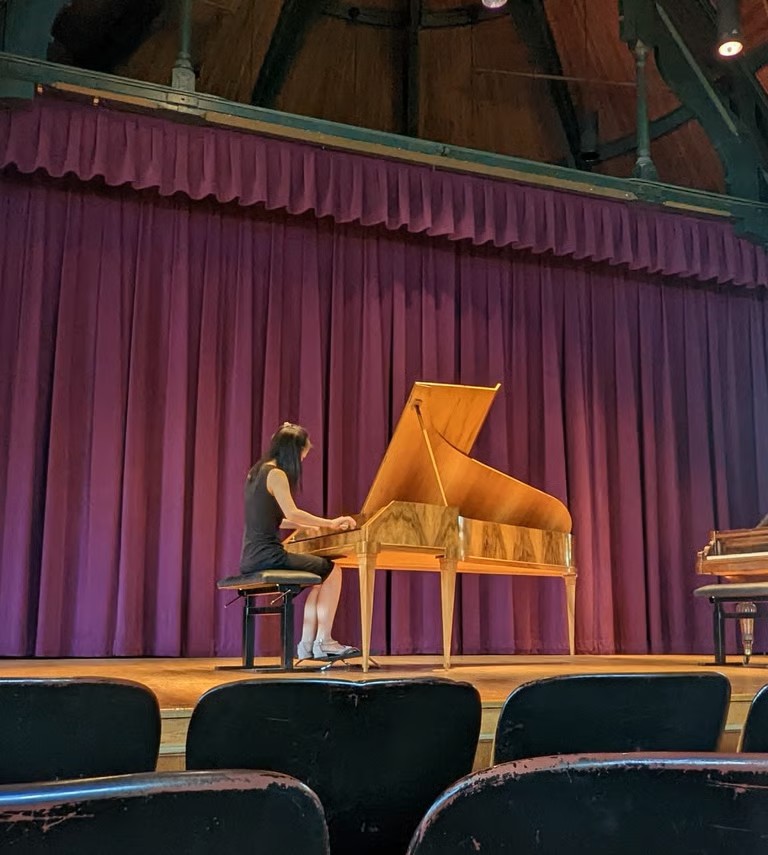 Trinity College Dublin: Live Performance, Archival Work, and Symposia
Experimenting with the fortepiano has itself been an invaluable source of discovery for her, in terms of understanding how music changes with evolutions of instruments. For example, Tan notes how the association of loudness with virtuosity may have arrived in the second quarter of the century, alongside increasingly powerful, louder pianos.
Her work questions these assumptions by rediscovering the subtleties and creativity that a fortepiano offers, but which modern instruments often obscure. While working in the archives, she discovered a piece by British composer Emma Macfarren, in which the piano score indicates ‘bells’. To achieve this effect on the piano, the performer is directed, through performance markings on the score, to play these notes in a soft and short manner, while putting the pedal down to capture the sound. “On a piano from the mid-1800s, this effect works beautifully. On a modern piano, however, the instrument’s greater resonance makes this effect difficult to realise. All these nuanced performance details are immensely rewarding for modern-day pianists, but trying to translate them for use today makes editing particularly challenging.”
Building upon this research, Tan is compiling a consolidated edition of nineteenth-century chamber music performed by Clara Wieck, to be published in A-R Editions, a Wisconsin-based publisher which advocates for under-represented music. Her preface to the edition will include her critical notes, detailing how she has evaluated the music and addressed discrepancies in the score, making the case for why this music is important, and why it should continue to be played.
While at Trinity, Tan continues to make connections between academia and performance. She originally met her advisor, Associate Professor of Music Dr Nicole Grimes, when she was based at the University of California, Irvine. When Grimes then returned to Trinity, her alma mater, in 2024, Tan got in touch. “I chose Trinity because of her. And then I realised that there are historic ties between the Royal Irish Academy of Music and Trinity.” Currently, Trinity music students attend the RIAM for instrumental lessons, but Tan is working towards further collaborations. “I’ve since given a lecture in the RIAM, and hopefully there will be more opportunities to really build on the historic connections between two very prestigious institutions.”
These connections will be built upon in the upcoming symposium she is organising,Rediscovering Celtic Heritage: Musical Legacies across the Irish Sea, on the 26th and 27th of February, taking place in the Department of Music and Trinity Long Room Arts and Humanities Research Institute. The theme will be Nineteenth-Century Celtic Heritage, due to Tan’s connections across Wales and Ireland. A particular focus is the music of Fanny Robinson, who was Southampton born, moved to Ireland, and built her career in the RIAM. Performance and academia will be extremely intertwined: with musical recitals, scholarly papers, and presentations from artistic practitioners and industry leaders who have come from across Ireland, Scotland, Wales, and the Isle of Man.
“I’d like to continue to work on this music with subsequent projects,” she adds. “There was a proliferation of piano music based on national airs in the nineteenth century, which meant there was a lot of music circulating on Scottish, Irish, and Welsh themes. They’re great fun to play, and are of a shared tradition with the kind of music I’ve been working on during my doctorate and as part of this Postdoctoral Fellowship. In the near future, I would like to pivot from Continental Europe to Britain, focusing on British female composers who wrote in various genres long perceived as ‘masculine’.”
The musical world has made significant progress in recent decades in reshaping the canon and bringing women composers to prominence. Tan feels fortunate to have witnessed, and taken part in, this shift through her own performing projects. “What excites me now is that we’re beginning to look beyond individual figures to entire musical cultures that were marginalised, including the traditions of Ireland and Wales. There is still an enormous amount to rediscover, and I hope to continue contributing to the broader understanding of our rich, diverse musical past.”
- Interview by Dr Sarah Cullen
Cheryl Tan
Cheryl Tan is a Postdoctoral Research Fellow in the School of Creative Arts, Trinity College Dublin. She is a pianist, fortepianist, researcher, and lecturer whose work focuses on keyboard culture of the long nineteenth century. She holds a Doctor of Musical Arts from Cornell University, where she studied historical performance practice. She previously studied in Britain, graduating from the University of Oxford with First Class and the Royal Welsh College of Music and Drama with Distinction. She has also taught across performance and academic disciplines, having held positions across Britain at the Universities of Southampton, Bristol, and Oxford, as well as at Cornell University in the United States. Shaped by her experiences as a pianist and scholar, her research into lost pianistic traditions and the works of women composers seeks to bring scholarship and practice into mutually illuminating dialogue.
- Cheryl’s website
- The Glamorgan Duo
- Rediscovering Celtic Heritage: Musical Legacies across the Irish Sea