

Alice Butler and Daniel Fitzpatrick on aemi, making space for the arts and supporting & exhibiting experimental film
Having worked as aemi’s founders and co-directors for ten years, film programmers Alice Butler and Daniel Fitzpatrick have now further strengthened their creative ties with Trinity by curating and co-ordinating their own film module, “Through Another Lens.” Butler and Fitzpatrick talk with #researchMATTERS about their collaborative artistic practices, supporting independent cinema, and the landscape of experimental film in Ireland.
Establishing aemi
Butler and Fitzpatrick founded aemi in 2016 to create more opportunities for film-makers and researchers to experience experimental cinema. Their collaboration was a result of their shared background in film in Dublin. Butler was a member of the programming department at the Irish Film Institute; her role included facilitating screenings by the Experimental Film Club, of which Fitzpatrick was a key curator. The concept of the film club came from a visit from avant-garde film-maker Jonas Mekas, a key figure in establishing the experimental film community in New York. He encouraged Irish film-makers to similarly screen more experimental film.
Fitzpatrick and Butler’s other work that highlighted a need for screenings in Dublin included PLASTIK festival of Artists’ Moving Image, which Fitzpatrick ran with film practitioners Jenny Brady, Sybil Montague and Fifi Smith. Through these initiatives they met future aemi partners. Alongside cinemas and festivals, their motivation also emerged from academia. Both Fitzpatrick and Butler were pursuing masters programmes and wanted to expand on their critical tools. The only way to see more experimental work was by programming: “that remains the impetus,” says Fitzpatrick. “The notion that we learn in public, you’re exploring things with audiences rather than doing this research alone.”
aemi was therefore built upon the concept that Irish artists should be exposed to international experimental cinema, but Butler and Fitzpatrick also wanted Irish artists to receive support to ensure that their films were being made, and moreover, were being seen. “In 2016, there was such strong work being produced, but it wasn’t leaving the country often enough,” Butler explains. “So now we go to festivals a lot. Danny was just in Glasgow. We form relationships with programmers of festivals foregrounding artists in experimental film, and really put Irish work in front of them. Considering we’re such a small country, there’s a huge amount of really impressive work being made.”
aemi’s festival work includes their annual touring programme: their 2026 iteration “Desire Lines” consists of mixed shorts featuring new work by both Irish and international artists Chloe Brenan, Collectif Faire Part, Eóin Heaney, Olivia Normile and Basma al-Sharif. It premiered to a sold-out audience at the Irish Film Institute in January. “We do this in order to say that Irish work should be in conversation with international work,” says Fitzpatrick, “so people can find their way into unfamiliar Irish work through more familiar international films. It’s a useful tool to move that conversation along.”
Supporting Irish Artists
aemi’s work focuses on supporting artists at all stages of the creative process. Once a month, for example, aemi hosts a full day of one-on-one sessions with film-makers, comprised of hour-long conversations with either of the co-directors, who will have watched material informed by the needs that the artists have, in advance. It’s clear that they very carefully consider the work of each artist before, during, and after their engagement. This means aemi can point them in the direction of film-makers that might be useful to refer to, or festivals that they should consider submitting to. “That’s the heart and soul of what we do,” Fitzpatrick enthuses.
The space in ATRL enables them to facilitate important exchanges of ideas, such as their Rough Cut events. They’re part of aemi’s ongoing programme, Developing Your Practice as a Film Artist, in which they select nine film-makers through an open call, and work with them across twelve months, Butler details. “We meet them once a month and they each get the opportunity to present a work in progress at a Rough Cut event.”
Rough Cut sessions are not open to the public: instead, Butler and Fitzpatrick work with the artists to decide what kind of audience would be useful. This includes inviting a cinema programmer – or individual with a similar level of experience – who can lead the responses to the work-in-progress. “The key thing is that the film-makers are speaking to each other about their projects and tracking them across the twelve months,” Butler adds. “They’re always fascinating conversations.”
Through such programmes, aemi provides vital supports to establish artistic pathways for practitioners at all career stages. These supports include aemi’s online toolkit, which is a collation of information for film artists offering practical information and resources around funding strategies, festival submissions, and communication of artistic practice. According to Fitzpatrick, “what we discovered in our conversations is that every film-maker had to learn everything from scratch: how to do it, how the ecosystem works. It seemed obvious to us that if there was a capacity for shared learning that would really start to get things moving.”
 The Arts Council and Funding Support
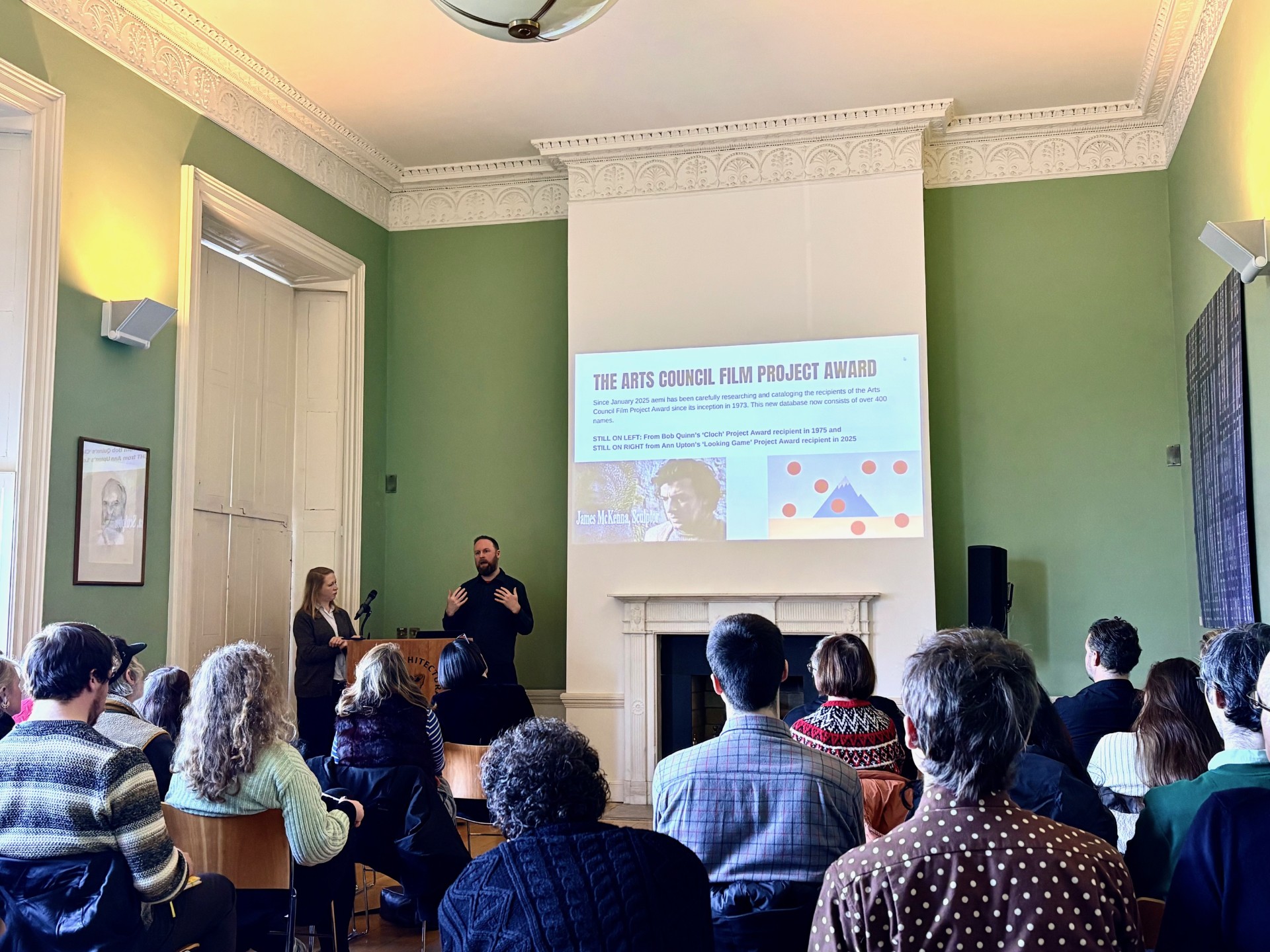
aemi is funded by the Arts Council, which has bolstered their mission of supporting Irish film-makers. Ireland is unusual in European terms, they explain, as the Arts Council has a dedicated team focused on film, in addition to visual arts. This model of funding is “absolutely central to a functioning ecosystem for film artists in this country,” Fitzpatrick notes.
Butler concurs that a defining element for independent film-makers is deciding whether they should apply for visual arts funding – if they’re making moving image work for galleries – or if they should opt for film finding if they want to screen in cinemas. “It’s quite a knotty dilemma to parse on an individual basis. So artists can spend time in relation to their own practice, and then come to us about what they want, and how to make the resources available work for them.” She points out that, “part of aemi’s longevity is that this awareness coincided with a genuine need on the Arts Council’s behalf. That’s where we come in, as a conduit between the Arts Council and the artists.”
Teaching Practice “Through Another Lens”
This year their work with up-and-coming film-makers includes teaching. Following ongoing collaboration in ATRL Dr. Sven Anderson, Assistant Professor of Film, invited Fitzpatrick and Butler to create a module, “Through Another Lens,” for his M.Phil in Digital Arts and Intermedia Practices. They’re also teaching students from the Screen Studies masters programme. “It’s a really interesting mix of students coming from different places,” according to Butler. Guest lecturers from the world of experimental film include Frank Sweeney, Laura Fitzgerald, Sibyl Montague, and Temmuz Süreyya Gürbüz.
They’re now working with one of their favourite groups: students encountering the field for the first time. Fitzpatrick points out that, “some of the Screen Studies students are interested in comedy writing, which isn’t an obvious cross-over with experimental cinema, although it’s an interesting thread to pull! It’s always rewarding, how people respond to the work.”
As part of their practical research, the students will make their own short films. “They seem to be really excited about that opportunity,” says Butler. “I think they find it freeing, because a lot of this work is production-lite. There is a whole practice in this area of film-making that is DIY, and you can make something that has enormous impact.” Teaching has also helped them return to the theoretical aspects of experimental film. “When you’re running a module you get to look more conceptually at what’s exciting about cinema, and remind yourself about the thinkers and makers who are actually building this practice.”
 ATRL and Beyond
ATRL is a return of sorts to Trinity for both of them: Butler pursued both her BA and MPhil in Trinity, while Fitzpatrick’s DCU Digital Arts and Humanities Programme was inter-institutional, in connection with ATRL and the Trinity Long Room Hub. “My MPhil, in Textual and Visual Studies, was where I did my thesis that focused in large part on Tarkovsky, and that was the point at which I got interested in the material that I’m working in now,” Butler notes. “My supervisor was Justin Doherty, who was in the School of Russian. He couldn’t have been a better supervisor. So it’s really nice being back.”
aemi’s ongoing activity on accessibility in the arts is closely tied with ATRL. They recently hosted a collaboration regarding captioning work with artists Jenny Brady and Elaine Lillian Joseph. They have another upcoming event around practices of audio description, “An Equivalent Pulse,” with Irish-born UK-based researcher Prof. Sarah Hayden.
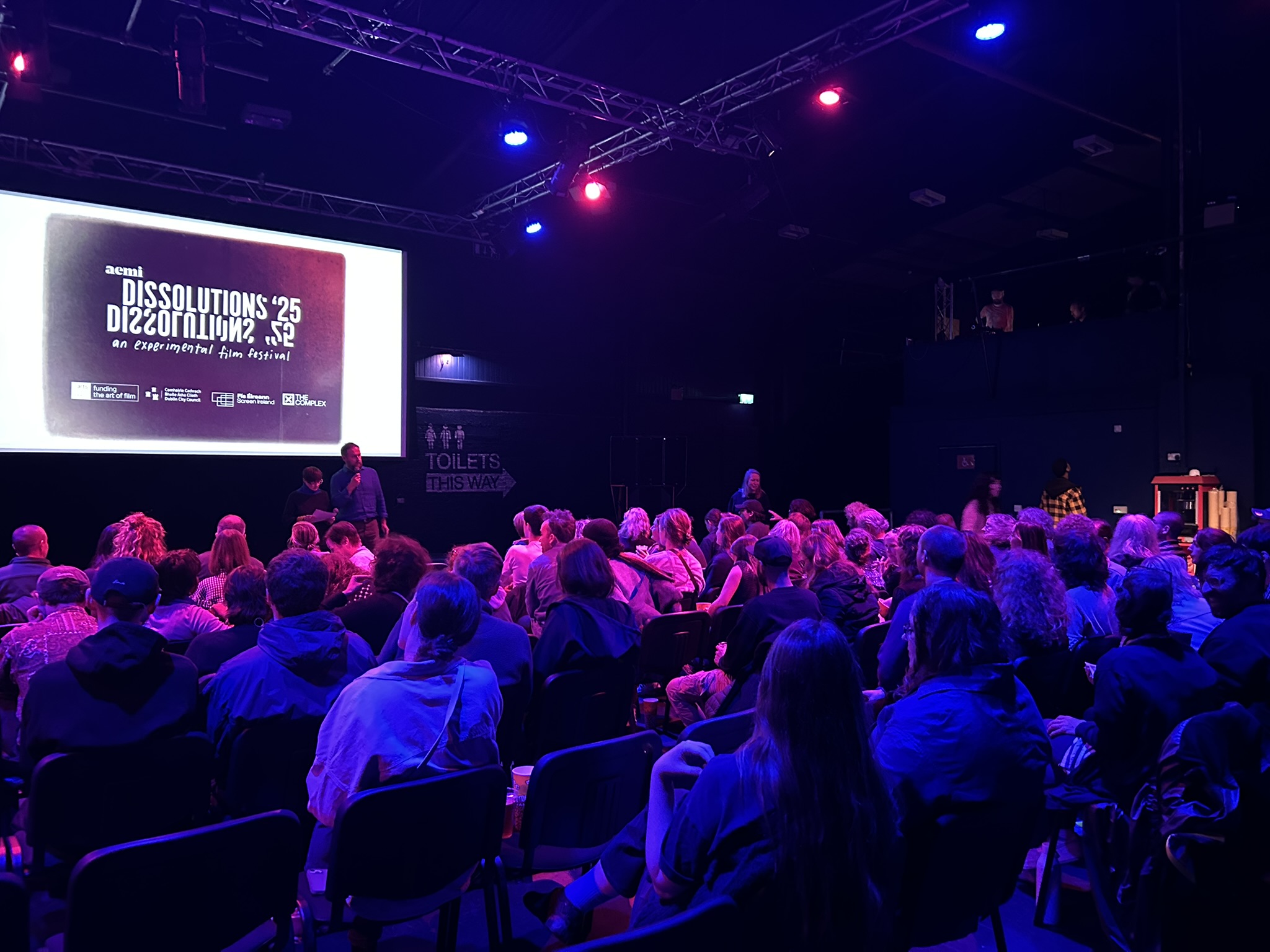
Access in all its forms is very central to aemi’s goals, and unfortunately they will be unable to continue with one of their most ambitious undertakings: their Dissolutions experimental film festival. For two years in a row, Dissolutions featured screenings, workshops and discussions around the work of 30 of aemi’s Irish and international collaborators. However, the Dissolutions venue, the Complex, has recently been forced to close. Fitzpatrick explains, “The festival doesn’t exist now, at least in the iteration we had before, because the Complex were absolutely central, not just as a venue but as an actual partner. So if it’s to continue we have to completely rethink what we’re doing.”
The Changing Landscape of Experimental Film
How has experimental film in Ireland changed over the last ten years? Butler highlights that it’s now a more robust, confident landscape, with more work being screened at international festivals. “Jenny Brady screened at the New York film festival, Frank Sweeney won the Tiger award at the international film festival Rotterdam, Holly Márie Parnel has screened extensively internationally. That’s indicative of a broader tendency.” Fitzpatrick adds that it’s a bigger and more diverse scene now that there’s greater visibility. “It’s easier and quicker, in certain instances anyway, for people to get a foothold.” There is more appetite from festivals and venues. Where previously it was assumed that experimental film belonged in a gallery, or in niche one-off screenings, now it’s screened more regularly and to more audiences.
The flip-side to the optimism, however, is that it’s very difficult to function as artists in Ireland. “Most of the Ireland-based film-makers we work with have had to leave Dublin,” says Butler. “There are real ramifications in the way the city and the country is run, but people are still pursuing art, which is good. They’re persevering.” Fitzpatrick suggests that “it would be nice to see that resilience met with an appropriate response or return, to see their city show up for them in the way that they’re showing up for their city.”
A premises of aemi’s own is something that would greatly support their mission. Somewhere, ideally, with a library or resource space to screen works-in-progress. Fitzpatrick notes that, “it’s great to have ATRL and we’d do more again if we had our own space.” According to Butler, “some level of distribution would be amazing. Just this week I’ve had two separate conversations about the need for time around the screenings, for people to talk properly. A lot of this work is political, a lot is deeply personal.”
Indeed, aemi’s activity highlights how important these exploratory spaces are. Ultimately, what is needed is a confluence of screening, platforming work, and artists meeting their communities. As this discussion highlights, you have to encounter work by experimental film-makers in order to visualise a space for yourself there.
- Interview by Dr Sarah Cullen
Alice Butler
Alice Butler is a Dublin-based film programmer, curator, lecturer and writer. Alice worked at the Irish Film Institute for six years where she curated several film seasons and had responsibility for artist moving image programming. Solo curatorial ventures have included ‘The L-Shape’ at The Dock, ‘As We May Think’ at IFI and ‘New Spaces’ with VAI Northern Ireland.
Alice has written on the moving image for Sight and Sound, Vdrome, Paper Visual Art and Enclave Review and she has lectured or participated in panels on the moving image at Trinity College Dublin, Dublin City Gallery, The Hugh Lane, IMMA and PLASTIK Festival of Artists’ Moving Image.
Daniel Fitzpatrick
Daniel Fitzpatrick is a Dublin-based cultural programmer and arts professional who has worked in the area of film and film programming since 2010. Daniel co-founded and was co-director of PLASTIK – Festival of Artist Moving Image which ran from 2015-2017. He founded Hollywood Babylon, a midnight movie screening programme at the Light House Cinema. Daniel has worked as a lecturer, programmer, and researcher with a special interest in the field of artists’ and experimental moving image for many years. He also served as Director of the silent film festival Killruddery Film Festival from 2009 to 2012 where he worked with the film historian Kevin Brownlow. Daniel was also co-director of Experimental Film Club.